
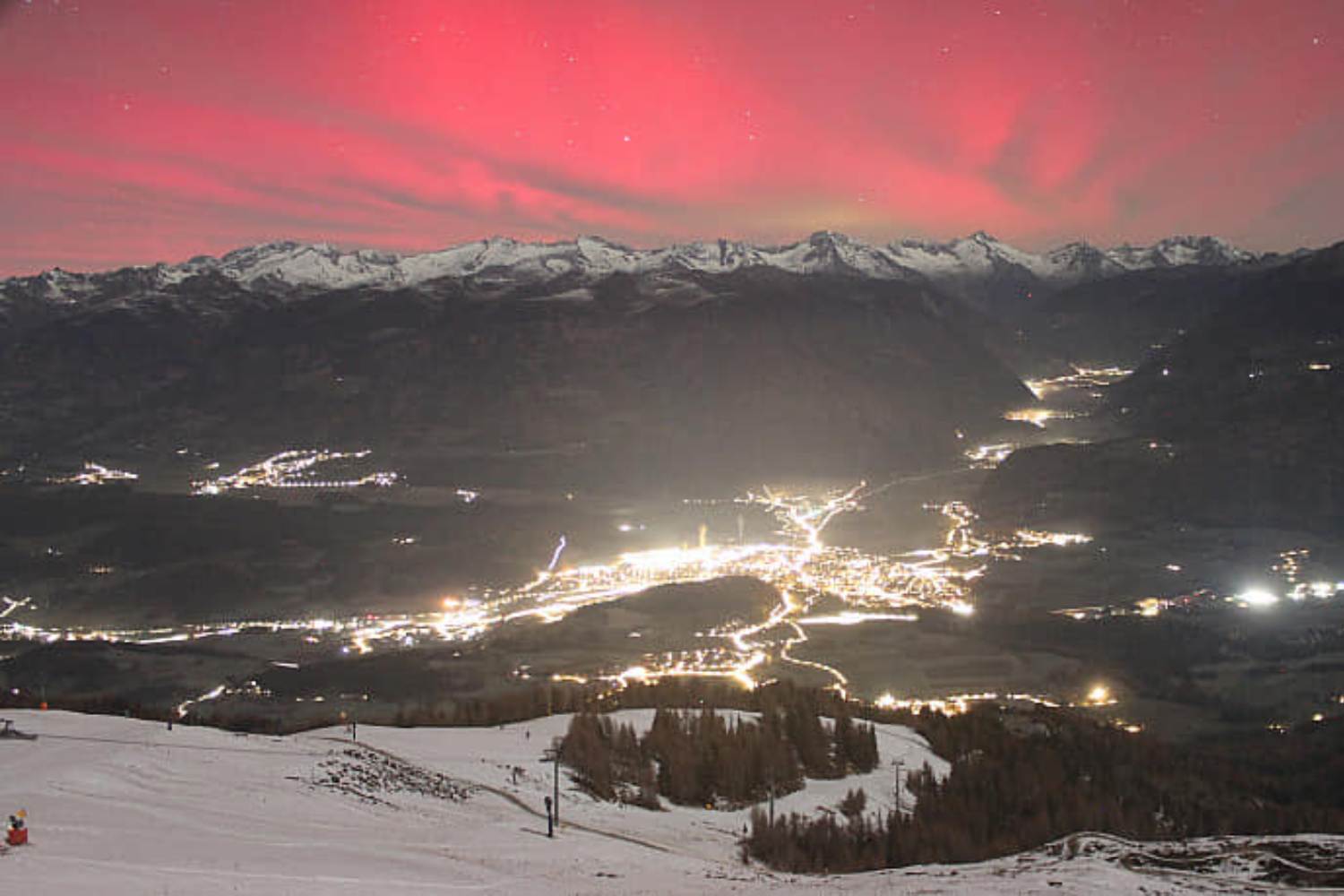
On the night between 11 and 12 November, the Italian sky was transformed into a canvas of dancing lights: an aurora borealis visible from North to South, an event that rarely happens in our latitudes. It was caused by a severe geomagnetic storm, classified G4, generated by two coronal mass ejections (CMEs) coming from the Sun. Their rush towards the Earth unleashed a wave of charged particles which, upon coming into contact with the atmosphere, lit up the sky with red and purple shades.
The phenomenon, immortalized by thousands of enthusiasts, was observed in various regions: from Piedmont to Sardinia, passing through Lombardy and Veneto. The images show flashes and columns of light that mesmerized anyone lucky enough to look up at the sky.
This evening too, keep your eyes on the sky
The intensity of the phenomenon is linked to the exceptional level of solar activity these days. In particular, an X5.1 class flare, among the most powerful recorded recently, launched an enormous quantity of magnetized plasma into space. Solar particles, interacting with oxygen atoms at an altitude between 400 and 800 km, produced the characteristic red glow that distinguished this aurora from the typically green ones in Nordic skies.
Good morning with the Northern Lights
from the Asiago observatory
(web) pic.twitter.com/L2RAUGKkEk— Dalia
(@Amo_Abbracci) November 12, 2025

The storm has reached a G4 level, with peaks comparable to those of the great storm of October 2024. But it doesn’t end there: the arrival of a third CME is expected, defined as a “cannibal CME” due to its ability to incorporate the previous ones, which could further fuel the celestial spectacle in the next few hours.
Tonight at 4.45 from Brione in the province of Brescia – Cristina Zava#auroraboreal #brione pic.twitter.com/Vw1wisQGDO
— Jacobino
(@Illuminista71) November 12, 2025
Anyone wishing to witness the phenomenon again can try their luck this evening too, orienting themselves towards the North and choosing places away from light pollution. Conditions remain favorable and the G4-G5 geomagnetic alert remains active. In a period in which the Sun shows increasingly intense activity, Italy discovers itself – at least for one night – a small Mediterranean Lapland, where the sky turns red and science meets wonder.
You might also be interested in:
