
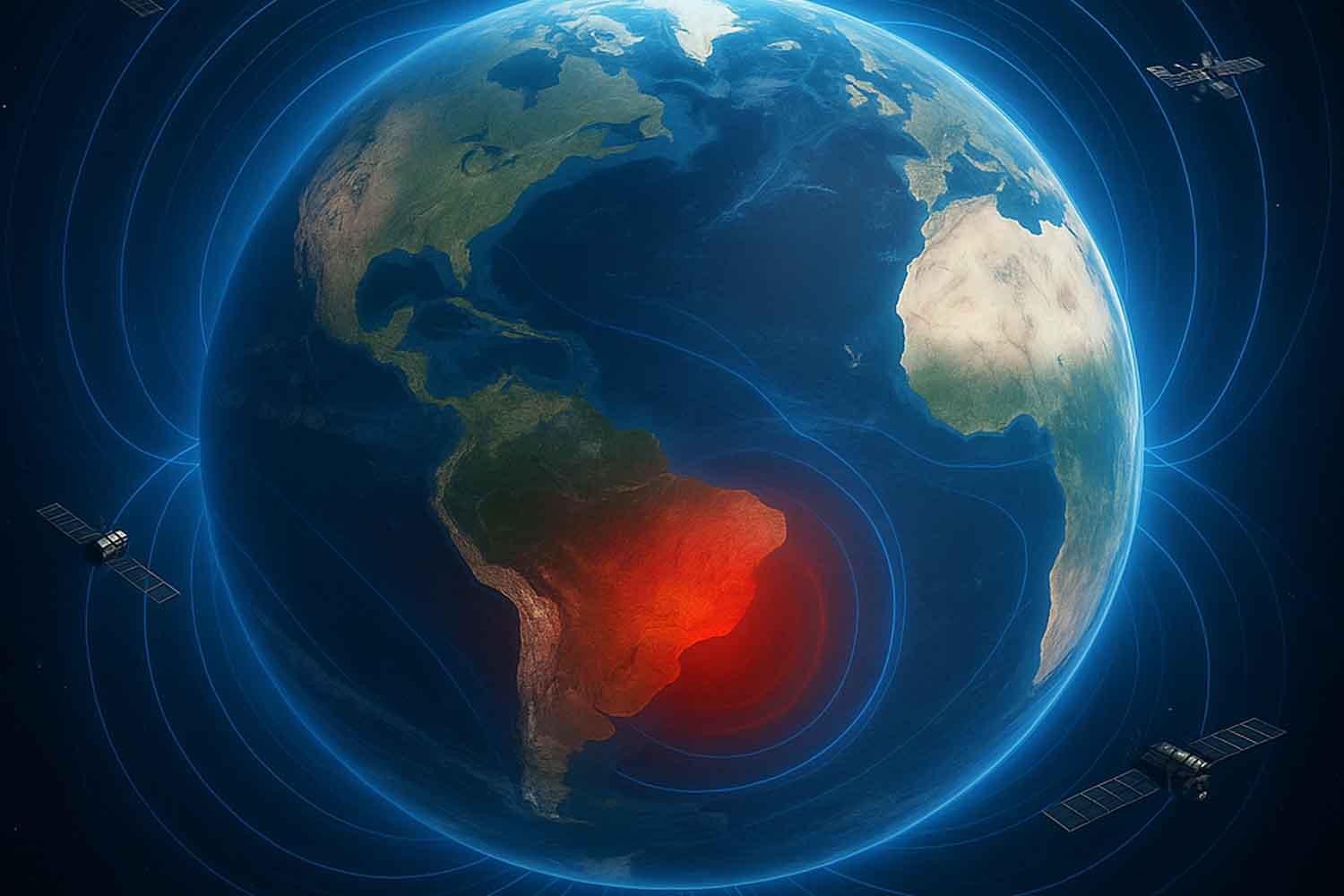
There is a region above South America and the Atlantic Ocean where Earth’s magnetic field is much weaker than normal. Is called South Atlantic Anomaly (SAA) and, according to new findings from the European Space Agency (ESA), continues to widen.
The data comes from three Swarm satellitesin orbit since 2014 to study how our planet’s magnetism behaves. The analyzes show that the area of weakness it has grown by an area equal to about half of Europewhile an area of stronger magnetic field above the Canada has shrunk and one above the Siberia it expanded.
Chris Finlayresearcher at Danmarks Tekniske Universitet and lead author of the study published on Physics of the Earth and Planetary Interiorsstated:
Over the past eleven years the weak South Atlantic region has continued to increase in size. We already suspected it, but the new data confirms it with certainty.
What is the South Atlantic Anomaly
The Earth’s magnetic field was born in molten iron core of the planet, approximately 2,900 kilometers below the surfaceand acts as a natural barrier against charged particles of the solar wind. It is what protects us from cosmic radiation and allows us to see spectacular phenomena such as Northern and Southern Lights.
When this protection weakens, however, radiation can penetrate more easily. For those who live on Earth nothing changes, but for satellites, probes and astronauts in low orbit the difference is significant.
The radiation can damage electronic circuitscause malfunctions and even temporary blackouts. Astronauts, if they pass through the area, are exposed to higher doses of radiationwith a increased risk of DNA damage or, in the long term, to develop pathologies linked to exposure.
The data
The strength of the Earth’s magnetic field varies between 22,000 and 67,000 nanotesla (nT)while a common refrigerator magnet measures approximately 10 million. In the SAAthe intensity falls below 26,000 nT. Today, at the weakest point, a force of 22,094 nTMeaning what 336 nT less than 2014.
According to Finlay, these moves were not expected and could depend on movements of the liquid metal in the planet’s core, though the precise causes remain unknown.
It is not a reversal of the poles, but attention is needed
The Earth’s magnetic field is reversed several times throughout historybut scientists assure that, as Finlay points out:
We know that in the past the magnetic field has weakened many times, showing weak areas like the SAA, without however reversing the poles.
According to experts, it is rather about a natural fluctuation which could last from decades to centuries.
How can we prepare
The main problem concerns the space infrastructure: satellites, scientific missions and itself International Space Station.
To reduce risks, new generations of satellites will have to be more resistant to radiation and the designers will have to take into account the expansion of the SAA in orbital routes, as Finlay explains:
As the weak zone grows, satellites will be exposed over a larger and larger area. This must be considered when planning future missions.
Also Hagay Amitgeophysicist at the University of Nantes, confirms that the measurements of the Swarm mission are essential to understand what happens in the heart of the Earth:
Only continuous and precise data can help us interpret the profound movements that generate our magnetic field.
