
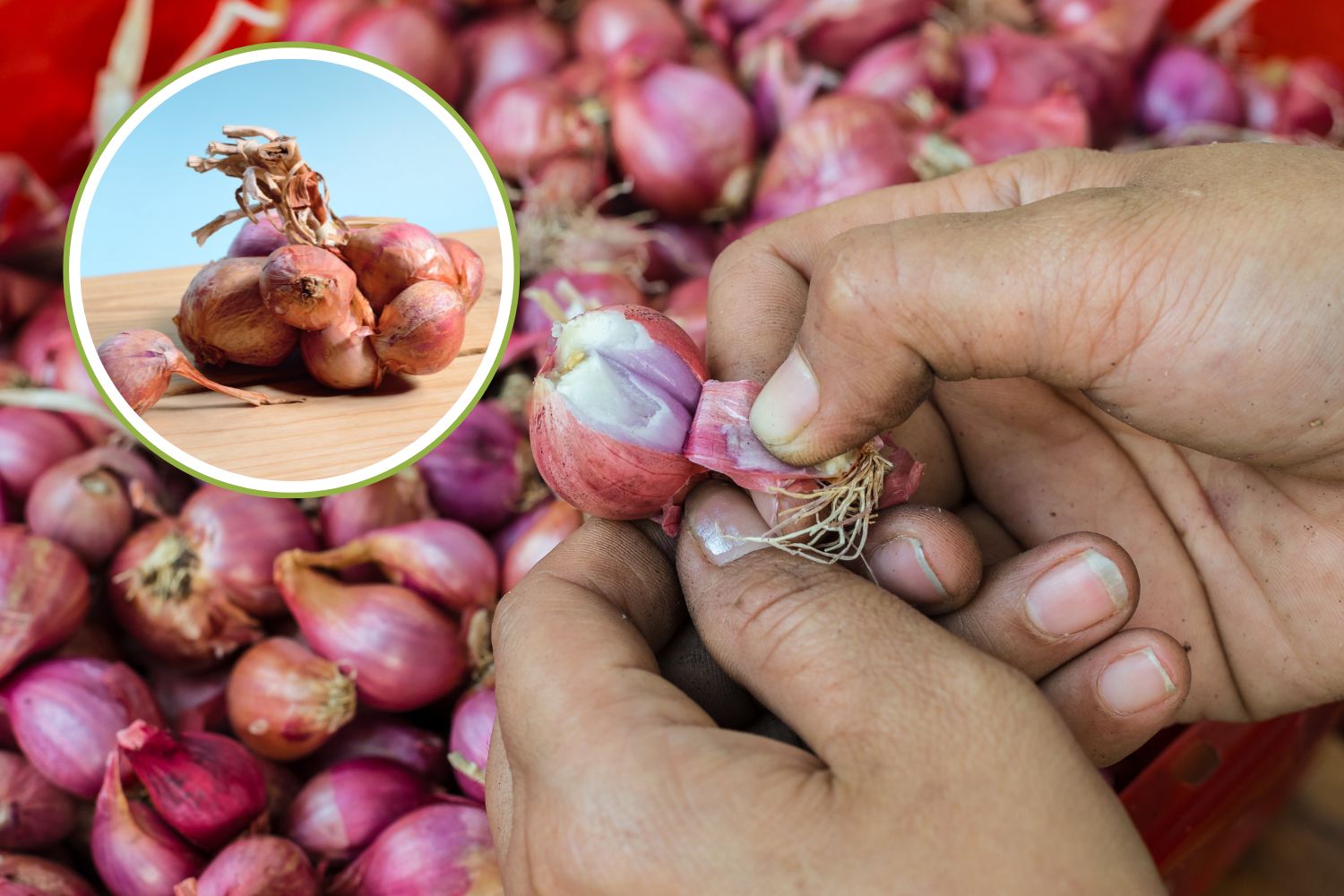
In many Italian cuisines, shallots appear almost exclusively when sautéing, when in reality this tapered bulb deserves much more consideration. Its flavor is more aromatic than onion, while remaining delicate, while its intensity is lower than that of garlic, characteristics that make it the ideal ingredient for preparations that require balance and finesse. Shallots can be used to prepare salads, refined ragùs and to accompany fish-based dishes.
The botanical family to which it belongs, that of Liliaceaeis the same as garlic, onion and chives. The first cultivation areas were located in the Middle East, probably in the region of the ancient city of Ashkelon, from which the scientific name Allium ascalonicum derives. It arrived in Europe between the 12th and 13th centuries, brought by the crusaders returning from the Holy Land.
The varieties grown in Italy
In our country there are different varieties of shallots, each with distinctive characteristics. The Scalogno di Romagna PGI for example, which has long and slender leaves, a rather twisted flask-shaped bulb, golden sheaths, pulp with pink-lilac shades and a spicy flavour. The production area extends between the provinces of Ravenna, Bologna and Forlì.
Jersey Dutch has short bulbs with pink skin, streaked pulp and a mildly spicy flavour. It is an early variety, less vigorous but appreciated for its delicacy. The common or gray shallot has very elongated bulbs, a purple casing and a pungent and aromatic flavour: it is a rustic variety that ripens late, and is easy to keep fresh during the winter.
Nutritional properties and benefits
From a nutritional point of view, shallots provide approximately 72 calories per 100 grams, with a high percentage of water, a low quantity of fat and a precious concentration of fibre. Contains vitamins A, C and group B, as well as essential minerals such as potassium, phosphorus, calcium and magnesium.
How can we not mention allicin, a substance produced when shallots are crushed, which can lower bad cholesterol levels in the blood, with beneficial effects on the prevention of atherosclerosis and heart disease. The antioxidant compounds present, including quercetin and kaempferol, contribute to the body’s protective action.
Selenium helps support the immune system and has anti-inflammatory properties, while potassium is essential for proper muscle function and maintaining fluid balance. To make the most of these properties, it is preferable to consume it raw, since cooking disperses part of the vitamins.
Harvesting at the right time
Harvesting generally takes place at the beginning of summer, when the leaves begin to turn yellow: the bulbs must be uprooted from the ground with the help of a fork or spade. The period varies depending on the intended use: the June harvest provides a product to be consumed fresh, while the mid-July harvest provides a product that can be used for conservation and transformation.
Bulbs with leaves keep for much longer, an often overlooked detail that can make a difference in the winter months. After uprooting, the bulbs should be dried in the sun and then left in warm, ventilated places for 10-15 days before definitive storage.
Winter preservation methods
Conservation is a very important aspect of preserving the shallot during the cold months, given that, if kept in cool, dry and well-ventilated rooms, it can last up to six months without losing its characteristics. The ideal temperature is between 3 and 15 degrees, with preference for the lower end of the range.
The environment must be dry, cool and dark, so cellars, sheds and well-ventilated rooms are the perfect places to store it. Relative humidity must remain below 70% to avoid mold and rot, and light must be absolutely avoided, because it could promote the growth of shoots and accelerate deterioration. The bulb with a little stem can be preserved in bunches, or in hanging braids, as is done with garlic (traditional technique which guarantees excellent air circulation around the bulbs).
Absolutely avoid both storage in the refrigerator (an excessively humid environment which can compromise the quality of the product) and storage in waterproof packaging (sealed packages create condensation, an ideal environment for the development of bacteria).
Practical tips for the pantry
The physical arrangement of shallots deserves some attention. Wooden boxes and wicker baskets will work great, because they allow good air circulation, and remember to set up only one layer, avoiding overlapping which could create pressure points and encourage deterioration.
Periodically check the condition of the bulbs to identify any problems. A bulb that begins to deteriorate should be removed immediately to prevent the problem from spreading to others. Signs to look for? Excessive softening, as well as the appearance of mold and too many shoots.
