
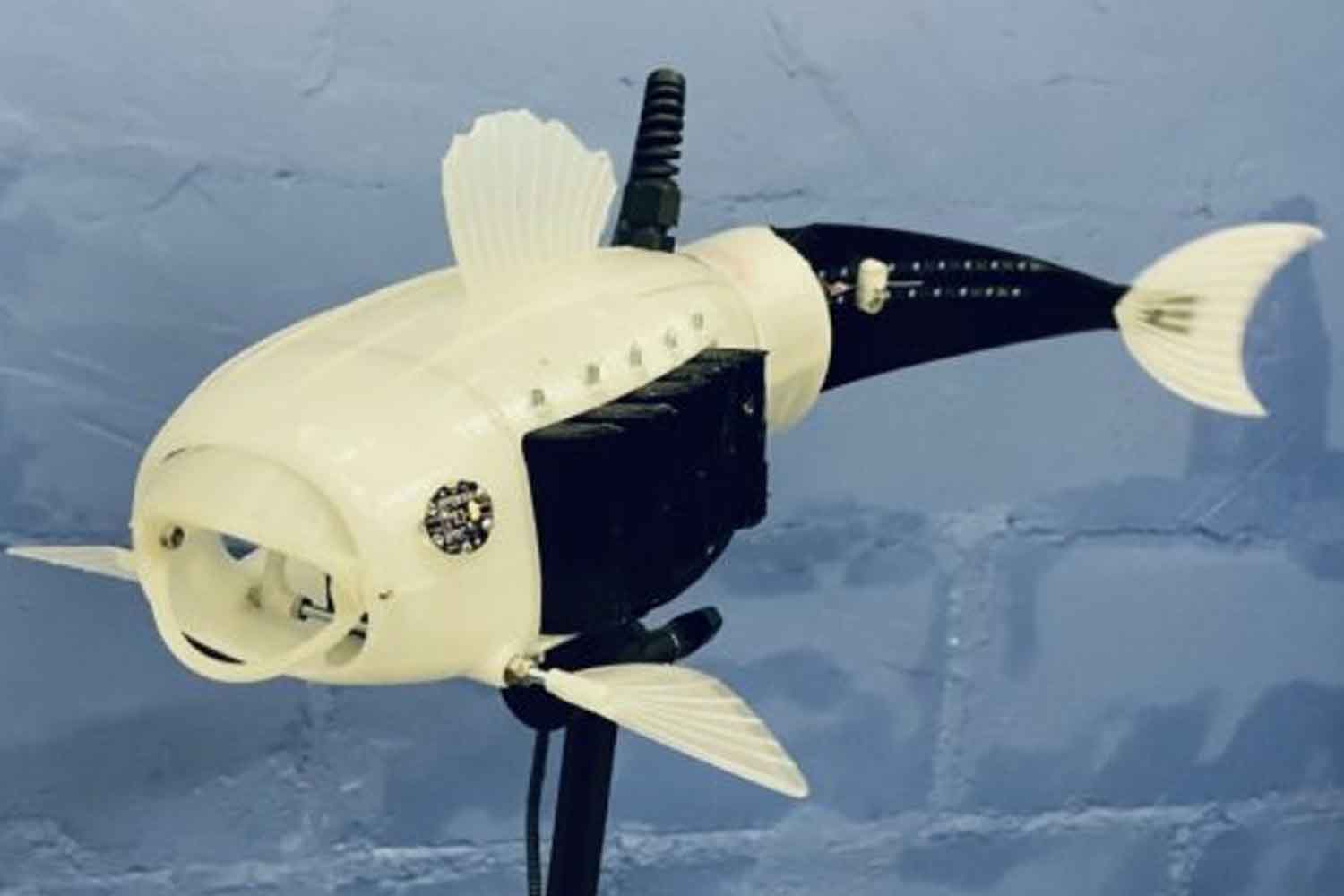
In the heart of England, among the laboratories ofUniversity of Surreya small aquatic robot destined to do big things was born. Is called Gillbertand it’s a 3D printed fish that not only mimics the movement of salmon, but filters microplastics from lakes and streams. Behind this surprising project is Eleanor Mackintosh, a young chemistry student who united science, sustainability and creativity to address one of the most pressing environmental problems of our time.
How it works
Gillbert is the size of a salmon and has a surprisingly lifelike appearance. But it’s not just aesthetics: its design reproduces the functioning of the gills of real fish. As it swims, water enters through its mouth and is expelled through a net placed in its artificial gills. This is where the magic happens: the microplastics – those tiny particles that escape most filter systems – are retained within the robot’s body.
The fish is equipped with a motor propulsion system, it is remotely controlled and designed to be modularso it can be updated or modified. Every part can be easily 3D printed, even by non-experts, using low-cost materials and accessible technologies. Gillbert’s real strength is this: it is open sourceso anyone can download the files and build their own robot fish to help monitor and clean up local waters.
From the classroom to the lake
Gillbert’s first prototype has already been put to the test in a lake near Guildford, UK. During the test, the robot has swam regularly and collected microplasticsproving that its structure and filtering system work. The goal now is to make it even more efficient, autonomous and capable of operating for long periods without the need for external controls.
The project was born within the Natural Robotics Contesta scientific competition that rewards the best robotics ideas inspired by nature. Eleanor’s proposal beat out almost 100 participants, convincing the jury for hers clarity, sustainability and real impact. The prototype was then created thanks to the collaboration with Dr. Robert Siddall and his research team.
Because Gillbert can make a difference
Microplastics are plastic fragments smaller than 5 mm which result from the degradation of larger waste. They infiltrate rivers, lakes and oceans, are ingested by aquatic animals and reach us through the food chain. Removing them is extremely difficultprecisely because of their size.
Gillbert not only manages to intercept them, but does so in a sustainable, economical and sustainable way directly involving students, citizens and schools. The project demonstrates that innovation is not just a matter for laboratories and companies: it can also arise at school.
And, unlike many industrial solutions, Gillbert is meant to be replicableeasily customizable and adaptable to different contexts. It can become an educational tool, an ally for environmental associations or simply a concrete example of how science can have an immediate and tangible impact.
