
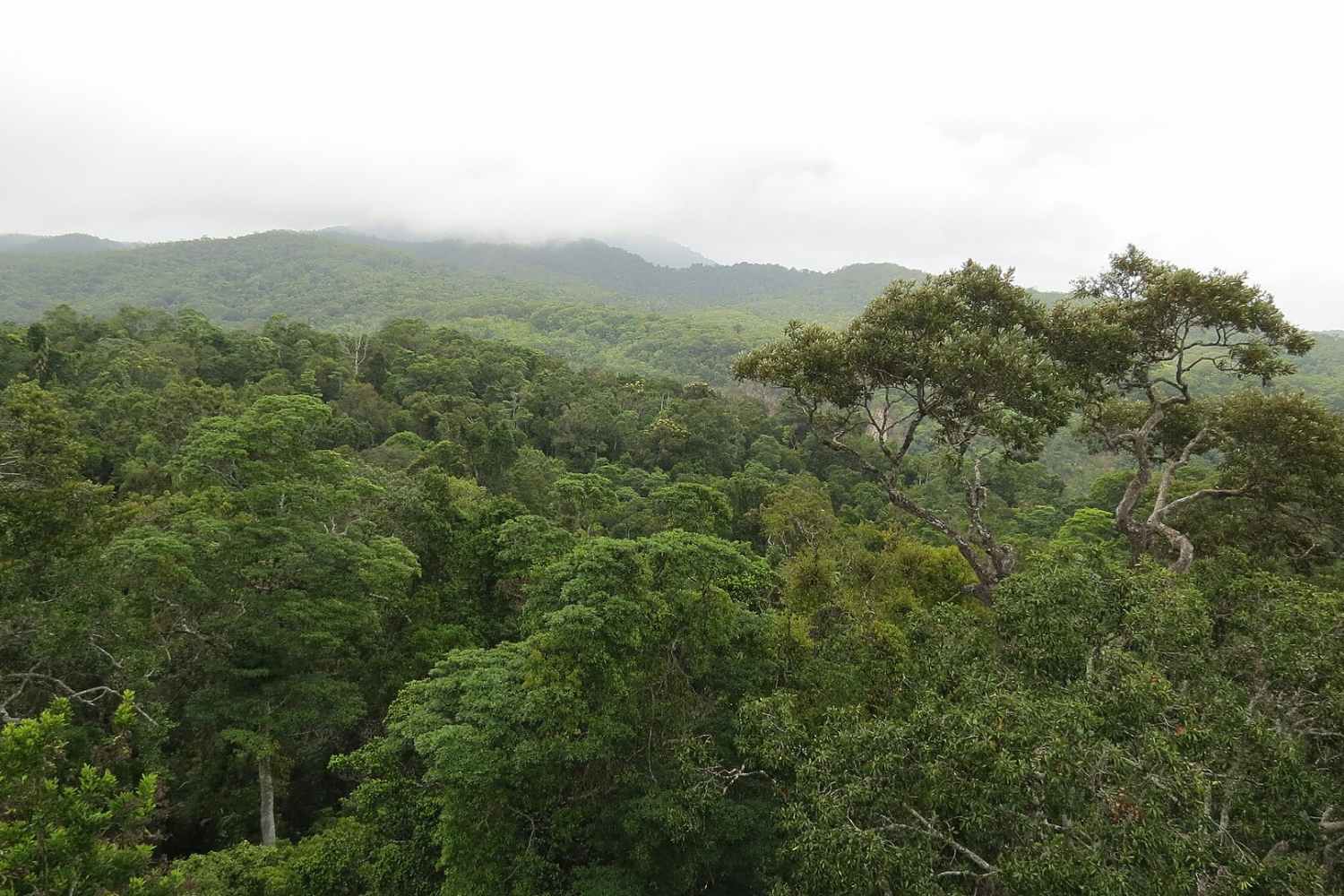
Forty-nine years of counting trees. To measure their growth, their health, their ability to do what forests have always done: breathe CO₂ and produce oxygen. Then, one day, Australian researchers realized that something had changed.
The rainforests of northern Queensland have become part of the problem. From 2000 onwards, instead of absorbing carbon from the atmosphere, they released it.
It’s the first time this has happened in a tropical forest. And the study published in Nature – based on the monitoring of around 11,000 trees in 20 different sites from 1971 to 2019 – leaves no room for optimistic interpretations.
The numbers don’t add up anymore
Until 2000, Queensland forests were accumulating carbon at a rate of 0.62 megagrams per hectare per year. In the decade 2010-2019, the sign in front of the number changed: -0.93 megagrams per hectare per year. It’s not a miscalculation. It’s a turnaround. Forests began to return more CO₂ to the atmosphere than they captured.
Nature research paper: Aboveground biomass in Australian tropical forests now a net carbon sourcehttps://t.co/LR1BLdrVmR
— nature (@Nature) October 17, 2025
David Bauman, a researcher at the Institut de Recherche pour le Développement and co-author of the study, doesn’t mince words when we speak to him: “If tropical forests are losing their ability to serve as carbon sinks, they may no longer be reliable partners for our climate goals.”
Translation: the plan we have relied on for decades – planting trees, protecting forests, offsetting emissions – may no longer work.
Twice as many die as before
The reason is simple and terrifying at the same time: trees are dying. Twice as many people die compared to the past. And when a tree dies, all the carbon it has accumulated in the wood during its life is released into the atmosphere as it decomposes.
We are not talking about deforestation. These trees are dying exhausted by a climate they no longer recognize: increasingly intense heat waves, prolonged droughts, tropical cyclones that are becoming more violent year after year.
“Extreme temperatures, water deficits, devastating cyclones,” lists Bauman. “Trees are adapted to warm, humid conditions, but what’s happening now is beyond their ability to withstand.”
If the growth of new trees compensated for these losses, perhaps there would be no problem. But he doesn’t. The budget is in the red. And it keeps getting worse.
The green that deceives
There is a detail that makes the story even more absurd. Seen from space, these forests have never looked so lush. The foliage is 20% greener than in the 1980s. The satellites record an increase in photosynthesis, exactly what one would expect with more CO₂ in the air (the so-called “fertilizer effect”).
But it’s all appearance. “Any potential increase in photosynthesis leading to greener forest canopies did not result in increased carbon storage in stems and branches,” Dr Hannah Carle, who led the research, told the newspaper.
In other words: the forests look greener, but underneath that facade they are suffering. Trees grow more slowly. And above all, they die earlier. Much earlier.
What if it wasn’t just Australia?
David Karoly, a climate scientist at the University of Melbourne who was not involved in the study, raised the alarm to the Guardian that no one wants to hear: “If tropical forests around the world were to follow Australia’s example, current climate projections could underestimate future global warming.”
This would mean that the models on which the Paris agreements, the mitigation strategies and the carbon neutrality objectives are based are already outdated. That we have even less time than we thought. That emissions reduction targets should be revised upwards.
Australia might just be the canary in the mine. The first sign of a much broader collapse.
Be careful, however, about drawing the wrong conclusions. “The mistake would be to blame the forests for having become polluting,” Bauman is keen to point out. Tropical forests remain among the largest carbon and biodiversity sinks on the planet. Protecting them remains essential.
The problem is not the trees. The problem is the impossible conditions we have created for ecosystems that have evolved over millions of years to function in a completely different climate.
This discovery forces us to face a truth that we preferred to ignore: we cannot continue to burn fossil fuels hoping that “the forests will take care of it”. It doesn’t work like that anymore. Maybe it never worked like that.
Half a century to understand what’s happening
Forty-nine years old. Almost half a century of data, patiently collected, year after year, tree after tree. In an age where funding for long-term ecological monitoring is increasingly scarce, it is increasingly difficult to obtain.
Yet without this data, this warning sign would have remained completely invisible. Annual variations would have masked the trend. The crisis would advance in total silence.
“The reduced carbon sink capacity of forests makes emissions cuts much more difficult,” Karoly explained. “We need an even faster transition away from fossil fuels.”
There is no longer room for rhetoric, for half measures, for postponements. The turning point was already passed in 2000. We are only now realizing how serious it is.
The forests that still resist must be protected not only from chainsaws, but also from the extreme climate that is bringing them to their knees. And in the meantime, decarbonization must become radical, immediate, non-negotiable.
