
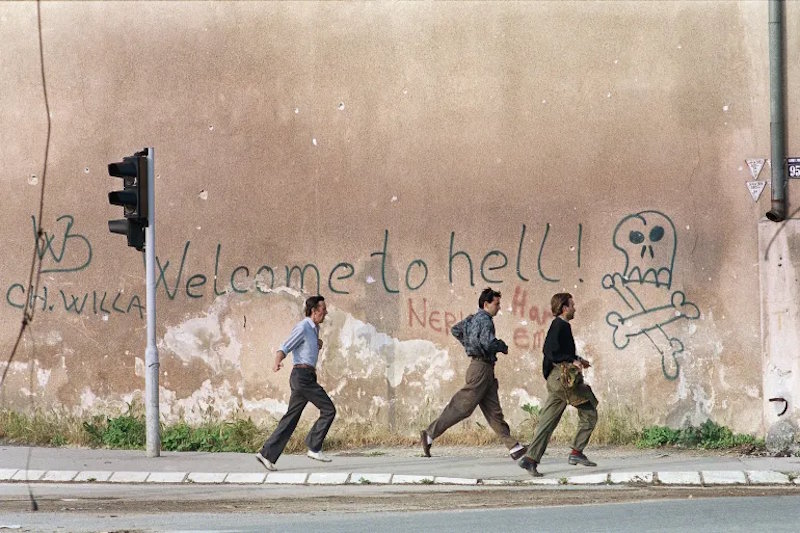
On Fridays they met in Trieste, on the border with the former Yugoslavia, for a weekend of “hunting”. Transported by the Yugoslav/Serbian company Aviogenex in the hills around Sarajevo, there they allegedly paid the Bosnian Serb militias loyal to President Radovan Karadzic (later convicted of genocide and crimes against humanity by the International Criminal Tribunal for the former Yugoslavia in 2016) to do one thing: shoot ordinary people.
That’s right: that was a hunt, yes, but for civilians, and those were Italians (but also others) who were leaving for a weekend for a real Safari. They are the now well-known “Sarajevo snipers“, people who paid to go and shoot civilians during the war in Bosnia. Brutal and macabre, exactly like those who go to contemplate the devastation of the Palestinian enclave from the hill of Sderot, less than a kilometer from Gaza.
Real war tourists who would have shelled out up to 100 thousand euros, adjusted for current inflation rates and currency exchange rates, since the euro was only introduced in 1999, to join the trips to Sarajevo to commit the murders.
Today, 30 years after the Dayton Agreements signed in November 1995 by Milosevic, Tudjman and Izetbegovic, an investigation by the Milan Prosecutor’s Office brings to light the ferocious activity of these “weekend snipersThe “Sarajevo snipers”, Westerners who allegedly paid to shoot citizens of the besieged city.
The complaint
Everything in Italy started with the writer Ezio Gavazzeni, who after years of research handed over a dossier to the judiciary. What lit the fuse for him was news read for the first time in the 1990s and then resurfaced in 2022, when the Slovenian director Miran Zupanič presented the documentary Sarajevo Safari.
The film tells of the “war tourism” organized in Bosnia, around the besieged city: businessmen and wealthy Westerners who, upon payment, were accompanied to the Bosnian Serb positions to “experience the thrill” of hitting human targets.
I had come across this story already in the 90s – Gavazzeni tells La Repubblica. Il Corriere della Sera and La Stampa talked about it, then everything fell into oblivion. When I saw Sarajevo Safari I understood that I could no longer remain silent. I contacted the director, collected testimonies, cross-referenced sources and, with the help of criminologist Martina Radice, we built the profile of the alleged hunters. That’s when I decided to report.
Snipers and their horror journeys
According to the reconstruction, the alleged participants were mainly wealthy businessmen or professionals, with an interest in hunting and weapons. For a two or three day trip they paid amounts comparable, today, to the cost of a three-room apartment in an average area of Milan. The departures took place mainly from Northern Italy, often passing through Trieste. The organization of the activity, according to testimonies, would have necessarily required the approval of the Bosnian Serb militias who, during the siege, controlled the hills around the city.
The investigation today is based on various sources, including that of a former Bosnian secret service agent. All the documentation collected was deposited at the Milan prosecutor’s office. Meanwhile, Gavazzeni talks about a “manhunt for no reason”. According to the facts he gathered, the people involved did not act out of ideological motivations or ethnic hatred, but simply out of a sense of power and adrenaline. He describes individuals looking through rifle sights as if it were a video game, shooting at anyone who passed by. The ideological component, in some cases linked to an alleged fight against Muslims, would have been marginal. The main thrust would have been the belief that one could kill without consequences, also supported by the erroneous certainty that the crimes were now prescribed.
The history of Sarajevo
Sarajevo experienced 1,425 days of siege between 1992 and 1996. Over 11,000 civilians died during that period, including around 1,500 children. Bosnian Serb troops led by Radovan Karadžić and Ratko Mladić they surrounded the city, preventing access to food, water and medicines. Every street crossing exposed civilians to the risk of being hit by snipers. Karadžić and Mladić were sentenced to life imprisonment by the International Criminal Court in The Hague for war crimes and genocide, also in relation to the Srebrenica massacre of July 1995, in which over 8,000 Bosnian Muslims were killed.
Gavazzeni explains that the population of Sarajevo had been aware of the possible presence of “tourist-executioners” for years. For thirty years, however, the story was dismissed as an urban legend. The opening of the investigation represents for many a form of recognition and listening after decades of silence.
The investigation is in its early stages and at this time there are no charges or names made public. It will be the task of the Carabinieri ROS to verify the veracity of the testimonies and ascertain the identity of the alleged perpetrators, who today would be between 65 and 80 years old.
Thirty years later, the hills that once hosted snipers have become walking places again. The city, however, has not forgotten. Every family in Sarajevo lost someone during the siege. Establishing whether a fatal shot came from a soldier or a civilian arriving from abroad will probably be impossible, but the launch of the investigation reopens a deep wound.
If everything is painfully confirmed, everything would push us to reconsider the way in which – again – the relationship between war, money and entertainment is interpreted.
Sources: La Repubblica / YouTube
