
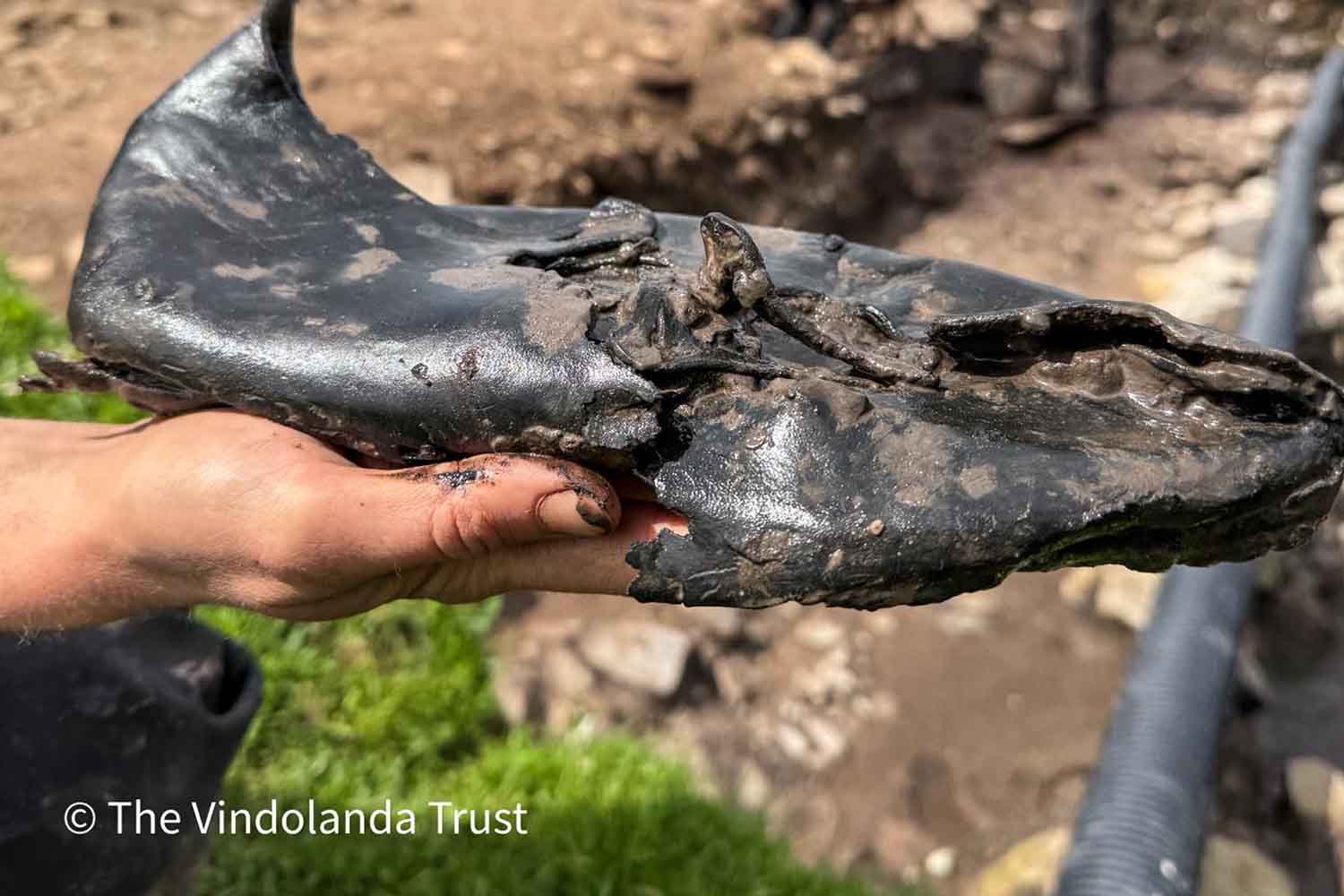
An out of the ordinary archaeological find is causing discussion among scholars of Roman history: near Hadrian’s Wallin the north of England, a team of archaeologists has unearthed 32 shoes from the Roman eraand some of them present truly surprising dimensions. The largest fits well 32.8 centimetres from toe to heel: one size equal to an American 14 or an English 13practically unobtainable for that era.
The discovery occurred in Roman fort of Magnaan ancient military installation located in Northumberland, where in May this year a new excavation was opened in a Roman trench ironically renamed “ankle-breaker”. Here the Romans, in addition to building defensive structures, they also threw away their own wasteshoes included. And right in that pit, exceptionally sized men’s footwear has emerged which today raise new questions about the composition of the legions that occupied northern Britain.
Taller? Stronger? Or from another part of the Empire?
What is striking is not only the quantity, but above all the unusual measure of many of the shoes found. Eight out of thirty-two exceed 30 centimeters longa measurement completely out of scale compared to other contemporary finds found so far. And the comparison with the nearby site Vindolanda – one of the most studied Roman settlements north of the Vallo – fuels the mystery even more.
In Vindolanda, which is only seven miles (about 11 km) from the Magna fort, over 5,000 Roman shoes were recovered over the last fifty years. And yet, only four or five exceed 30 centimetres. Most of the inhabitants of Vindolanda – soldiers, civilians, women and children – he had much smaller feet (and probably stature)..
Second Rachel Frameone of the archaeologists involved in the excavations, it is plausible that the soldiers of Magna were physically more imposing:
They may have come from a different region of the Empire, perhaps further north or from the Balkan provinces, where the stature was taller, but this is only conjecture at the moment. We just know that it’s very, very unusual.
The soles are practically intact
What makes the discovery even more precious is theexceptional state of conservation of footwear. Thanks to anaerobic soil conditionsdeprived of oxygen, the leather has remained intact for centuries. In many cases, the soles still clearly show the treadsa very rare detail in finds of this type.
But there are not only giant’s shoes: in the same excavation Children’s shoes were also foundconcrete proof that the Roman soldiers stationed in Magna lived together with their families. A scene of daily life, perhaps, which re-emerges after 2000 years with all its humanity.
The teacher Elizabeth Greenean expert on Roman footwear and professor at Western University in Ontario, is also responsible for the shoe collection ofarchaeological body of Vindolandawhich for years has maintained a real “shoe specialists” in your team. Greene points out that, even taking into account the natural shrinkage of the leather after discovery (up to 1 cm)the greatness of these shoes remains extraordinary:
Even once conservation is complete, they will remain among the largest we have ever found.
This discovery – along with numerous others from Roman Britain, such as curious sculptures of winged goddesses or food remains similar to pizza found in Pompeii – contributes to redefine our imagination of daily life in the most remote territories of the Roman Empire. And it reminds us how much we still have to learn from what the earth preserves under our feet.
