
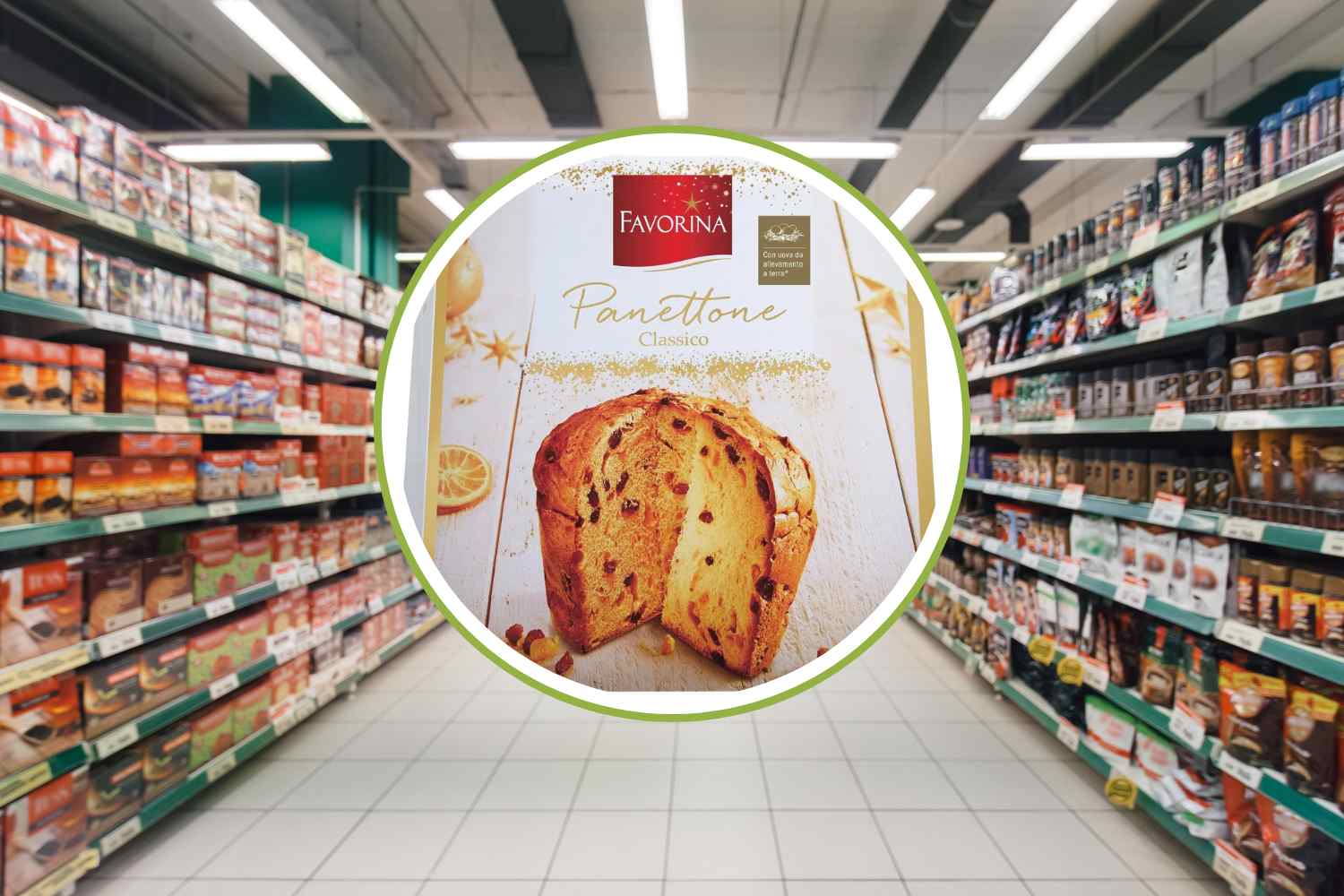
Who produces the Panettone Favorina Classico sold by Lidl? And what’s really inside? Let’s take a closer look at the label.
Christmas is approaching and the supermarket aisles are once again filled with panettone of all price ranges. Lidl, like every year, offers its Favorina Panettone Classico, often at very competitive prices compared to the more well-known brands. And inevitably the doubt arises: “If it’s cheap, will it be of lower quality?”
A legitimate question, but the answer is not so obvious.
Buying a large-scale retail product does not necessarily mean sacrificing quality. It depends on who makes it and what’s actually in the dough.
Who produces Lidl Favorina panettone?
The Favorina Classico panettone is not produced directly by Lidl, but made on behalf of the chain. And the name we find behind it is anything but unknown.
This panettone comes from the Bauli factory, one of the best-known Italian companies in the sector of leavened products for special occasions. We are talking about a giant with historical headquarters in San Martino Buon Albergo (VR), which has been working on panettone, pandoro and colombe for decades with a deeply rooted know-how.
It is therefore not an improvised product created by anonymous laboratories: behind it there is a consolidated industrial reality, specialized in precisely this type of work.
Ingredients
The label of Favorina Classico shows an extremely typical composition of traditional panettone:
The label specifies that it may contain traces of nuts and soy.
In short, the recipe is the canonical one for industrial panettone: natural leavening, fresh eggs, real butter, raisins and candied fruit in non-symbolic quantities. There are emulsifiers – and this is normal in this product range – but no aggressive preservatives appear.
Famous brand versus discount brand: does it really make a difference?
Here is the part that many underestimate.
The fact that Bauli produces both for itself and for Lidl does not mean that the panettone is identical to the “official” Bauli.
The recipe may change in the proportions of butter, the type of flavourings, the quality of the ingredients or the processing times. These are physiological differences, necessary to contain the final price.
But the production base remains high-level: the lines, the sourdough and the know-how are the same as those of a leading brand in the sector.
It’s not enough to look at the brand to judge
Devaluing a panettone just because it has a discount name is a rather common mistake.
The label, the actual manufacturer, the list of ingredients: these are the elements that really matter.
The branding on the package is often just the most visible part, not the most relevant.
Savings yes, but with awareness
Lidl’s Panettone Favorina does not claim to compete with artisanal or premium products, but it is not a second-class dessert either.
Whoever buys it gets an honest panettone, with correct ingredients, and above all made by a high-profile company like Bauli.
Spending less doesn’t mean accepting a poor product. Sometimes it just means knowing how to read labels.
