
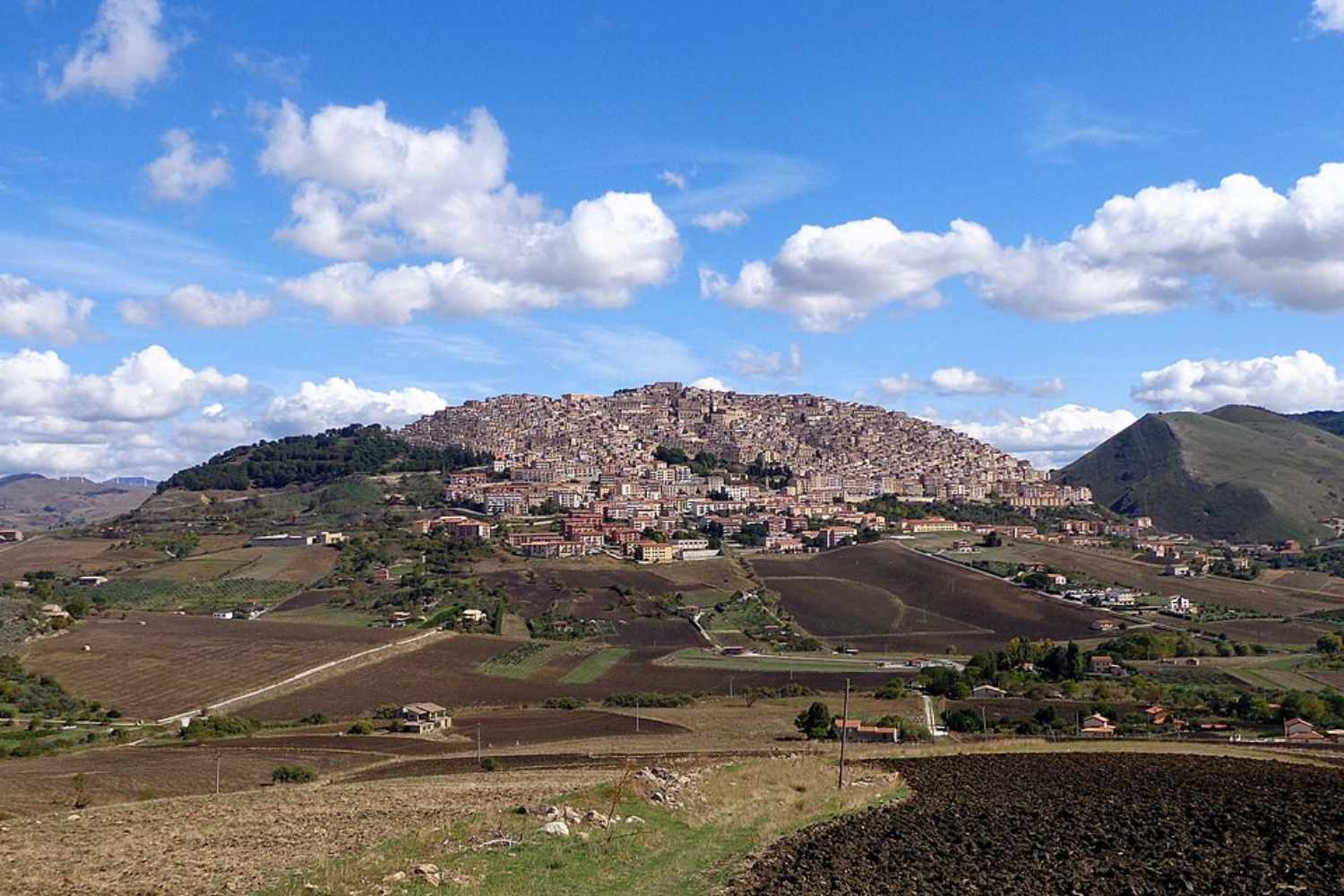
It is located in Sicily, in the heart of the Madonie mountains, far from the routes beaten by mass tourism. Gangi is a small village of around six thousand inhabitants that has conquered the pages of the Guardian, where it has been included in the ranking of the lesser-known but worthy of a visit Italian places. The British newspaper collected the testimonies of its readers, who walked the Via dei Frati, the ancient 166 kilometer path that connects Caltanissetta to Cefalù crossing Gangi itself.
The response from travelers is absolutely positive, with descriptions of sublime landscapes and a truly satisfying overall experience, capable of restoring that sense of authenticity typical of places little visited by mass tourism. The village of Gangi represents one of the most evocative stages of the journey, where each day ends with the discovery of a small Sicilian historic centre. The Via dei Frati follows the routes that begging monks took for centuries, from the major convents to the most remote countryside, to collect alms to share with the most needy.
From legendary origins to medieval reconstruction
Gangi stands on a hill over a thousand meters above sea level and offers a panoramic view of the Madonie mountains. Its origins are lost in legend, when some scholars identify it with the ancient Cretan city of Engyon. The first historical documents attest to the existence of the village in the 12th century, in the locality of Gangivecchio. The town was destroyed in 1299 during the War of the Vespers and rebuilt on nearby Monte Marone, where it still stands today.
The historic center and the religious architecture
Gangi’s current appearance reflects its medieval and Renaissance history. The stone houses are arranged in steps along the slope, creating a compact urban fabric made up of narrow alleys and small squares. Corso Giuseppe Fedele Vitale, which you can see in the image below, represents the main artery of the village, named after the eighteenth-century doctor and poet who was secretary of the Accademia degli Industriosi. The course crosses the historic center connecting the main monuments and squares, overlooked by noble palaces, artisan shops and historic cafés.
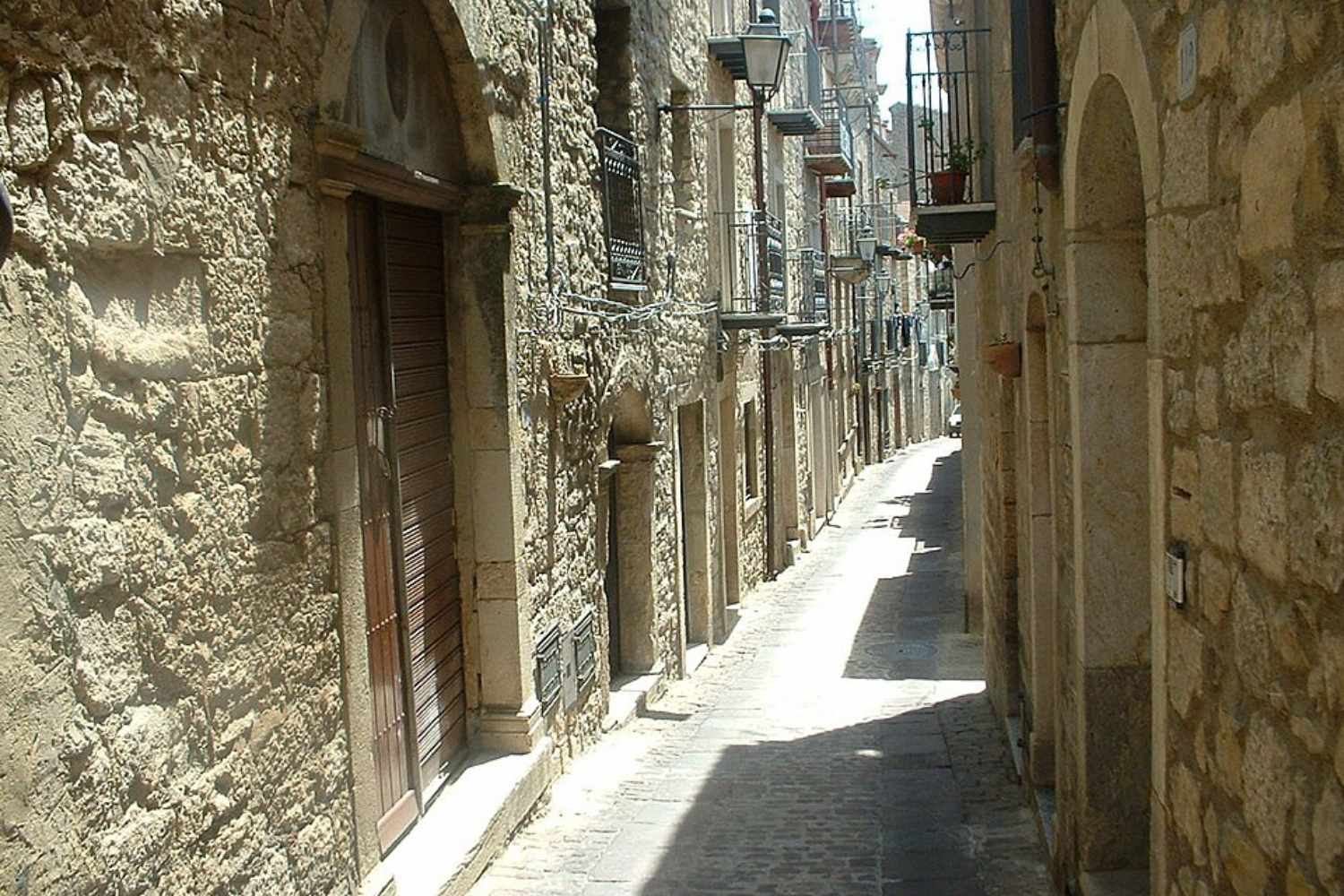
The colorful facades, flowered balconies and stone portals characterize the architecture of the village. In the main square stands the Mother Church of San Nicolò, founded in the 14th century and enlarged in the following centuries. Inside it houses works by Giuseppe Salerno, a local seventeenth-century painter known as “the Zoppo di Gangi”, and sculptures by Filippo Quattrocchi.
The crypt of the Mother Church houses a macabre peculiarity: the mummies of over one hundred priests who served in Gangi between 1725 and 1872. The bodies, preserved in an upright position and dressed in ecclesiastical clothes, represent a testimony to ancient embalming practices.
Other religious buildings enrich the heritage of the village, such as the Sanctuary of the Holy Spirit, dating back to the 14th century, inside which a fresco of Christ Pantocrator is preserved in the apse basin, and the Gangivecchio Abbey, founded in 1363 by the Benedictines, which for two centuries was the most important monastery in central-northern Sicily and which today has become a private residence, after being abandoned by the monks in the 17th century.
Palazzo Bongiorno and the Masonic secrets
Palazzo Bongiorno represents a special case. Built in the eighteenth century at the behest of Baron Francesco Benedetto Bongiorno, it housed the Accademia degli Industriosi, a Masonic club that promoted Jansenist and Enlightenment ideas. The frescoes in the rooms reflect Masonic symbols and philosophical allegories, making the building a “philosopher’s home” full of encrypted messages.
Towers, castles and noble families
The Torre dei Ventimiglia, built in the 14th century as a feudal tower, was later incorporated into the Mother Church as a bell tower. The Gangi castle, built between the end of the 13th and the first decades of the 14th century by the Ventimiglia family, dominates the village from above. The fortress then passed to the Graffeo and Valguarnera families, who maintained the title of princes of Gangi until the nineteenth century.
The siege of Cesare Mori
The village experienced dramatic moments in 1926, when the prefect Cesare Mori ordered the siege of Gangi to flush out bandits and mafiosi. The operation, conducted with very harsh methods, represented one of the most famous actions of the “iron prefect” wanted by Mussolini to fight organized crime in Sicily.
The village of villages and rebirth
Gangi has achieved important recognition in recent years. In 2012 it was proclaimed the Jewel Municipality of Italy and in 2014 it won the title of “Borgo dei Borghi”, the most beautiful Italian village, awards which have increased the visibility of the town, attracting visitors interested in its authenticity. The municipal administration has also started the one-euro houses project, to repopulate the historic center and counteract the depopulation that afflicts many villages in the Sicilian hinterland.
