
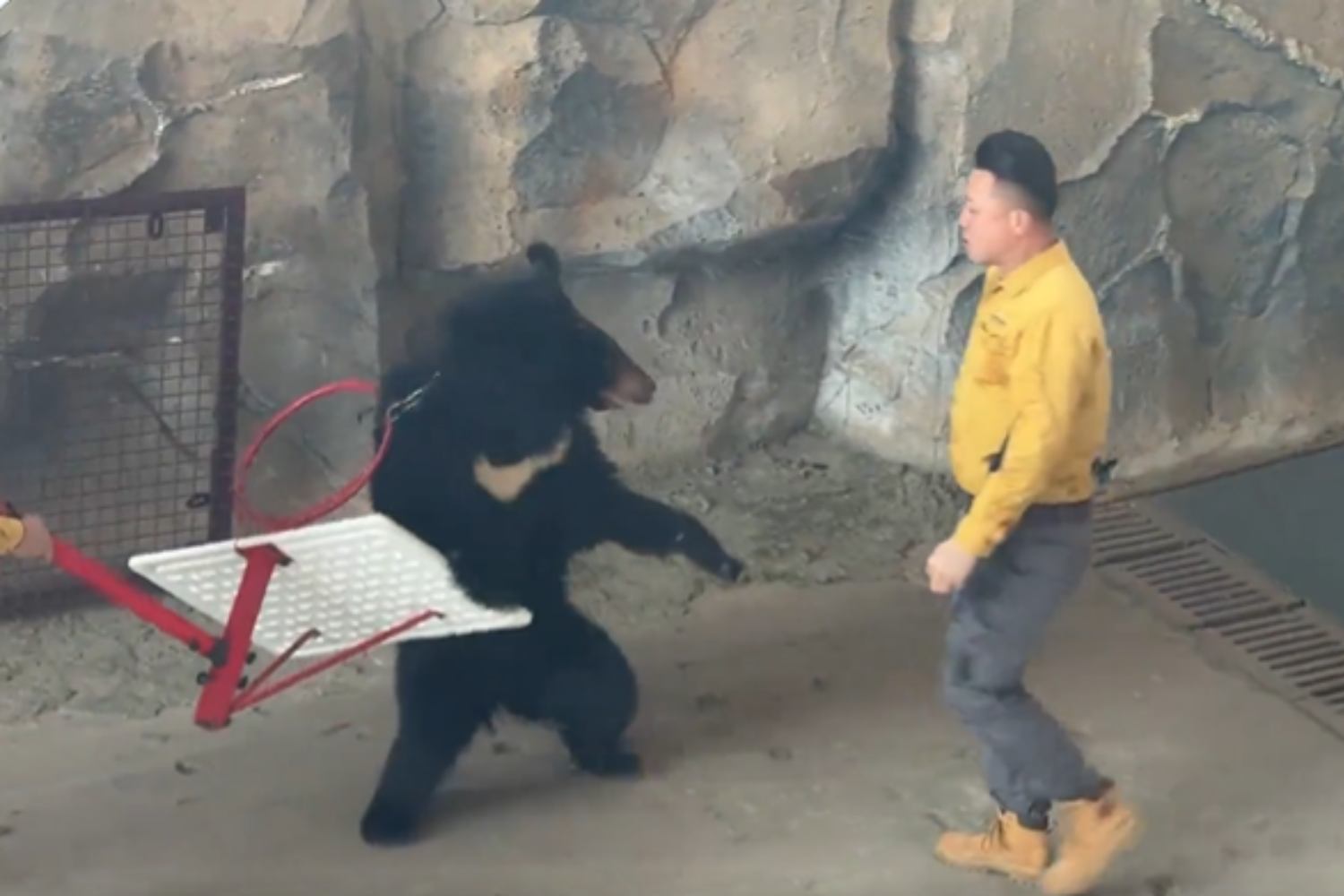
At the safari park in Hangzhou, China, an Asiatic black bear suddenly attacked its trainer during a public demonstration. The animal, called Xiong Er, was engaged in a performance that involved unnatural exercises such as moving on a hoverboard, driven by humans. While moving behind the stage, the bear showed clear signs of stress and, after being pulled by a paw and forced to walk on its hind legs, it reacted with a sudden attack.
The images recorded by visitors show the moment the bear lunges at the trainer, landing him on the ground. Various park staff members attempted to intervene using improvised objects, such as a basketball frame, stools and even a large bamboo stick, in an attempt to ward off the animal. The chaos sparked panic among the public.
Neither of them was injured
Fortunately, the park announced that neither the trainer Zhou Jiazhen nor the bear were injured, but it still decided to suspend all demonstrations with Asiatic black bears and to move Xiong Er to a larger and quieter area in the mountains. According to Jiazhen, the bear had no real intention of hurting him. According to him, the attack arose from the animal’s desire to reach a bag of carrots it had with it.
A reaction due to the stress of these absurd performances
However, the version given by the trainer did not dispel concerns about the use of animals in performances, on the contrary. The incident has rekindled the debate on the use of wild animals in public performances. The obligation to perform behaviors contrary to their nature, such as balancing on a hoverboard or moving on two legs for long distances, can generate stress, frustration and unpredictable reactions. Similar incidents are often the result of unnatural routines imposed for entertainment purposes, putting both animals and operators at risk.
The park has faced controversies in the past, such as allegations – later denied – that some bears were actually people in disguise. Now what has happened brings to the fore again the need to rethink the relationship between recreational facilities and wild animals, promoting more ethical practices that respect their well-being without turning these specimens into circus animals.
A black bear at Hangzhou Safari Park in China attacked its keeper during a show yesterday.
The park pulled the bear from performances, saying the smell of treats the keeper carried likely triggered the reaction
pic.twitter.com/DD1eRN3Au6
— Volcaholic
(@volcaholic1) December 7, 2025
You might also be interested in:
