
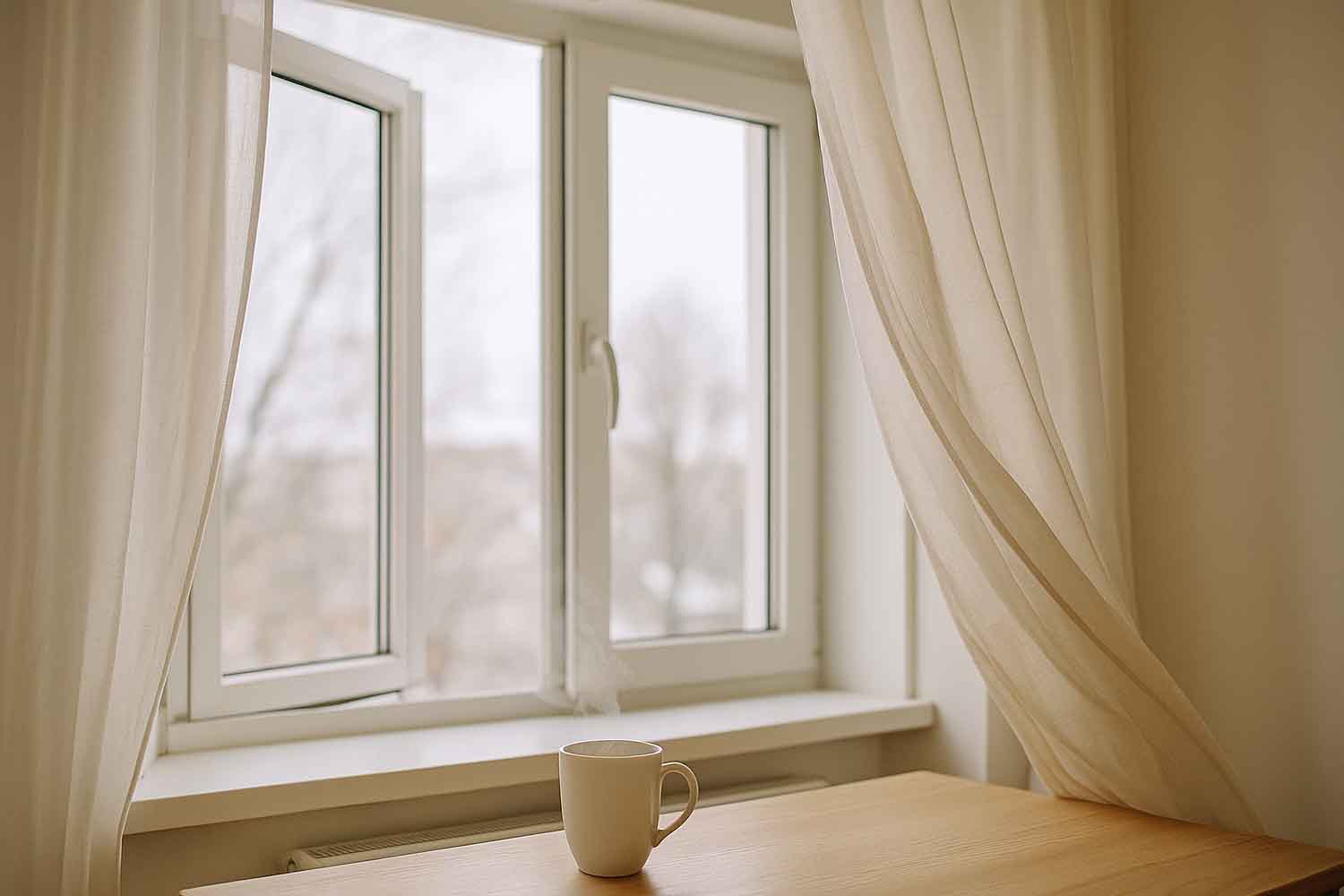
There is a paradox that we all know: it’s cold outside, the heating is on, yet the air in the house always seems a little heavy, dense with humidity, foggy. Opening the windows almost seems like a betrayal of the hard-won warmth. And yet it is right there, in those minutes that seem forbidden to us, that the true quality of the air we breathe is at stake.
In recent years we have learned to consider the house as a protective shell, but this shell – if it doesn’t breathe – becomes a small greenhouse in which humidity immediately finds a place to settle: cold walls, windows, forgotten corners. It is the perfect environment for mould, a silent but tenacious companion, which does not look at anyone: it arrives when the air stagnates, it stays when we continue to ignore it.
The truth is that indoor air ages much faster in winter than it seems. We spend more time indoors, we cook more, we take hot showers, we dry clothes in already tired rooms. Each gesture adds a small percentage of humidity which accumulates, it does not disappear on its own. And this is where that famous 5 minute rule comes in, often dismissed as popular legend but actually surprisingly solid. Much more solid than you think.
Because just a few minutes are enough to renew the air
Opening the windows completely for five minutes is not an impulsive act, but a precise mechanism. The freezing air enters quickly, the warm, moisture-laden air exits just as quickly. The exchange occurs so abruptly that the walls, the furniture, the floor, what we technically call “thermal mass”, do not have time to change temperature. They stay warm, ready to return comfort in a matter of moments.
Today this practical intuition is also confirmed in scientific literature. The recent study published on Building and Environment analyzes how ventilation affects indoor air quality and what happens when environments, especially very isolated ones, do not breathe sufficiently. Research shows that air exchange – natural or mechanical – is one of the most decisive factors in avoiding accumulations of CO₂, volatile organic compounds, particulate matter and, of course, humidity.
The most interesting data concerns modern homes: sealed, efficient, impeccable from an energy point of view, but often so airtight that they suffocate. In these cases, short and intense ventilation is a surprisingly effective strategy because it cleans the environment without significantly altering the heat balance.
Five minutes, no more. In some conditions even three are enough. Windows wide open, not closed. A current of air that passes through the house, not a very timid thread of breeze that doesn’t move anything. It is a gesture that recalls the old wisdom of grandmothers, but which today brings with it numbers, graphs, humidity curves measured in the laboratory. Ventilating well does not mean keeping it open for a long time: it means doing it intensely.
How our well-being changes when we let a little winter in
When new air enters, something happens that we immediately notice, even if we don’t know how to name it. The room seems lighter, the windows fog up less, the musty smell vanishes. Even sleep improves: excess CO₂, as confirmed by many research on indoor air quality, affects our ability to concentrate and the quality of rest.
The paradox is that the more we fear “cooling the house”, the colder we actually make it. Unvented humidity penetrates the walls, wets them, cools them from the inside, turns them into a breeding ground for mold.
Opening windows for a few minutes, however, dries the air enough to protect everything else. And it is a gesture that we can do every day, even several times, without worry about the bill and without fear. The ideal hours are the middle of the day, if possible, when the cold is a little less biting. But the truth is that the benefit is there anyway.
Airing is a tiny gesture that forces us to have a greater awareness: the house is not a place to be sealed but an organism to be accompanied. She breathes when we help her to do so. And when she breathes, we breathe better too.
You might also be interested in:
