
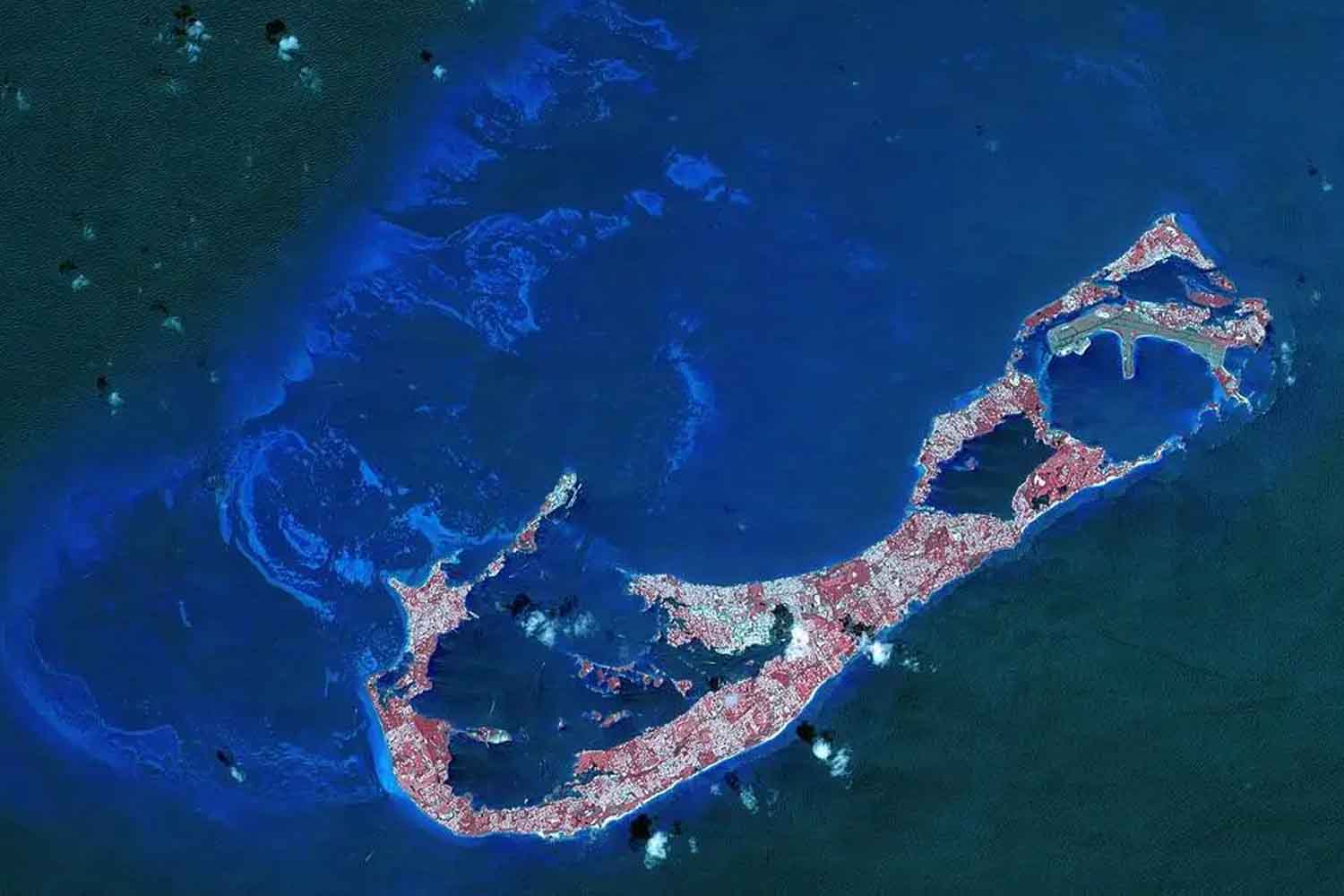
Under Bermuda there is something that, until recently, did not appear in any geology textbook. It is not a Bermuda Triangle-style mystery, nor a suggestive hypothesis: it is a real rock structure, identified thanks to seismic data, which helps to explain why these islands continue to remain raised above the ocean that surrounds them, despite volcanism having ended millions of years ago.
Bermuda rests on a bulge of the ocean floor about 500 meters high. In other similar contexts, this type of elevation is linked to a flow of hot material that rises from the Earth’s mantle, fuels volcanism and raises the crust. It is the classic model, the one that works in Hawaii and many other oceanic archipelagos.
Here, however, something doesn’t add up. Bermuda’s volcanic activity ended between 30 and 35 million years ago, and there is no evidence of a hot plume still active beneath the islands. According to traditional models, once the volcanoes extinguished, the archipelago should have slowly subsided. And instead it remained there, stable, as if something continued to support it from below.
The distant earthquakes that revealed what lies beneath the crust
To understand what was happening beneath Bermuda, the researchers took a direct route: listening for earthquakes. The study, published in Geophysical Research Letters, is based on data collected by the BBSR seismic station, installed directly on the archipelago and active for years.
The signals of 396 earthquakes with a magnitude equal to or greater than 5.5, which occurred in different parts of the world, were analyzed. These seismic waves, crossing the Earth, change speed and direction depending on the materials encountered. By studying these variations, the researchers were able to reconstruct a detailed profile of the subsurface up to about 50 kilometers deep.
The result shows an apparently ordered structure: the surface volcanic rocks, the oceanic crust, the boundary between crust and mantle. Immediately underneath, however, something unexpected emerges.
The rock “pillow” that supports Bermuda from below
At about 21 kilometers deep, analyzes reveal an anomalous layer almost 20 kilometers thick, with different characteristics compared to the surrounding mantle. It is a continuous, stable structure that appears consistently in all the checks carried out.
According to the researchers, this is a case of underplating. During Bermuda’s volcanic phase, some of the magma did not reach the surface, but remained beneath the crust, accumulating and solidifying over time. This rocky body is slightly less dense than the mantle that surrounds it.
The difference is small, about 1.5%, but enough to produce a lasting upward push. It is this “cushion” of solidified rock that continues to support the archipelago, preventing it from sinking into the Atlantic.
A simpler explanation for anomalies that have lasted for millions of years
This model also helps to clarify other seemingly contradictory aspects of Bermuda. In fact, the area shows negative gravitational anomalies and a normal heat flow, elements that are difficult to explain with the idea of volcanism still active at depth.
In this case, it is not the heat that keeps the crust raised, but the composition of the rocks beneath it. An ancient structure, formed millions of years ago, which continues to fulfill its role without the need for additional energy.
For William Frazer, a seismologist at Carnegie Science and lead author of the study, Bermuda may not be an exception. Checking whether similar structures also exist under other oceanic islands could change the way we interpret the stability of many emerged lands born from volcanism.
You might also be interested in:
