
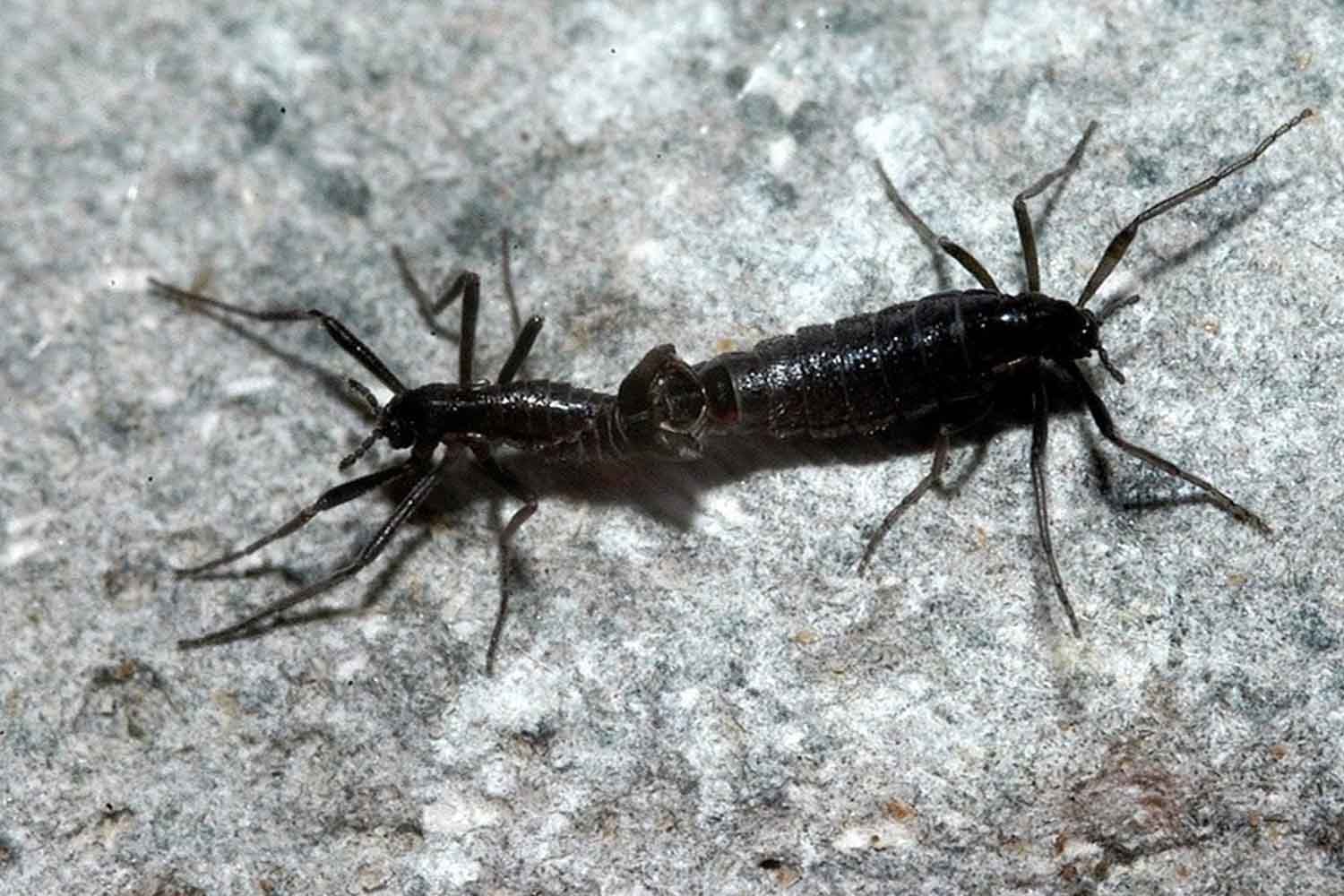
Not even Antarctica, the continent that more than any other we associate with the idea of intact nature, has remained outside the problem of microplastics. The invasion of microplastics has reached here too, creeping into a place that for decades we considered far from the direct consequences of human activities. And he did it silently, entering the body of a tiny insect that lives only in these extreme lands.
We are talking about Belgica antarctica, a wingless fly, a few millimeters long, more or less the size of a grain of rice. It is the only native insect of Antarctica and has always represented a symbol of life’s extraordinary ability to adapt to even the most difficult conditions. Today, however, this small organism tells a different story, which concerns all of us.
The discovery comes from a study published in the scientific journal Science of the Total Environment and coordinated by the University of Kentucky, United States. Italian scientists from the University of Modena and Reggio Emilia and the Elettra Sincrotrone of Trieste also participated in the research, confirming an international work that combined different skills to analyze an increasingly global problem.
Researchers have identified fragments of microplastics inside the digestive system of Belgica antarctica, demonstrating that these particles have now also entered the terrestrial systems of Antarctica. A fact which, alone, is enough to undermine the idea of a continent completely protected from human pollution.
The invasion of microplastics studied between the laboratory and the field
To understand what happens to this insect when it comes into contact with plastic, the team led by biologist Jack Devlin conducted a series of tests in the laboratory. The specimens were exposed to microplastics for ten days, a relatively short period but imposed by the operational difficulties of working in Antarctica.
The results, at first glance, might seem reassuring. The insects did not die and showed no obvious changes in metabolism, even when exposed to high concentrations of microplastics. But looking deeper, a signal emerges that deserves attention: fat reserves progressively decreased as the amount of plastic ingested increased.
In an extreme environment like the Antarctic, where energy is a precious resource, having less fat means being more vulnerable. It means having fewer “supplies” to face the cold, periods of food scarcity and harsher environmental conditions.
Alongside laboratory experiments, the researchers analyzed larvae collected in the wild. 40 samples were taken from 20 different sites and the intestinal contents were studied with advanced techniques capable of recognizing even particles invisible to the naked eye. Fragments of microplastics were found in two larvae, one of which was positively confirmed as plastic.
This may seem like a low number, and in fact it is. But it is enough to issue a first warning, as the researchers themselves point out:
Antarctica has much lower levels of plastic than the rest of the planet, but we now know that microplastics are entering the system.
And that’s exactly the point. We are not faced with a visible emergency, but with an ongoing, slow and discreet process. Microplastics can arrive in Antarctica in many ways: transported by the wind for thousands of kilometers, released by human activities related to scientific research, tourism or fishing, or brought ashore by marine animals. Once they arrive, they can enter food chains, even the simplest ones, such as the Antarctic terrestrial ones.
Belgica antarctica plays a key role in these ecosystems. Its larvae contribute to the recycling of nutrients and support an already fragile balance. Altering their energy balance, even slightly, could have broader consequences over time.
Today the ingestion of microplastics still seems rare. But this research shows that the border is no longer impassable. The invasion of microplastics has also reached the last continent, reminding us that what we produce and disperse into the environment never really stays away.
You might also be interested in:
