
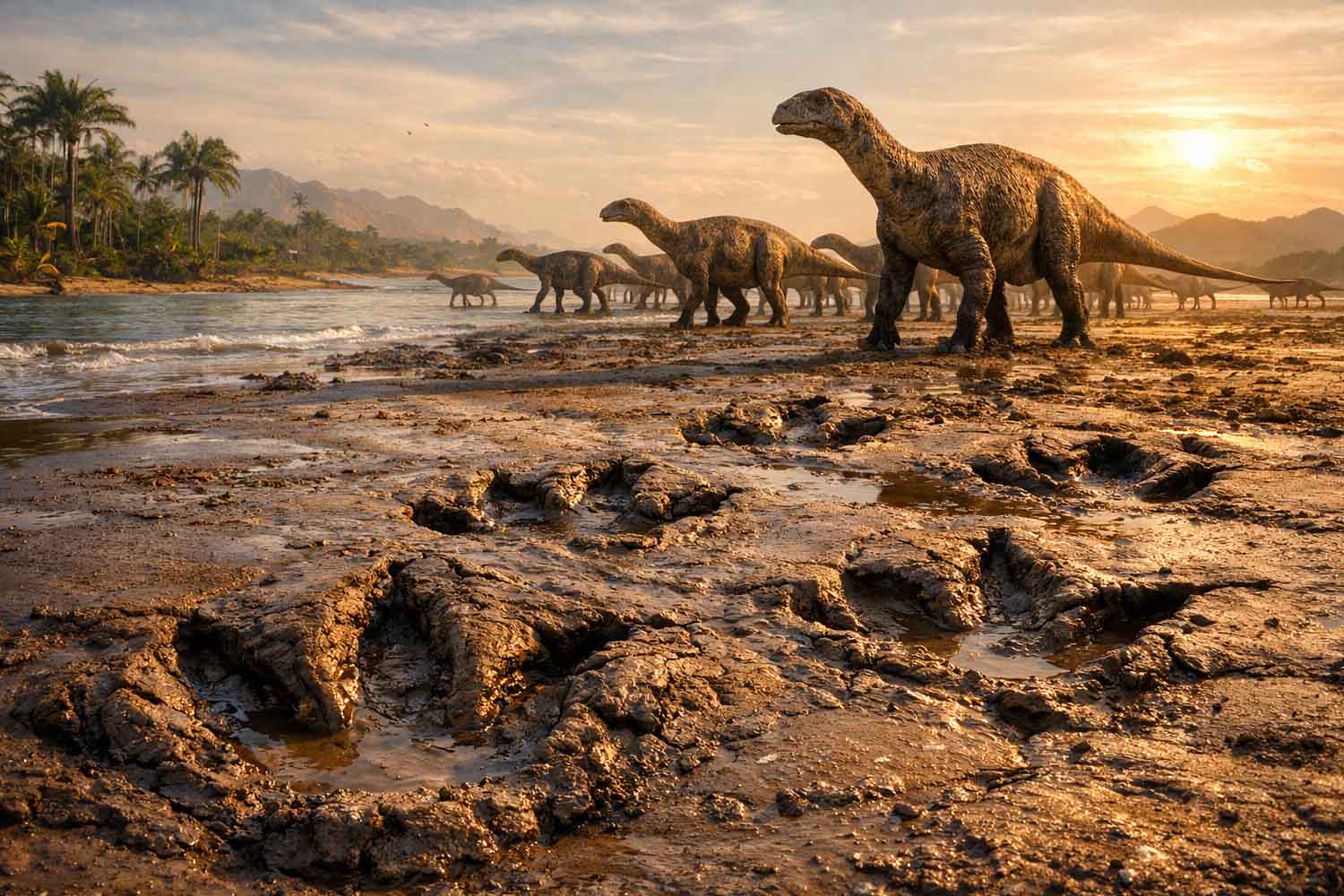
In the heart of Stelvio Parkamong the peaks that today dominate the Lombard Alps, an extraordinary testimony of the Earth’s most remote past resurfaces. Thousands of dinosaur footprintsdating back to approx 210 million years agowere identified on almost vertical dolomite walls, revealing the presence of large herds of herbivores that populated these areas in the Upper Triassic.
The discovery, announced by Lombardy Region together with the paleontologist Cristiano Dal Sasso of Natural History Museum of Milanimmediately attracted the attention of the international scientific community for the exceptional state of conservation of the traces and the extension of the site.
An unprecedented paleontological site
The footprints identified are not simple isolated footprints. On the contrary, they form continuous tracks hundreds of meters longvisible today on almost vertically inclined rocky surfaces. In some cases, the traces remain Detailed impressions of fingers and clawsa very rare element that allows scholars to reconstruct the gait and behavior of animals with great precision.
According to Dal Sasso, we are faced with a real one “dinosaur valley”an area that extends for kilometers and represents the largest dinosaur footprint site in the Alps And one of the richest in the world. The parallel walks observed on the rock faces constitute clear evidence of herds in synchronized movementwhile other configurations suggest complex behaviors, such as groups arranged in a circle, perhaps for defensive purposes.
From the shores of the Tethys Ocean to today’s vertical walls
When these footprints were imprinted in the mud, the environment was profoundly different from the current one. The dinosaurs moved along wide tidal flatslapped by warm waters of the Tethys Oceanin a context similar to today’s tropical areas. The muddy surfaces stretched to the horizon for hundreds of kilometers, providing an ideal habitat for large, lumbering herbivores.
The current almost vertical position of the footprints does not correspond to the original one. It is the result of massive geological deformations which, over millions of years, have led to lifting of the Alpine chain. This makes the site even more fascinating, because it allows you to read, on the same rock, both the history of life and that of the formation of the mountains.
Initial analyzes indicate that the footprints could belong to prosauropod dinosaursherbivores from long neck and small headconsidered the ancestors of the large Jurassic sauropods, such as the brontosaurus. Animals with a robust build, equipped with sharp claws on hands and feetwhich in some species they could reach 10 meters long. Prosauropod skeletons have already been found in Switzerland and Germanystrengthening the hypothesis put forward by scholars.
A chance discovery destined to last decades
The credit for the discovery goes to nature photographer Elio Della Ferrerawhich the September 14, 2025 was located in the Fraele Valley to photograph deer and bearded vultures. During the hike, he noticed the footprints surfacing on the rock, some of which reach 40 centimeters in diameter. The first images were immediately sent to Dal Sasso and the Supervisionstarting scientific checks.
Studying the site will not be easy. The area, in fact, and will require the use of drones and remote sensing technologies to map and analyze footprints. According to experts, it is a immense scientific heritage that will require decades of work to be fully understood.
The discovery also takes on a significant symbolic and media value, as it brings the Valtellina Alps in the spotlight less than two months after the start of Milan-Cortina Winter Olympic Gamesoffering a powerful narrative that unites sport, nature and the planet’s deep history.
