
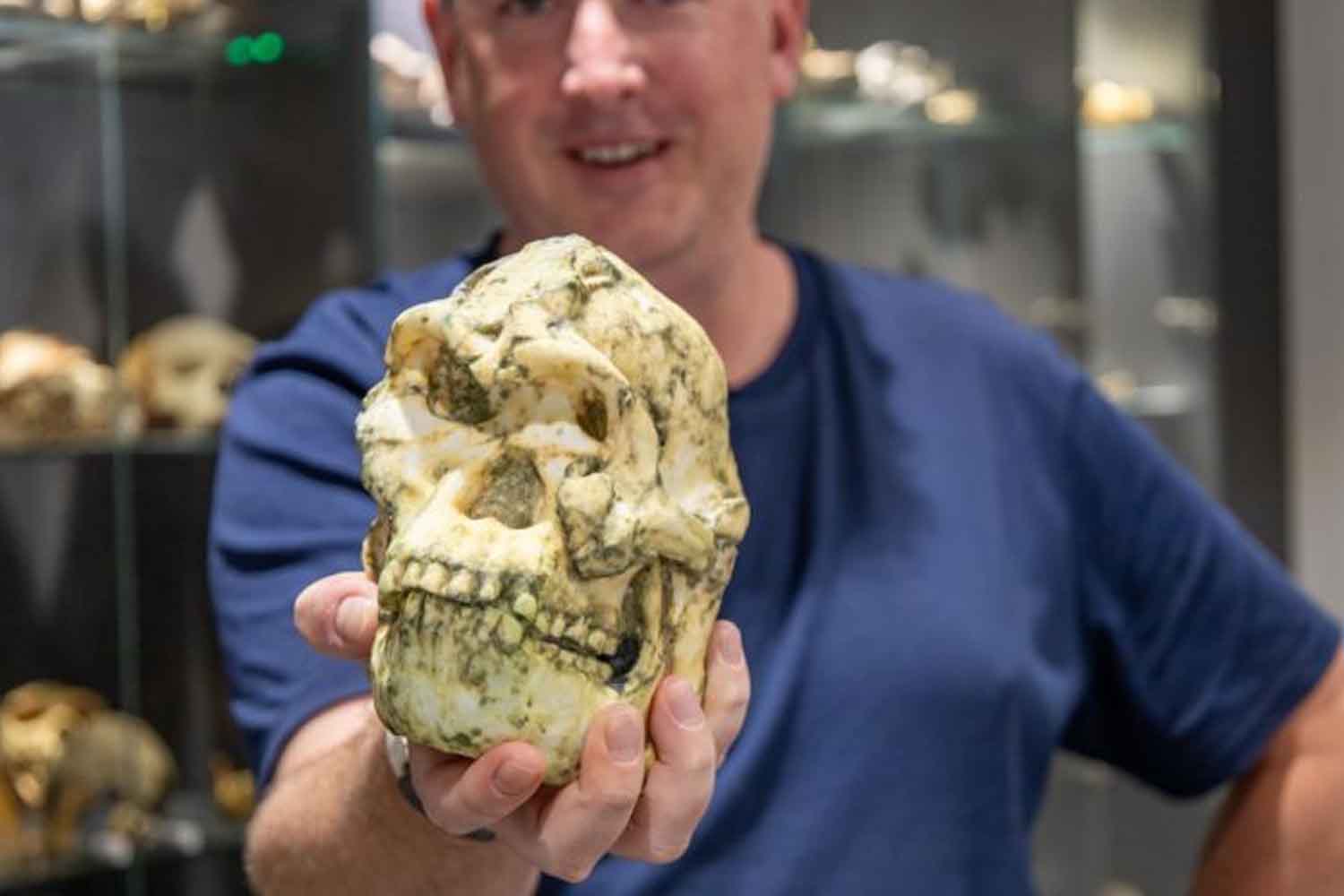
There is a fossil, kept for years in the heart of South Africa, which today is once again making headlines and calling into question what we thought we knew about the origins of man. Is called LittleFoot and is one of the most complete hominin skeletons ever discovered. Now, according to a new study, it may belong to a previously unknown species of human ancestor.
Little Foot was first shown to the public in 2017, but its story begins much earlier. It was 1994 when, in the caves of Sterkfonteinnorth-west of Johannesburg, some foot bones came to light. From there began a very slow and complex excavation, which lasted over twenty years, which led to the almost complete reconstruction of a skeleton of Australopithecusa group of hominins that lived in Africa more than four million years ago.
For years scholars have debated who Little Foot really was. The paleoanthropologist Ronald Clarkewho led the excavations, attributed it to the species Australopithecus prometheus. Other researchers, however, have always thought that it was Australopithecus africanusa species known since 1925 and already well documented in the same caves.
Today, however, a third hypothesis comes into play. A group of Australian researchers has published a study onAmerican Journal of Biological Anthropology arguing that Little Foot . According to them, we could be faced with something new.
Little Foot and the enigma of the australopithecines
Leading the research is Jesse Martinresearcher at La Trobe University in Melbourne and the University of Cambridge. The central point of his work is simple but powerful: some anatomical features of Little Foot, especially in the lower part of the skull, are different from those observed in other Australopithecus fossils found at Sterkfontein.
That area of the skull, the researchers explain, is one of the most stable from an evolutionary point of view. It changes very slowly over time. Precisely for this reason, when evident differences emerge, it is difficult to dismiss them as simple individual variations. In other words, they could indicate a different species.
The surprising thing is that these clues have remained under everyone’s eyes for years. Little Foot is the most complete human ancestor fossil ever found, yet it could hide a story yet to be told. According to Martin, we are not just talking about a new point on the human family tree, but perhaps about an entire evolutionary branch that we had never identified.
The authors of the study, however, choose caution. They do not propose a new official classification and suggest that the eventual name of the species should be decided by the team that has followed the fossil for more than two decades. A gesture of scientific respect, but also a sign that the debate is far from over.
To complicate the picture there is also the question of age. Little Foot has been dated to 3.67 million yearsbut some scholars believe it cannot be older than 2.8 million years. An enormous difference, which directly affects its place in the history of human evolution.
What is certain is that Little Foot continues to ask us uncomfortable questions. Who were we really? How many different paths did evolution take before reaching us? Sometimes, to discover something new, we just need to take a closer look at what we thought we already knew.
