
Every time we do a washing machine, thousands of them go along with the dirty water plastic microfibres. Invisible, light, persistent. They come from synthetic fabrics, pass through purifiers and end up in rivers, agricultural fields and food. A seemingly harmless daily gesture thus contributes to one of the most widespread and least perceived environmental problems.
A group of researchers from the University of Bonn decided to tackle the problem starting from a simple question: How can we intercept these fibers before they come out of the washing machine, without complicating the life of those who use it? The answer does not come from a futuristic laboratory, but from the sea. Precisely, from the mouth of an anchovy.
The idea was born by observing the fish that filter the water without ever blocking the system
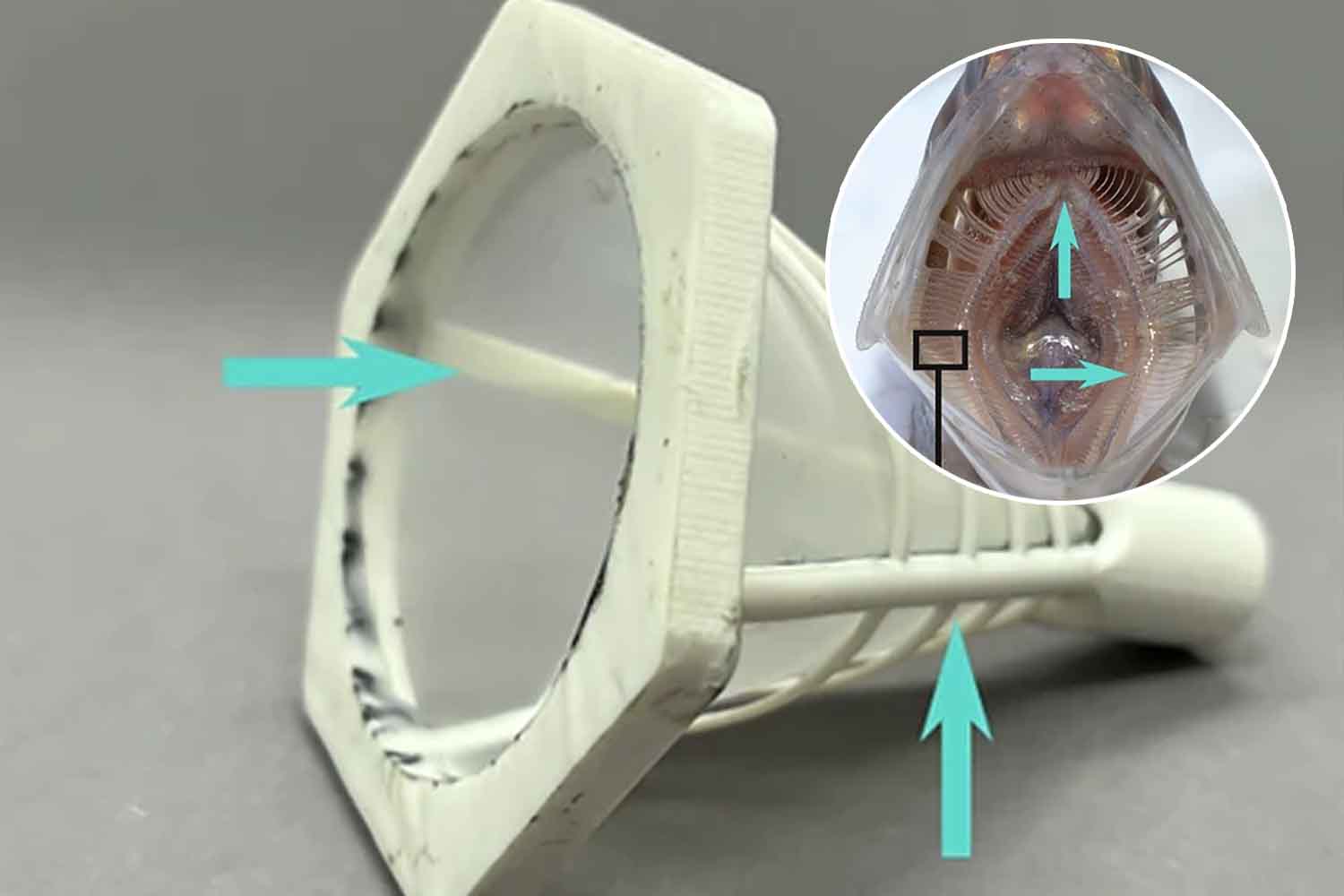
Anchovies, sardines and mackerel feed by filtering the water as they swim. They let in large quantities of liquid, retain only what is needed and never get clogged. The water flows, the larger particles are accompanied to a collection point and the system cleans itself.
The researchers copied this principle and adapted it to the drain of a washing machine. No front barriers, no filters that fill up and stop working. The water is made to flow along an inclined surface, so the microfibres do not stick but are dragged away by the flow. The result is a small cone-shaped device, inserted into the exhaust pipe. Water passes, fibers do not.
In tests it retains almost all microfibres and does not require continuous maintenance
During laboratory tests, the filter managed to retain over 99% of microplastics present in waste water. The interesting thing is that it does not block: the collected fibers are conveyed into a side chamber and removed automatically thanks to short pulses of water.
There are no cartridges to change, there is no need to disassemble anything, it does not require constant attention. It is designed to operate silently, like the natural systems from which it takes inspiration. And it is precisely this simplicity that makes it credible even outside the laboratory.
Because laundry is a major source of microplastics
When we talk about microplastics we immediately think of the sea. In reality, one of the main sources is domestic. Only one family can release hundreds of grams of microfibers every year simply washing clothes. Even when purification plants manage to intercept them, the problem is not solved. Microplastics often end up in sewage sludge, which is used as agricultural fertilizer. In this way they return to the soil and crops.
Block them Beforedirectly at the source, is one of the most effective and least exploited steps. And this is where this type of filter can really make a difference. The device does not eliminate the problem of synthetic fabrics and does not replace more conscious choices. But it intercepts a huge amount of plastic before it enters the environment, without changing daily habits.
Researchers are already testing the system with real wastewater, full of hair, detergent residue and dirt. It works even in less than ideal conditions. According to the team, with the support of an industry company, it could be integrated into washing machines within a few years. Sometimes the most effective solutions are not revolutionary, but discreet. Like copying a fish and putting it, metaphorically, behind the washing machine door.
