
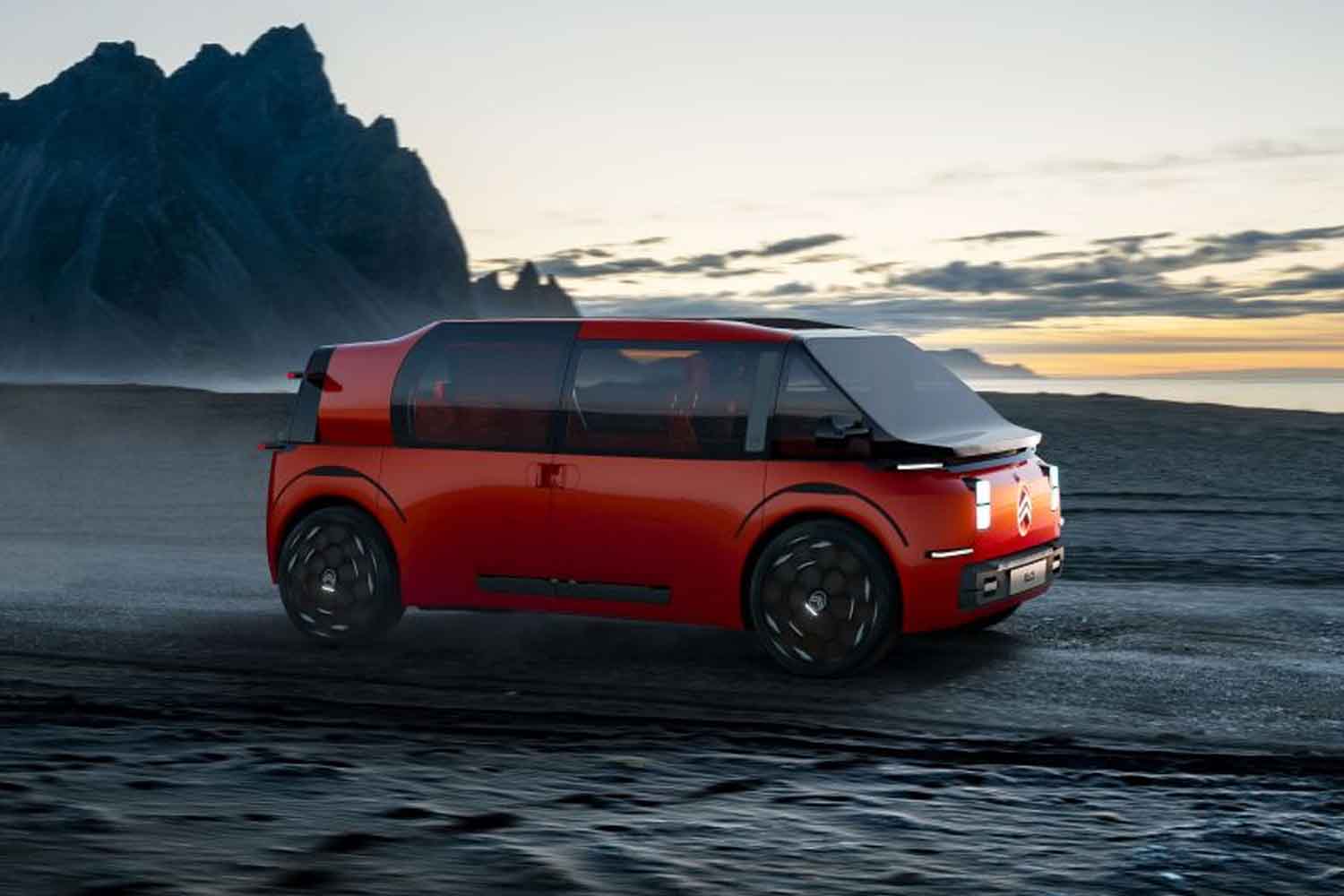
There is a simple, almost banal question that has accompanied the debate on electric cars for years: is it really useful as it is? Between gigantic SUVs, dashboards full of screens and technological promises that few actually use, the answer is not always obvious. The Citroën ELO concept, born from the collaboration with Decathlon, tries to move the conversation elsewhere. Not about performance, not about luxury, but about everyday use. On how we experience time, travel, breaks.
ELO is not a “dream” car in the classic sense. It is rather a concrete experiment: what if the car returned to being a space to be inhabited, even when it is stationary?
Small on the outside, surprisingly liveable on the inside
At first glance it is striking for its small dimensions: 4.10 meters in length, little more than a normal small car. Yet, inside, the space changes scale. Six real seats, flat floor, continuous surfaces, lots of light. The effect is not that of a “full” car, but of an open, almost domestic environment.
The most surprising choice is the central driving position, a rare solution that eliminates the classic separation between the driver and the traveller. No bulky dashboard, no visual barriers. The four doors against the wind, without a central pillar, do the rest: when they open, the passenger compartment becomes a single space, accessible, legible, easy to use. Even for those who are not particularly familiar with the car.
Here the idea is not to amaze, but to make everything immediate. Enter, exit, load, sit. Without unnecessary rituals.
Rest, free time, work
The name ELO comes from three English words: rest, play, work. Rest, leisure, work. Not abstract concepts, but real situations. In the moment of rest, the car transforms. The seats are repositioned, inflatable mattresses developed with Decathlon appear, powered by an integrated compressor. The lights change function, become softer. There is also a projection system that allows you to watch a film directly from the cockpit. Not to “make an impression”, but to restore meaning to downtime, to breaks, to improvised nights.
When free time comes into play, ELO opens up to the outside. The seats become camping seats, the compartments accommodate sports equipment, tents and covers extend the space beyond the car. Thanks to vehicle-to-load technology, car energy can power small electrical devices. It’s the idea of the car as a mobile base, not as an object to be displayed.
Then there is work, an increasingly present topic even outside the offices. A removable shelf, organized spaces, information projected on the windscreen. Everything you need, without multiplying screens and distractions. The car becomes a place to focus, not another device to manage.
Simple, recycled materials, designed to last
ELO’s sustainability does not come from high-sounding slogans, but from very concrete choices. The materials are largely recycled, resistant, easy to clean. The surfaces are flat, multifunctional, designed for intense use, even outdoors. The idea is to reduce what breaks, what ages badly, what forces frequent replacements.
Technology also follows the same logic. The tires developed with Goodyear integrate sensors that report wear and pressure directly on the rim, with a visible color code. Fewer mysterious spies, fewer incomprehensible messages. Only useful information, when needed. It is a sustainability that does not require technical skills or constant attention. It runs in the background.
ELO is not a car ready for the road, but an open question about the mobility to come
Citroën ELO is not a model intended for production as it is. It’s a concept, and it shows. But that’s not the point. The point is the question it asks: does it still make sense to design ever larger, more complex and expensive cars, when the majority of journeys are urban, short, daily?
ELO suggests a different path. More sober, more flexible, more attentive to how we really use the means. It doesn’t promise miracles, it doesn’t sell performance. It proposes a less shouted and more experienced idea of mobility. And that’s exactly why it’s intriguing.
You might also be interested in:
