
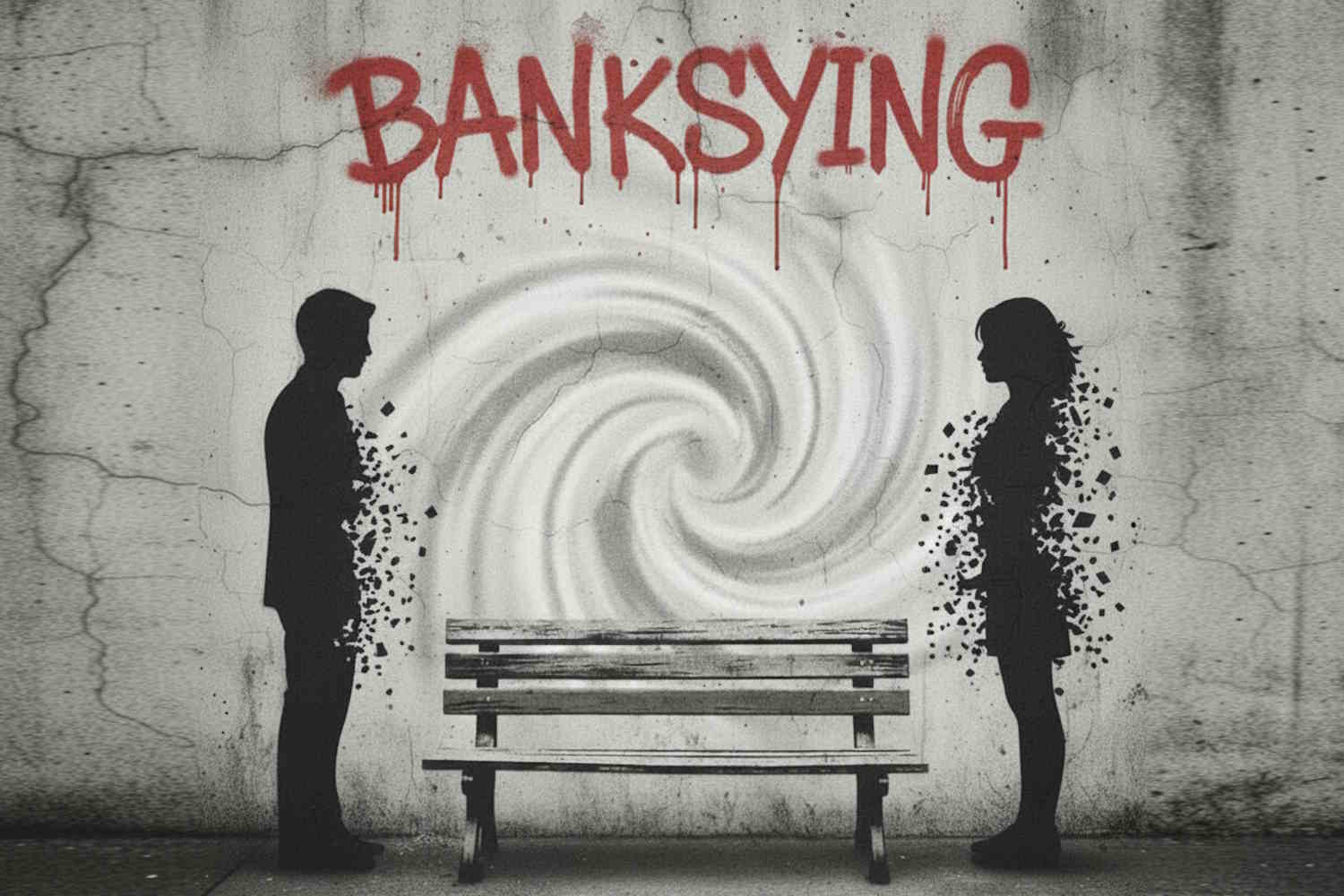
Maybe it’s already happened to you: the person you were with begins to change. Not suddenly, but slowly. He writes less, avoids seeing you, but says he’s just tired. He seems distant to you, but continues to act as if nothing had happened. Then, one day, he disappears. Without explanations. No confrontation, just silence.
Well, it’s called Banksying. And it’s much more common than you think.
The name takes inspiration from Banksy, the street artist who creates works in unexpected places and then disappears. Likewise, those who Banksying leave a relationship with a silent, planned strategy. First he distances himself emotionally, then he deletes every trace – photos, tags, contacts – without saying anything. Even after years of relationships. No final message, just absence.
For those who suffer, the effect is devastating. Because you don’t immediately understand that it’s ending. You find yourself looking for signs, wondering where you went wrong, while the other person has already said goodbye alone for weeks.
Banksying: a slow but intentional disappearance
Banksying is not a spontaneous decline in interest. It’s a plan. We stop responding consistently, we avoid opportunities for discussion, we empty moments of intimacy. Everything seems normal, but underneath there is a precise strategy to leave without taking the responsibility of actually closing.
Whoever does it has already decided. But he doesn’t have the courage to have a conversation. So we take back one step at a time, leaving the burden of doubt to the other. Silence is passed off as stress, tiredness, a “complicated period”. But in reality, it is a way to disappear silently.
The problem? The other person doesn’t understand what’s happening. And this causes a crisis. Mental rumination is activated, you begin to obsessively check social media, reread messages, ask yourself if you have exaggerated, if you have said something wrong.
There is no longer a dialogue. There are no more gestures. But there isn’t even a real break. And this confuses, wears out, destroys trust. It is a form of silent emotional violence: it doesn’t scream, but it leaves its mark.
Ghosting or Banksying?
Unlike ghosting – where you suddenly disappear – Banksying is a gradual, almost invisible process. You start with increasingly colder responses, less contact, then you delete photos and interactions, you pretend that everything is fine, until one day the relationship ends without you even being able to react.
Those who suffer it remain in limbo. He doesn’t know if it’s really over, if we can still talk, if everything was true or not. This makes Banksying crueler than ghosting, because it leaves you in uncertainty for weeks or months. It’s a slow fading of the light: first you see, then you see less, then darkness.
Many experts talk about “sentimental quiet quitting”. Just like those who stop committing themselves at work but formally remain in their position, those who Banksying stop investing in the relationship, but don’t say it. And this makes it impossible for the other to react, understand, really close.
How to tell if you’re being Banksyed and what you can do to protect yourself
There are precise signs that can help you understand if you are Banksying. Here they are:
If you notice that all this happens constantly and without explanation, stop. It’s not just stress: it’s a project. Giving a name to the situation is the first step to getting out of it.
This dynamic isn’t just annoying, it can also be emotionally draining. Those who suffer it often enter a loop of thoughts: they check social media, blame themselves, look for explanations. But he finds nothing, because the other has already closed – only, he hasn’t said so.
This is why it is useful to recognize the signs and, if they become a constant, take a step back. Not out of pride, but out of clarity.
What can you do?
It’s not a drastic way to react, it’s just a way to protect yourself from toxic communication. No one should be stuck in a relationship where they no longer know what they are.
There are those who plan their disappearance by asking ChatGPT for help
There is another disturbing aspect of Banksying, and that is the new digital complicity. Some recent cases tell of people who, before disappearing, asked online forums, male communities or even artificial intelligence for advice.
Tools like ChatGPT are used to study the best strategy to “cool down” a relationship: reduce the time spent together, avoid personal conversations, invest in other connections to move the energy elsewhere.
Yes, there are those who plan everything weeks in advance, even posting content on TikTok while they are already planning their farewell. And while the other person deludes themselves that there is still an “us”, in reality they have already been excluded from the project.
This “strategic disappearance” is no less violent just because it is silent. On the contrary. It is precisely because it is planned that it leaves deeper wounds.
When love becomes an enigma, words are needed to rebuild
Banksying isn’t just disrespect, it’s planned emotional erasure. Whoever does so decides not to take responsibility for closing. And those who suffer it are left without language, in an empty space where everything has been left half done.
It’s not weakness to ask for help. Talk about it with trusted people. Ask for support from a professional, a psychologist, a clinic. Putting words to what happened is an act of emotional hygiene, not an excess.
If you are looking for an image to remember him: Banksying is not disappearing into thin air, it is dismantling one’s presence until love remains only an enigma. And when a relationship becomes a puzzle, the solution is to put the words back in line. Because this is the only way to rebuild the sense of self.
You might also be interested in:
