
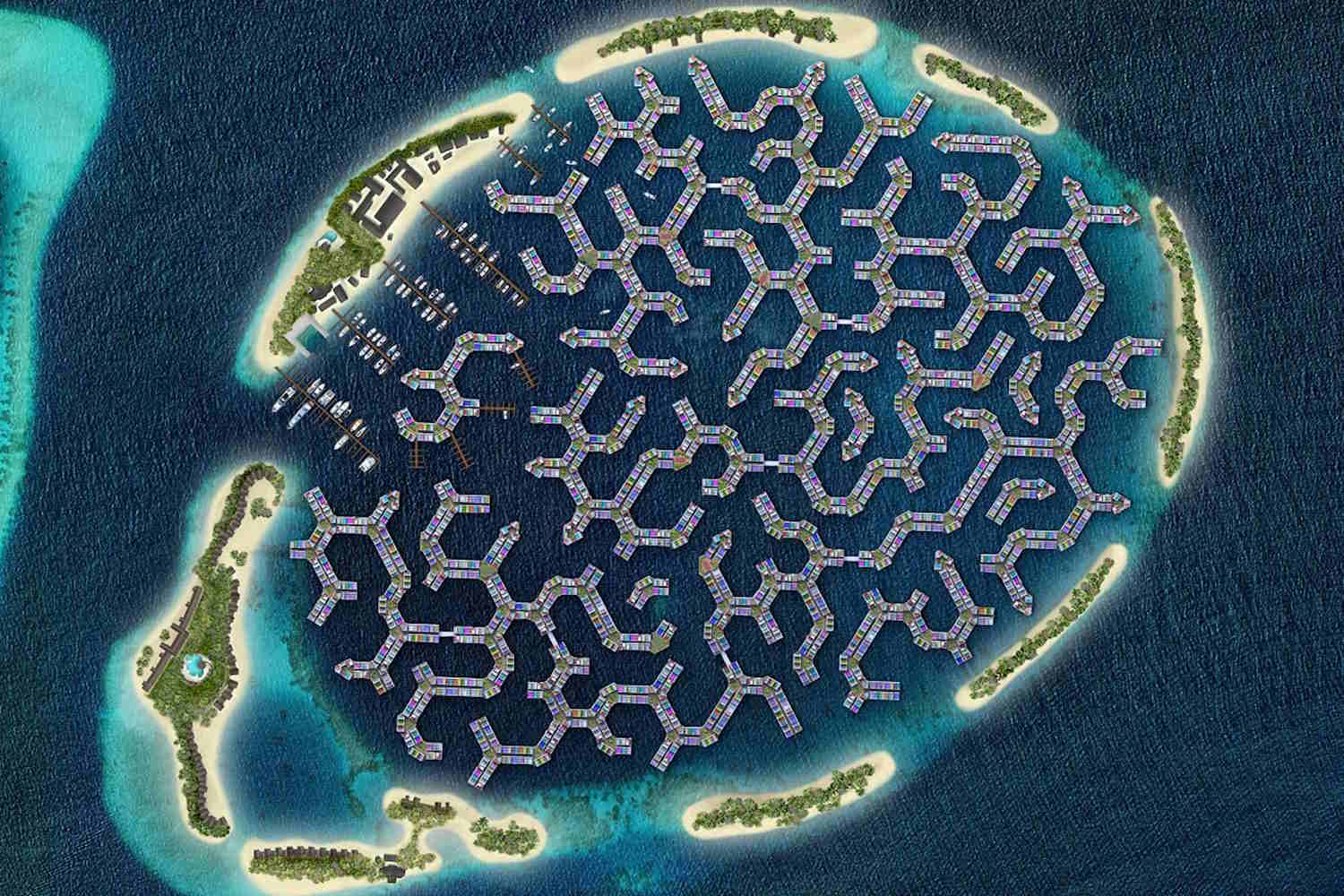
It is called Maldives Floating City and it is an island city built in an atoll near Malè, the capital of the Maldives. Its will be the shape of a coral and its objective will be to respond to the rising seas and the population density of the city.
Developed by Dutch Docklands together with architect Koen Olthuis, it will offer 5,000 luxury housing units, for a total of 20,000/30,000 inhabitants. But is it really worth it?
What is the basic fact is that with 80% of the land less than one meter above sea level, the Maldives is on the front line of the climate crisis. Rising seas, intensifying storms and overcrowding in the capital have created an urgent need for adaptive infrastructure.
What is the Maldives Floating City
MFC is based on an advanced floating architecture inspired by the Netherlands’ centuries-old expertise in water management.
View this post on Instagram
Located just 10 minutes by boat from Malé, it will be a real modular island city that should host up to 30 thousand people and will be built on an atoll near the capital. The idea is to create a floating urban settlement composed of interconnected hexagonal modules, capable of adapting to the sea and growing over time without consuming new land. The arrangement recalls the structure of the brain coral, not only for aesthetic reasons, but also to maximize stability and connections between the various elements.
The city will be made up largely of housing modules: each unit will have a surface area of approximately 100 square metres, to which will be added 40-50 square meters of private greenery. The homes, equipped with two or three bedrooms, open space spaces and a veranda overlooking the sea, are designed as high-level residences. The prices, in fact, reflect this approach: they start from around 250,000 dollars for the simplest solutions, up to over 1.5 million dollars for the largest and most refined units.
Below the water level, each module will extend for approximately two metres, while large surfaces will be dedicated to public spaces such as squares, parks and meeting areas. The modules will be separated by navigable channels, between 4 and 8 meters wide, which will allow the passage of small boats and will contribute to defining an “aquatic” urban network. The choice of the hexagonal shape also allows the modules to be connected without creating voids, increasing the contact surface and the overall stability of the structure.
On the energy front, the Maldives Floating City focuses on the use of solar panels and cooling systems that exploit marine energy and a design oriented towards natural ventilation. All technologies which, according to the programmes, will be applied not only to homes, but also to future modules intended for shops, schools, research centers and even agricultural areas, where hydroponic cultivation is planned.
One of the most innovative aspects concerns the materials. The project involves the use of Biorocksimilar to cement which forms directly in the marine environment thanks to an electrochemical process: a low voltage current favors the deposition of minerals naturally present in the water, such as calcium carbonate. Growth is slow, but the advantage is twofold: the material is non-toxic and encourages colonization by marine organisms, increasing local biodiversity. Alongside this, EPIC floating concrete will also be used, a floating concrete designed specifically for marine ecosystems, stable and designed to integrate with the underwater environment. The overall cost of the project is estimated at around 1 billion dollars for the construction of the first 5,000 housing units and the main infrastructure. The funds will come mainly from public-private partnerships between the Maldivian government and Dutch Docklands.
Will it be worth it? One of the most discussed elements is the absence of preliminary environmental reclamation interventions: a choice that reduces costs, but raises strong doubts about the real impact of the work on marine ecosystems.
The first authorizations were issued between 2019 and 2021, with a concession of approximately 15 hectares of marine surface. It now remains to be seen whether the Maldives Floating City will truly represent a replicable model of climate adaptation or whether it will end up being above all a futuristic and luxury showcase, accessible to a few, in one of the countries most vulnerable to climate change.
