
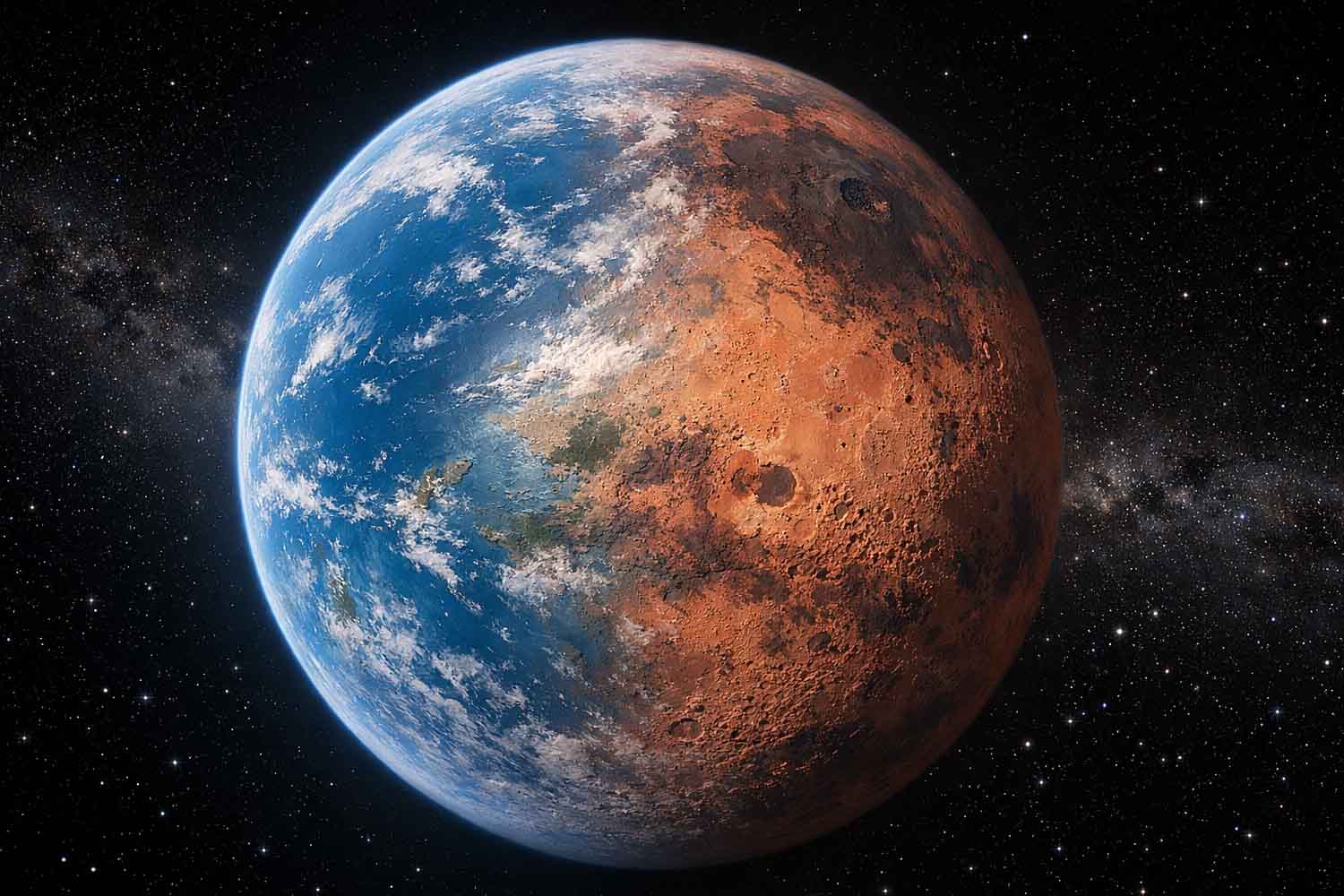
For us it has always been the Red Planet. And it was already so for the ancient Egyptians, who called it “Her Desher”, that is, “the red one”. But Mars, for much of its history, was not like that at all. I had liquid water on the surfaceathicker atmosphere and conditions very different from those we see today.
NASA has just put together the pieces of this radical change. And the answer does not come from the ground, but from much higher up, from the space surrounding Mars.
When Mars was not a desert but a planet with water and a stable climate
Images taken by orbiting probes show water-carved valleys, lake basins and a canyon system over 5,000 kilometers long. Structures of this type do not form quickly and cannot be explained without it flowing water for a long timeunder a sky denser than the current one.
The rovers also confirm this. In Gale Crater, the Curiosity rover analyzed rocks formed at the bottom of an ancient lake: water with a neutral pH, a few salts and the basic chemicals that, on Earth, allow microbial life. In the Jezero crater, however, Perseverance is studying an ancient river delta, one of those places where sediments accumulate and can preserve traces of life for billions of years. That’s why NASA chose that spot to look for answers.
Putting this data together, the picture is clear: Mars has had stable, long-lasting lakesprobably visible from space as blue surfaces, much more similar to Earth than we imagine. At the beginning of its history, Mars had a global magnetic fieldsimilar to the terrestrial one, which protected it from the solar wind. Then something changed. About 4 billion years ago, this shield disappeared.
Since then, the Martian atmosphere has remained directly exposed to charged particles from the Sun. And this is where the mission comes in. MAVEN from NASA, which for years has been studying what happens in the highest layers of the atmosphere of Mars. The data shows that the solar wind hits the atmosphere and, literally, strips away the atomspushing them into space. This process is called sputtering and it was observed in real time, not just reconstructed theoretically.
There is another fundamental detail. The water that reaches the upper layers of the Martian atmosphere breaks down into oxygen and hydrogen. Hydrogen, very light, Easily escapes into spaceespecially during dust storms and at certain times of the year. According to scientists, today this very loss of hydrogen is the main way in which Mars continues to lose its little remaining water. A slow but constant process that has had a profound impact on the evolution of the planet’s climate.
From habitable planet to extreme world
Combining current measurements with models of the young Sun, much more active than today, NASA concludes that Mars has lost a huge part of its original atmosphere.
With less atmosphere, the pressure dropped. And without enough pressure, liquid water cannot stay on the surface. The result is the Mars we know: a cold planet, with a very thin atmosphere made almost exclusively of carbon dioxide, extreme temperatures and radiation that reaches the ground without obstacles.
Today we go from around 20 degrees on the hottest days to temperatures below minus 120 degrees in the polar areas. Even at the equator, you only need to rise a few meters for the cold to increase drastically.
Mars is not just a “dead” planet. It’s a warning. It demonstrates how much a climate can change if magnetic protection, atmosphere and internal activity are lost. Understanding why Mars turned red also helps to evaluate whether distant planets, the ones we now call “potentially habitable”, can really remain so over time.
And remember one simple thing: even a planet that seems stable may not be stable at all.
