
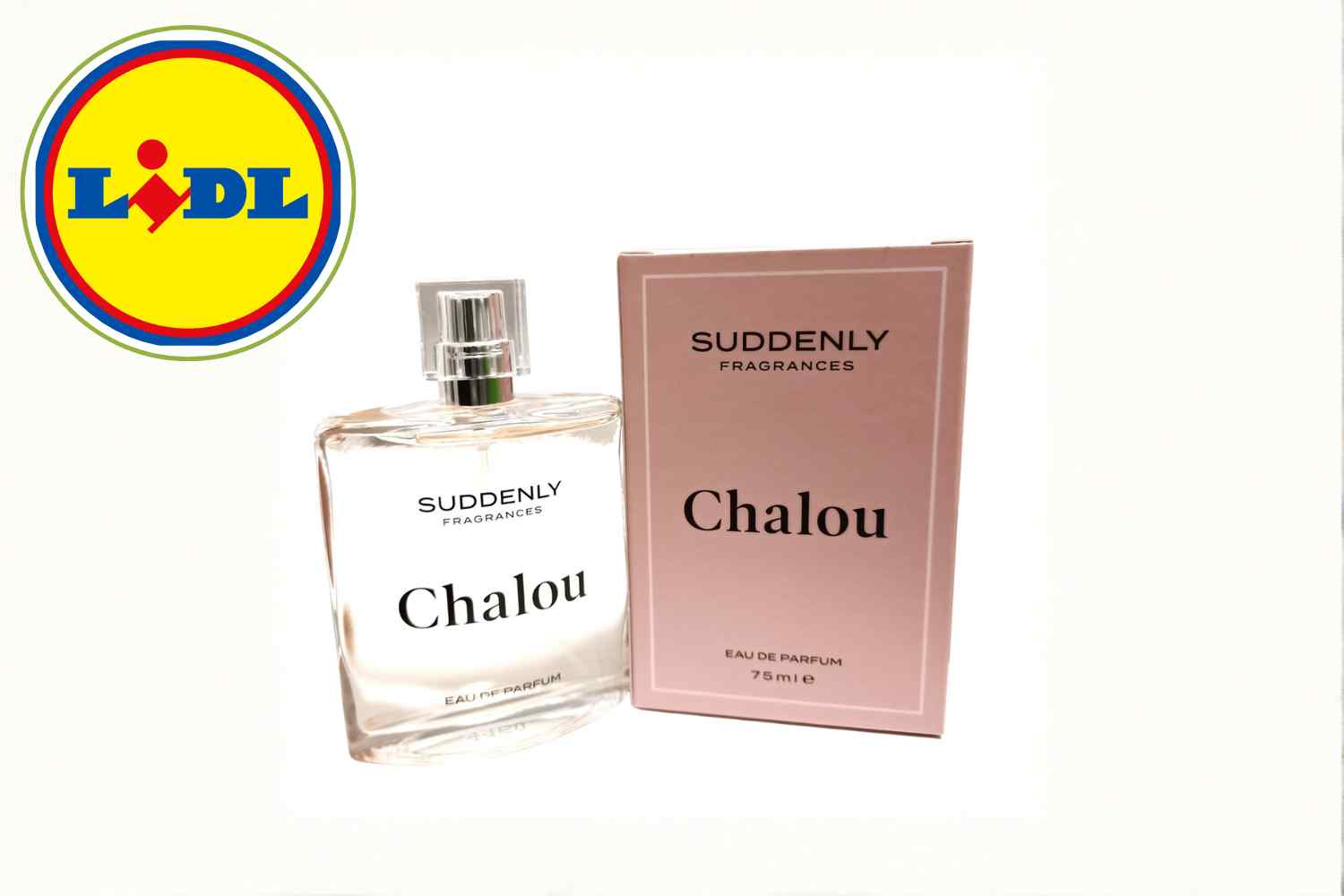
The Chalou perfume, available at Lidl, is an economical alternative inspired by the famous Chloé Eau de Parfum. An imitation, of course, but at a truly negligible price that defies any market logic.
The democratization of olfactory luxury passes through the discount store
The universe of niche perfumery has always embodied a certain elitism: refined compositions, selected raw materials, refined packaging. But above all, prices that rarely fall below the fifty euro threshold for standard formats. Yet, in recent years, European discounters have been able to undermine this paradigm with a strategy as simple as it is effective: offering fragrances inspired by the great classes of perfumery at an infinitesimal fraction of the original cost.
Lidl, in particular, has developed a real commercial philosophy around the so-called “equivalent perfumes”, transforming what might seem like a simple marketing gimmick into a customary phenomenon capable of intercepting the needs of an increasingly wider range of consumers. It’s not just about economic convenience, but about a redefinition of the very concept of accessibility to luxury.
Dupe: what’s behind the equivalent perfumes
The term “dupe” – a contraction of the English “duplicate” – indicates products designed to replicate, with varying degrees of fidelity, the sensorial characteristics of premium items. In the field of perfumery, this translates into the creation of fragrances that share the olfactory structure, aroma pyramid and overall impression of iconic perfumes, while using alternative formulations and less expensive ingredients.
It is essential to understand that these are not counterfeits: dupes operate in a gray but perfectly legal area, avoiding reproducing trademarks, logos or protected names, instead limiting themselves to offering a similar olfactory experience. The substantial difference lies in the quality and concentration of the raw materials used, in the complexity of the composition and, inevitably, in the persistence of the fragrance on the skin.
While a high-end perfume may contain rare and expensive natural essences, extracted using traditional methodologies that preserve their molecular complexity, an equivalent relies predominantly on synthetic reconstructions of those same notes. The result? An initial impression that is often convincing, but a lasting and olfactory evolution that is generally more limited over time.
Chalou: Lidl’s interpretation of the Chloé icon
Among the most interesting proposals in Lidl’s perfumery line, Chalou stands out, a fragrance openly inspired by Chloé Eau de Parfum, one of the pillars of contemporary women’s perfumery. Launched in 2008, the perfume from the French maison has managed to conquer an entire generation thanks to its romantic and feminine identity, built around a sumptuous floral composition.
Chalou proposes a reinterpretation which, despite the inevitable simplifications, tries to capture the essence of that successful formula. The olfactory pyramid opens with fresh and sparkling notes of litchi and peony, continues with a heart dominated by Damask rose and magnolia, to end with a warm base of ambergris, cedar and honey. It is a structure that faithfully follows the architecture of the original perfume, focusing on that dusty-floral character that has made Chloé a global bestseller.
The 50 ml bottle has a price that fluctuates around 4.99 euros, a figure that represents approximately 5% of the cost of the original perfume. An economic gap of this magnitude inevitably raises questions about the actual comparability of the two products, but also opens up interesting reflections on the relationship between perception of value and intrinsic quality in the perfumery sector.
The question of persistence: the Achilles’ heel of equivalent perfumes
If there’s one aspect where dupes show their most obvious limitations, it’s tightness. A high-end perfume is formulated to accompany the wearer for many hours, evolving through the different notes of its olfactory pyramid. Persistence depends on the concentration of perfumed essences (in Eau de Parfum generally between 15% and 20%), the quality of the fixatives used and the molecular complexity of the composition.
Equivalent perfumes, for economic reasons, use lower concentrations and less performing fixatives. The result is a fragrance that can be convincing in the first few hours of application, but which tends to fade more quickly, requiring frequent touch-ups. Some users report that Chalou maintains a perceptible presence for about three to four hours, compared to the eight to ten hours typical of the Chloé original.
This does not necessarily mean that the product is inadequate: it depends on expectations and the intended use of it. For those looking for a fragrance to wear occasionally, or for those who appreciate the ability to change scents throughout the day, this feature may not represent a problem. For those who consider perfume a constant element of identity, the need for frequent reapplications could be limiting.
When and where to find Chalou: the limited availability strategy
Unlike branded perfumes, which enjoy widespread and continuous distribution, discount dupes follow different commercial logics. Chalou, like other products in the Lidl perfumery line, is not permanently present on the shelves, but is offered through temporary promotional campaigns, often linked to specific periods of the year.
This strategy of artificial scarcity generates an urgency effect in purchasing: consumers know that when the product appears in the store, it may not be available for a long time. It is a mechanism that encourages impulse purchases and creates a certain buzz around launches, transforming shopping at the discount store into a sort of olfactory treasure hunt.
The periods of greatest availability tend to coincide with the holiday season, Valentine’s Day and early spring – times when demand for perfume naturally peaks. For those interested in trying Chalou, it is advisable to monitor Lidl promotional flyers or visit the stores during the indicated periods, keeping in mind that quantities are generally limited and stocks can run out quickly.
Beyond strictly olfactory considerations, the success of dupes raises interesting questions on a sociological and cultural level. We live in an era characterized by a widespread aspiration for luxury, fueled by social media and a visual culture that constantly celebrates an opulent lifestyle. At the same time, the economic conditions of large segments of the population make many of these status symbols inaccessible.
Equivalent perfumes fit into this space of tension, offering a way of access – however partial – to the symbolic universe of luxury. It’s not just about replicating a smell, but about appropriating, at least in part, the cultural capital associated with certain brands. Wearing a perfume that recalls Chloé means, for many, participating in an image of elegance and refinement, regardless of whether the product is the original or an equivalent.
This phenomenon can be read as a form of democratization of luxury, but also as an illusion that perpetuates dynamics of desire without ever fully satisfying them. The dupe, by definition, implicitly admits the existence of a superior original, thus keeping intact the hierarchy of value that it is supposed to subvert.
For whom Chalou really works
In the end, the relevant question is not whether Chalou is identical to Chloé – evidently it is not – but whether it represents a valid solution for certain needs. The answer depends heavily on individual expectations and the intended use of the perfume.
For those who want a floral and feminine perfume to wear occasionally, without investing significant sums, Chalou can be a more than reasonable option. For those looking for a fragrance to use daily as a personal olfactory signature, with a long-lasting hold and a complex evolution, investing in a higher range perfume will probably be more satisfying in the long run.
Ultimately, equivalent perfumes like Chalou do not replace the originals, but offer an alternative for those with different priorities: low-risk experimentation, variety in their fragrance collection, or simply the possibility of enjoying a pleasant scent without placing an excessive burden on the household budget. This is no small thing, in a market that too often seems to reserve olfactory beauty for those who can afford to pay premium prices.
