
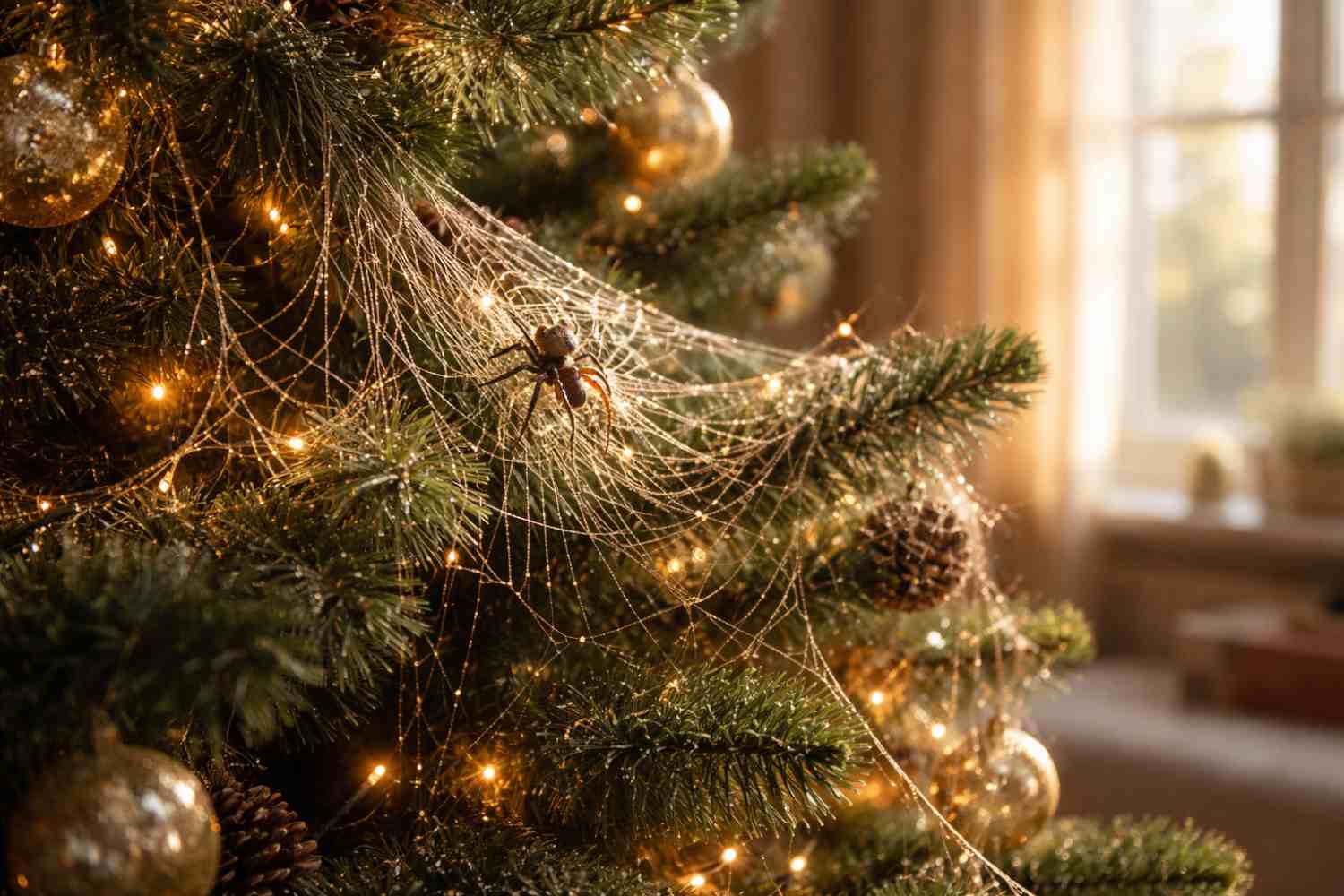
In our latitudes spiders are rather feared and it is no coincidence that they are associated at most with Halloween, certainly not with Christmas! But the world is beautiful because it is varied and in some Eastern European countries, such as Ukraine, it is even believed that they bring good luck. This is why it is customary to hang spider-shaped decorations on Christmas trees.
Cobwebs and Christmas don’t seem to have much in common. Yet a legend, deeply rooted in Ukrainian tradition, unites them all together — and also explains why silver threads have become a classic of Christmas decorations.
The Legend of the Golden Spiderweb
Some popular legends, of which there are numerous versions, explain why spiders are considered lucky. One of them tells the story of a poor widow who did not have enough money to buy glass lights and ornaments for the Christmas tree.
The fairy tale tells of a widow and her children who lived in a cold, drafty hut. They were good people but poverty stricken. One summer day, a pine cone fell to the earthen floor of their cabin and took root. The children enthusiastically cared for it, hoping that it would grow big enough to become a Christmas tree by winter.
The tree grew, but when Christmas Eve arrived, the family was heartbroken. To make her children happy, the widow tried to decorate it with what she had at home, but they couldn’t afford even a single ornament to decorate it. They went to bed with heavy hearts, leaving the tree bare.
But the house spiders, who had been watching from the corners, heard the children’s sobs. Eager to help, they climbed the tree and wove intricate gray webs all over the branches.
When the family woke up on Christmas morning, they opened the windows. In many older versions of the story, it is not Santa Claus, but the Christkind (Baby Jesus) who witnesses all this. Seeing the love the spiders had put into their work, he touched the webs. Upon contact, the gray silk transformed into shimmering gold and silver. The family was filled with joy and never lived in poverty again.
A further version of the legend tells the story of a mother spider and a mother farmer: the latter, being generous in spirit, allowed the mother spider to live among the branches of the Christmas tree. One fine day mother spider decided to repay her by decorating it with splendid sparkling cobwebs.
The history of tinsel
This folklore provides the origin story of one of our most common decorations: silver thread (tinsel).
The practice of draping trees with silver threads is a direct reference to those legendary metallic spider webs. In fact, this is rooted in history: the very first tinsel was invented in Germany in the early 1600s and was made of real ground silver. It was designed to reflect candlelight off the tree, mimicking the sparkle of an ice-covered spider’s web.
In Germany, these threads are still known as Lametta. Over time, real silver oxidized and turned black — just like a dusty spider web — eventually leading to the aluminum and plastic tinsel we use today.
Pavuchky: Ukrainian lucky spiders
But in Ukraine, the connection goes beyond simple silver wires. If you visited a traditional Ukrainian home during the holidays, you might find pavuchky (which literally means “little spiders”). While modern versions are often made of beads and wire, traditional pavuchky were large geometric pieces of furniture made of rye straw, distinct from the Christmas tree. Suspended from the ceiling, these lightweight structures rotated gently with the air currents of the house.
They served a spiritual purpose: the “cobwebs” of the straw furniture were believed to capture negative energy and keep evil spirits away. Furthermore, since spiders are often associated with the interconnectedness of family lines, these pieces of furniture were seen as resting places for the spirits of ancestors who visited the family during holidays.
If you like this legend, you can probably find decorations or simply use tinsel that reminds you of Christmas spiders. But you can also create your own. Making your own Christmas spider ornaments can be a delightful family activity during the holidays. Using wire, beads and other craft materials, families can come together on a chilly Christmas Eve to create their own “pavuchky” (or Christmas Spiders), infusing them with personal meaning and continuing the tradition in their homes.
The Christmas Spider has also found its way into literature and media, capturing the hearts of audiences with its tale of hope and transformation. Children’s books and animated films often feature the Christmas spider, spreading his magical version of a holiday story to new generations.
In the intricate web of life, the Christmas spider teaches us to find joy in small wonders and to believe in the magic of the season. So, the next time you see a spider or cobweb, perhaps during your holiday preparations, take a moment to appreciate these extraordinary creatures and the rich folklore they have inspired.
SOURCES: Southern Living/Treehugger
