
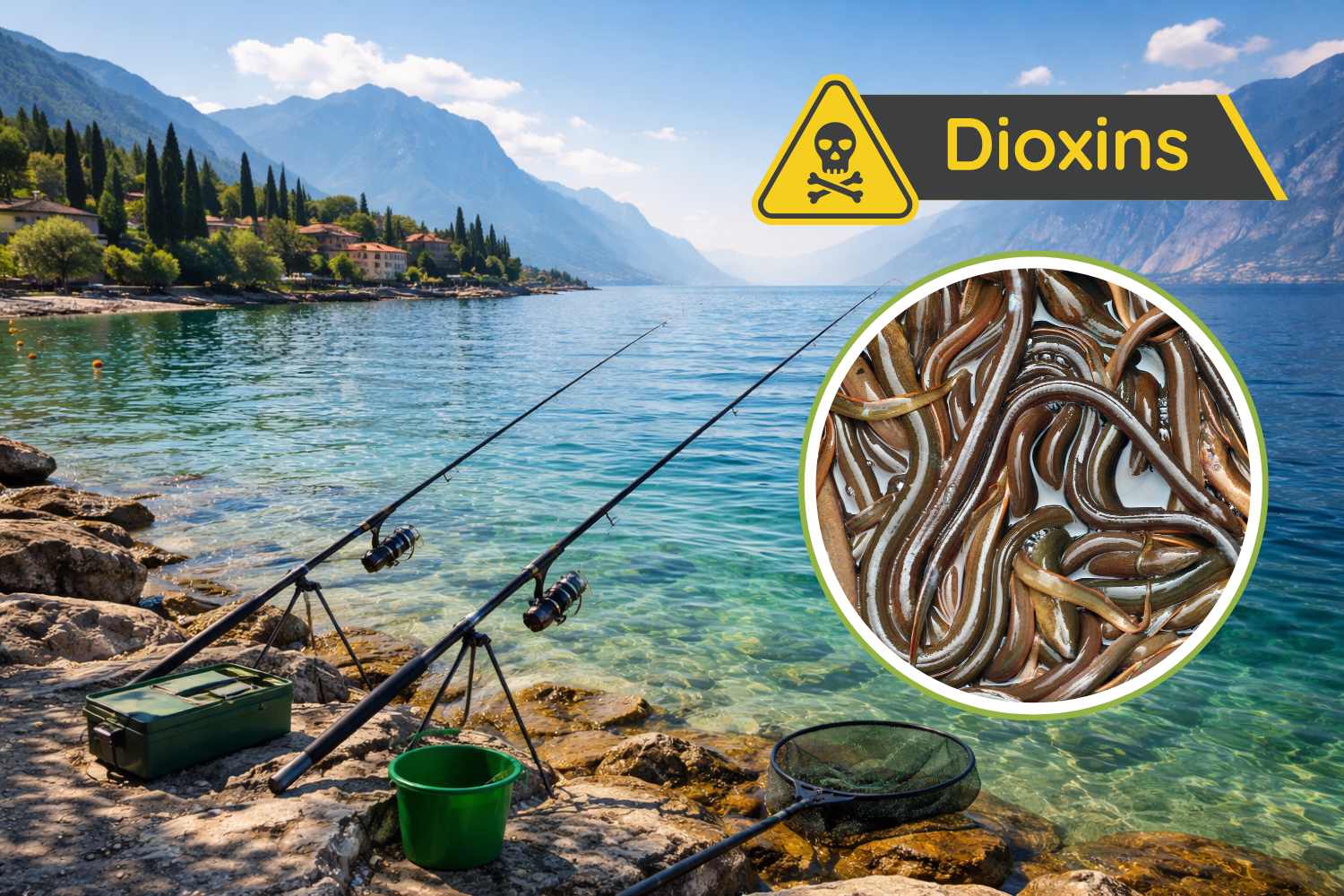
Eels, protagonists on our tables during the Christmas holidays and New Year’s Eve dinner, could hide an invisible but very real danger. A scientific study published a few months ago in the magazine Toxics raises the alarm: the eels of Lake Garda have worrying levels of dioxins and PCBs, toxic substances that can accumulate in our bodies with serious consequences for health.
The research, conducted by a team of experts from the Istituto Zooprofilattico Sperimentale delle Venezie and other scientific bodies, analyzed 90 adult eels caught in 2022 and the results are alarming: 28 out of 90 samples exceeded the European regulatory limit for dioxins and dioxin-like PCBs, with concentrations ranging from 1.70 to 77.1 pg/g. The most serious case recorded values more than 7 times higher than the limits permitted by law.
But it doesn’t end there: even non-dioxin-like PCBs have reached peaks of 1620 ng/g, more than 5 times above the safety threshold of 300 ng/g established by the European Union.
What is dioxin and why is it so dangerous
Dioxins and PCBs (polychlorinated biphenyls) are persistent organic pollutants, real environmental poisons that do not degrade easily. These compounds arise as by-products of industrial processes, waste incineration and manufacturing activities. Their use has been banned for decades, but they continue to persist in the environment, accumulating in the fatty tissues of animals.
Chronic exposure to these substances has been linked to immunotoxicity, endocrine disruption, and increased cancer risk. According to the European Food Safety Authority (EFSA), even the occasional consumption of highly contaminated eels can lead to exposure levels above the safety threshold, especially for vulnerable categories such as children and pregnant women.
Why do eels accumulate so many contaminants? European eels are particularly vulnerable to these pollutants for several reasons. These are fish rich in lipids (fats) – as much as 25% of their weight is made up of fat – and dioxins and PCBs, being lipophilic substances, accumulate preferentially in the adipose tissues. The study confirmed this dynamic: eels with higher fat content had higher concentrations of contaminants.
Furthermore, eels are bottom predators and very long-lived, remaining in continental waters for 6-20 years before migrating to the sea. This long period of residence in potentially contaminated water amplifies the bioaccumulation of toxic substances in their organism. It is no coincidence that they are among the few fish that manage to survive even in highly polluted waters, such as those of the mouth of the Sarno river, one of the most contaminated waterways in Europe.
Lake Garda, an emblematic case
Lake Garda, the largest Italian lake located in one of the most industrialized regions of the country, represents an emblematic case of persistent pollution. Eel fishing has been banned since 2011 due to the high levels of contaminants detected in previous monitoring campaigns.
Unfortunately, the comparison with the 2016 data shows a worsening of the situation: if six years ago 18 out of 90 samples were found to be non-compliant, in 2022 the number has risen to 28 out of 90, a sign that the problem has not been solved and indeed persists over time.
It is important to clarify that the eels of Lake Garda, being prohibited for fishing, do not reach our tables. However, this study raises a disturbing question: if even in a large lake in northern Italy the dioxin levels are so high, what happens in the other Italian fishing areas from which the eels we actually consume during the holidays come from?
The reasons (already known) for saying no to eel
Eel has always been a traditional dish of the Christmas holidays in many Italian regions, from the coastal regions to Lombardy, from Veneto to Emilia-Romagna, up to the Central-South. The Christmas Eve and New Year’s Eve dinners often feature marinated, grilled or fried eels, often kept alive at home until cooked.
However, in light of these data on dioxin contamination, consuming eels represents a concrete risk for public health, which is added to the other reasons – ethical, environmental and ecological – which have long led us to advise against this dish.
As we have repeatedly underlined, there were already several valid reasons for giving up eel:
There are numerous safer, sustainable and ethical alternatives for the holiday menu: certified fish from sustainable fishing, creative vegetable recipes that reinterpret traditional flavours, or simply the choice to diversify the menu by favoring local and seasonal products.
