
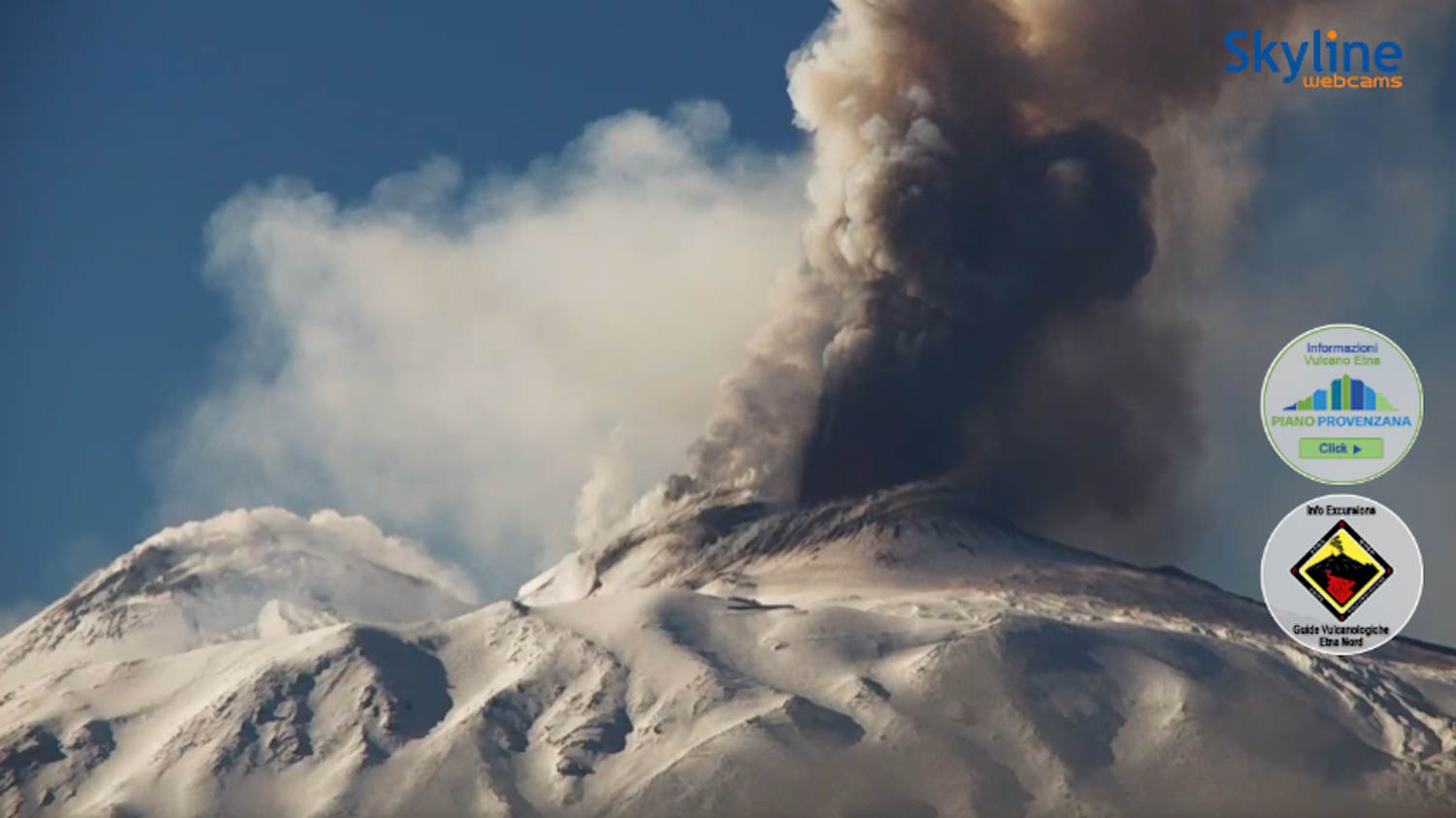
An (almost) end-of-year show offered by Etna: the volcano, after days of medium intensity activity, today 27 December “exploded” with lava fountains which this morning reached around 150-200 meters in height. As confirmed by theEtna Observatory of theNational Institute of Geophysics and Volcanology (INGV), the emission of ash also continues.
Climate AwarenessDec 26_2⃣
Kelvin-Helmholtz instability near Forchheim, Bavaria, #Germany
Eruption has begun at Mt #Etna in Bocca Nuova and Northeast craters
— Irene (@irene_makarenko) December 27, 2025
The IGNV, Etna Observatory, communicates that in the last 24 hours the eruptive activity at the summit craters of Etna has further intensified – the institute writes this morning 27 December – Strombolian activity has continued at the North-East Crater, with almost continuous explosions
In reality the intensification had probably already occurred during the night hours, but visibility was severely limited due to dense cloud cover, but, since the clouds were constantly illuminated by strong flashes, the activity of the volcano was evident.
Magnificent scenes on Etna this morning! #Etna #volcano https://t.co/ShIX0iKVgy pic.twitter.com/T18Q8b2ANS
— Ellie Weaver (@Elliebelle666) December 27, 2025
Then, around 10.00 Italian time, in partially improved visibility conditions, a rapid increase in the intensity of the activity was observed, with lava fountains approximately 150-200 meters high and continuous emission of ash. At approximately 10:50, however, the activity of the North-East Crater decreased again with sporadic ash emissions.
Yesterday 26 December, Stromboli (which is still on average active) and the European satellite reached a peak Sentinel-5P of ESA had in fact detected through TROPOMI (TROPOspheric Monitoring Instrument) a significant increase in sulfur dioxide coming from the volcano area.
On 2025-12-26 #TROPOMI has detected an enhanced SO2 signal of 9.18DU at a distance of 42.4km to #Stromboli or #Etna. Other nearby sources: #Etna. #DLR_inpuls @tropomi #S5p #Sentinel5p @DLR_en @BIRA_IASB @ESA_EO #SO2LH pic.twitter.com/wiD6Gw6c9Z
— TROPOMI SO2 (@TROPOMI_SO2) December 26, 2025
The IGNV, Etna Observatory, reports that a lava overflow is underway. Since the morning, in the images of the surveillance cameras, a small lava flow has been visible, which is pouring from the northern crater area onto the upper part of the Sciara del Fuoco. The length of this flow is a few tens of meters and has remained stationary for several hours. In the meantime, ordinary Strombolian activity is continuing from various vents in the main crater areas
The situation is under constant monitoring.
Sources: INGV 27 December / INGV 26 December / Etna North Live cam / Webcam Etna / X / TROPOMI SO2/X
