
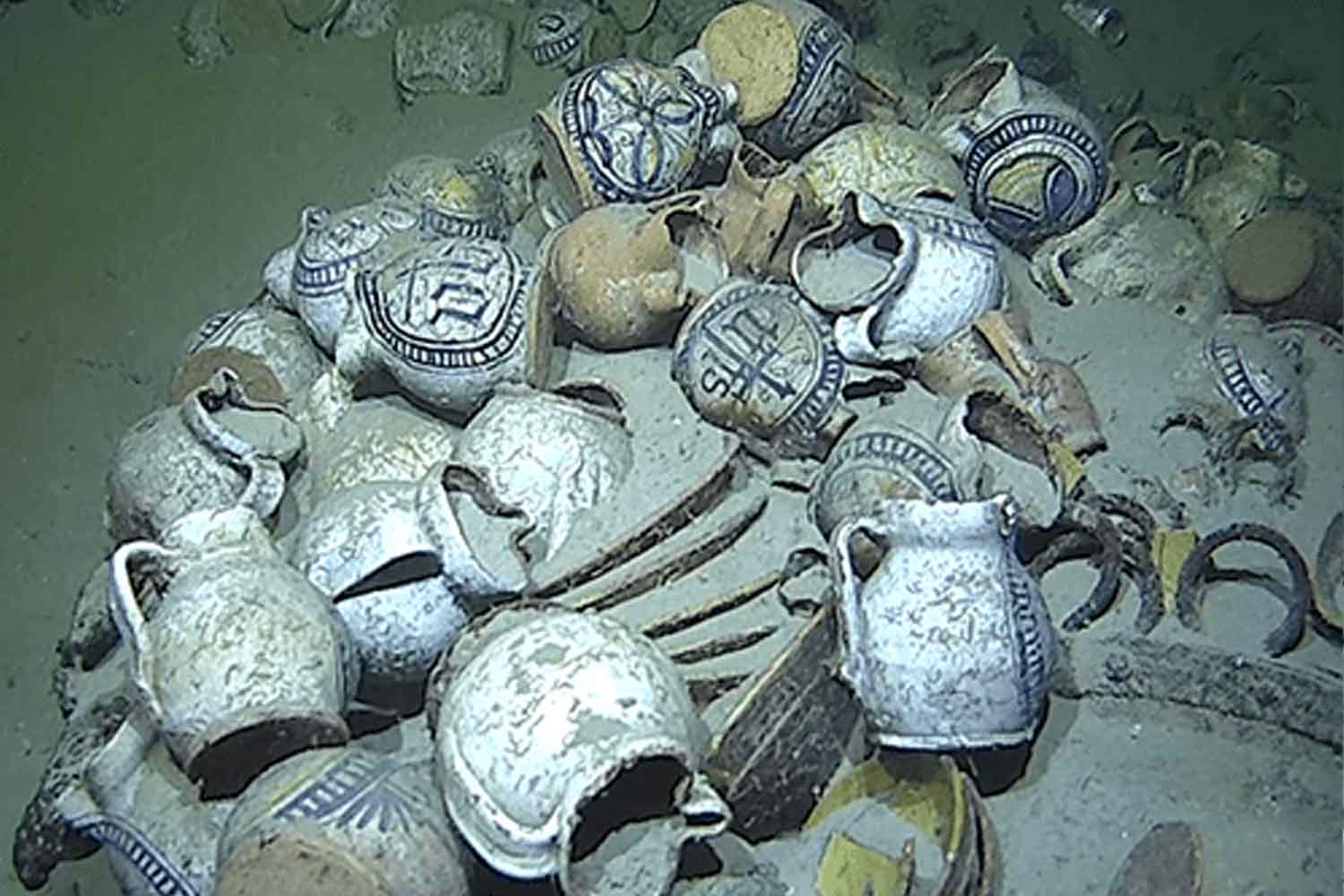
Off the coast of Saint-Tropezin Francethe Mediterranean seabed has yielded something that looks more like a time capsule than a simple wreck. A merchant ship dating back to the Renaissance, approximately thirty meters long, lies on the seabed in exceptional condition, at a depth never before reached for an archaeological site of this type in French waters. The localization took place during a Navy technical mission, in collaboration with the DRASSMthe French Department of Underwater Archaeology.
The depth is such as to place this discovery among the most extreme in the Mediterranean, immediately after the wreck of the USS Samuel B. Roberts. Here, however, we are not talking about war, but about trade, mercantile routes and daily life in the 16th century.
What protected the freighter was not human intervention, but the environment itself. At those depths the sea is cold, poor in oxygen and crossed by very weak currents. A combination that drastically slowed down the degradation processes and kept away the molluscs that normally devour the wood. The result is a surprisingly intact hull, with the hold still legible.
Underwater robots, ROVs, made it possible to explore the site without touching it. High definition cameras, sensors and photogrammetry systems have reconstructed a three-dimensional digital model of the wreck, destined to become a central tool for research and dissemination. It is an archeology that does not dig, but observes, measures and conserves, leaving everything where it is as much as possible.
Ceramics, iron and daily life: what the freighter’s cargo tells us
About two hundred ceramic containers were identified inside the ship, including amphorae and jugs decorated with floral motifs and religious symbols. Alongside these, iron bars, kitchen utensils and a ship’s cannon tell of a trade crossing that linked Italy, Provence and Catalonia. Not exceptional goods, but everyday objects and materials intended for everyday life, those that more than others help to understand how the Mediterranean economy of the Renaissance really worked.
This is what makes the site so valuable: not a spectacular treasure, but a coherent snapshot of a complex trading system, observed in its original context.
The disturbing detail: plastic and nets next to sixteenth-century finds
However, there is one element that is out of place, and quite a bit. Even at over 2,500 meters deep, among Renaissance ceramics and ancient wood, researchers found contemporary waste. Bottles, fishing nets, modern objects ended up in the depths and remained trapped next to a wreck from five centuries ago.
The contrast is stark and hard to ignore. On the one hand a historical heritage that has remained intact for hundreds of years thanks to the isolation of the depths, on the other the recent traces of human activity, which have arrived everywhere, even where the sea still seemed inviolate. It’s a powerful reminder that the oceans are not worlds separate from us, but fragile archives that we are filling, often without realizing it.
An underwater museum that also speaks to the present
The site, provisionally called Camarat 4, will remain largely on the seabed. The digital data collected will allow scholars to work remotely, share information and compare this wreck with other international contexts, reducing the risk of looting and damage.
For archaeology, it is a change of pace, but for those who look at the sea with environmental attention, it is also an opportunity to reflect. The Mediterranean is not only a natural space to be protected, but a place of memory, where past and present coexist, sometimes in an uncomfortable way. And perhaps from here, from a ship that has remained intact for five centuries, comes one of the clearest images of how urgent it is to rethink our relationship with the abyss.
