
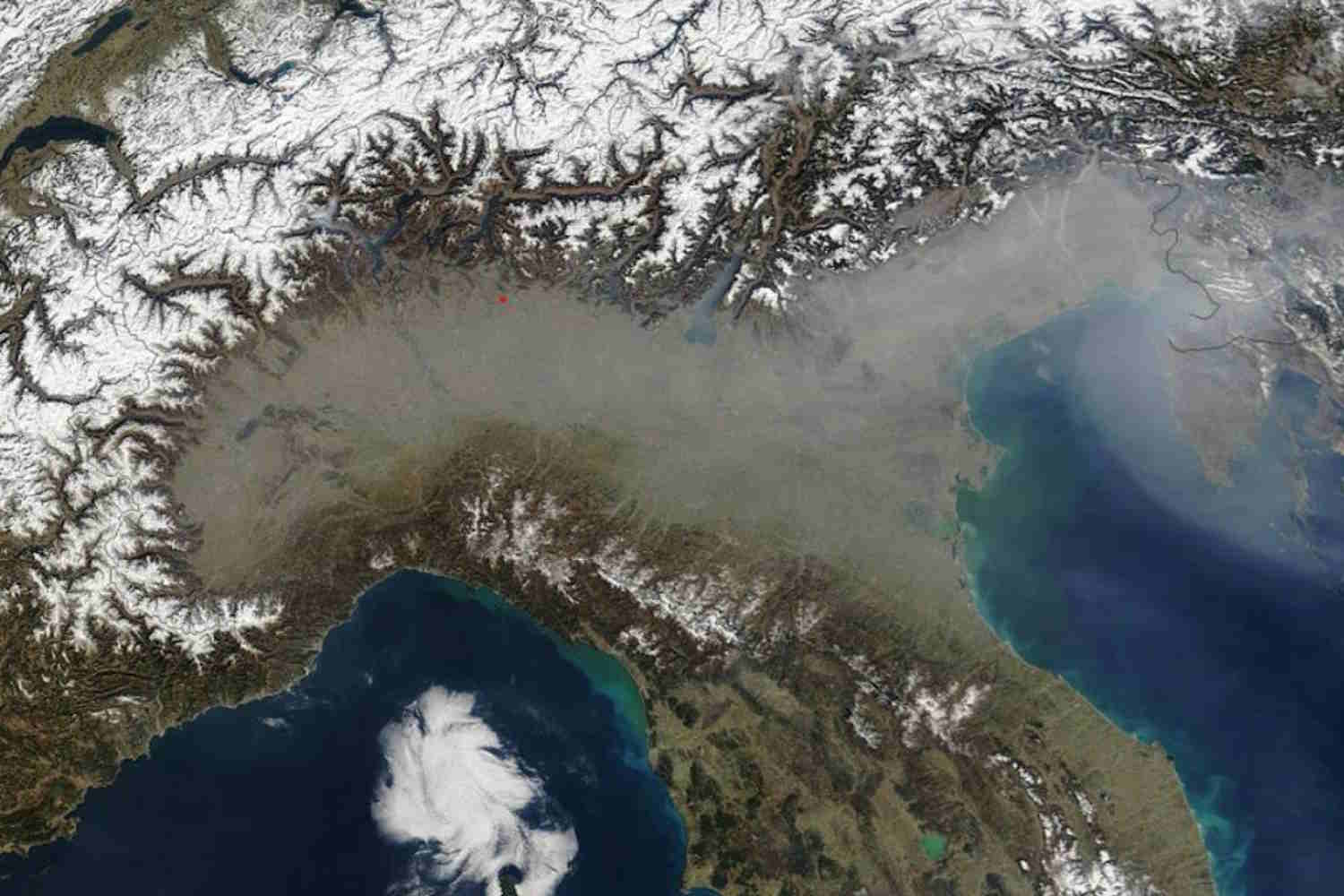
For years the European Union has been criticizing Italy for its terrible quality data in the entire Po Valley area. And not only that: our country already has two sentences passed by the EU Court of Justice for smog in the Po basin and a new formal notice ready to arrive.
Yet, faced with this scenario, the Meloni Government envisages in the Budget Law a 75% cut in structural funds intended for investments to improve air quality, at a time when, among other things, the first concrete results are starting to be seen.
In short, from 2026 to 2028, the funding intended for the regions of the Po Valley would be almost eliminated, with a possible increase postponed starting from 2029. A decision that risks seriously compromising regional plans against smog and further distancing Italy from compliance with European limits, precisely in an area that has historically been among the most polluted on the continent.
Those little improvements that will fall on deaf ears
In recent years, despite unfavorable structural conditions such as the high population density and the closed geographical conformation, something had started to move. According to Legambiente data, for example, for Veneto 2025 could end without exceeding the limit of 35 days of PM10 exceedances in most control units: a result that has not been seen for twenty years. Even in Lombardy the trend shows signs of improvement, albeit fragile, while in Piedmont and Emilia-Romagna the measures on mobility, agriculture and energy efficiency are slowly bearing fruit.
It is precisely now, however, that the Government chooses to take a step back, leaving the areas most exposed to air pollution without resources. A short-sighted move which not only exposes Italy to the risk of new European infringement procedures and possible sanctions, but which above all overshadows the protection of public health.
The numbers speak clearly. According to the most recent data from the European Environment Agency, in 2023 PM2.5 caused approximately 238 thousand premature deaths in Europe, of which 43 thousand in Italy alone, largely concentrated in the Po Valley. A negative record that continues to weigh like a boulder.
For the environmental association, reducing funds at this stage is equivalent to taking away oxygen from territories that were finally reversing course. Without adequate resources, many planned actions risk being scaled down or cancelled, with serious consequences both for people’s health and for Italy’s alignment with European standards.
The picture becomes even more worrying if placed in the European context, where Italy is among the countries pushing to slow down the stop on gas boilers and the implementation of the “Green Houses” directive, without however presenting a credible implementation plan. A reversal that goes in the opposite direction compared to scientific indications and international commitments on the climate.
“Leaving the health of the citizens of the Po basin at risk is a huge mistake and cutting resources right now, when the first results show that investing in air quality works and that we need to activate more incisive measures in the transport, agriculture and domestic heating sectors, is an irresponsible act that puts the health of 25 million citizens of the Po basin at risk. The country needs continuous, certain and far-sighted investments. We are ready, together with the regional committees, to make our voice heard forcefully. Air quality that does not comply with regulatory limits is a health problem even before an environmental one“, concludes Legambiente, which asks Parliament to immediately restore the funds provided for by the MASE directorial decree of July 2024 and not to abandon one of the most crucial fronts for the health and competitiveness of the country, inviting the Government to open a serious discussion with the Regions and to consider air quality as a national priority that cannot be postponed, not as an expense item to be sacrificed, which only with continuous policies, certain resources and effective coordination between the State, Regions and Municipalities will it be possible to guarantee citizens an environment healthier and more livable cities.
