
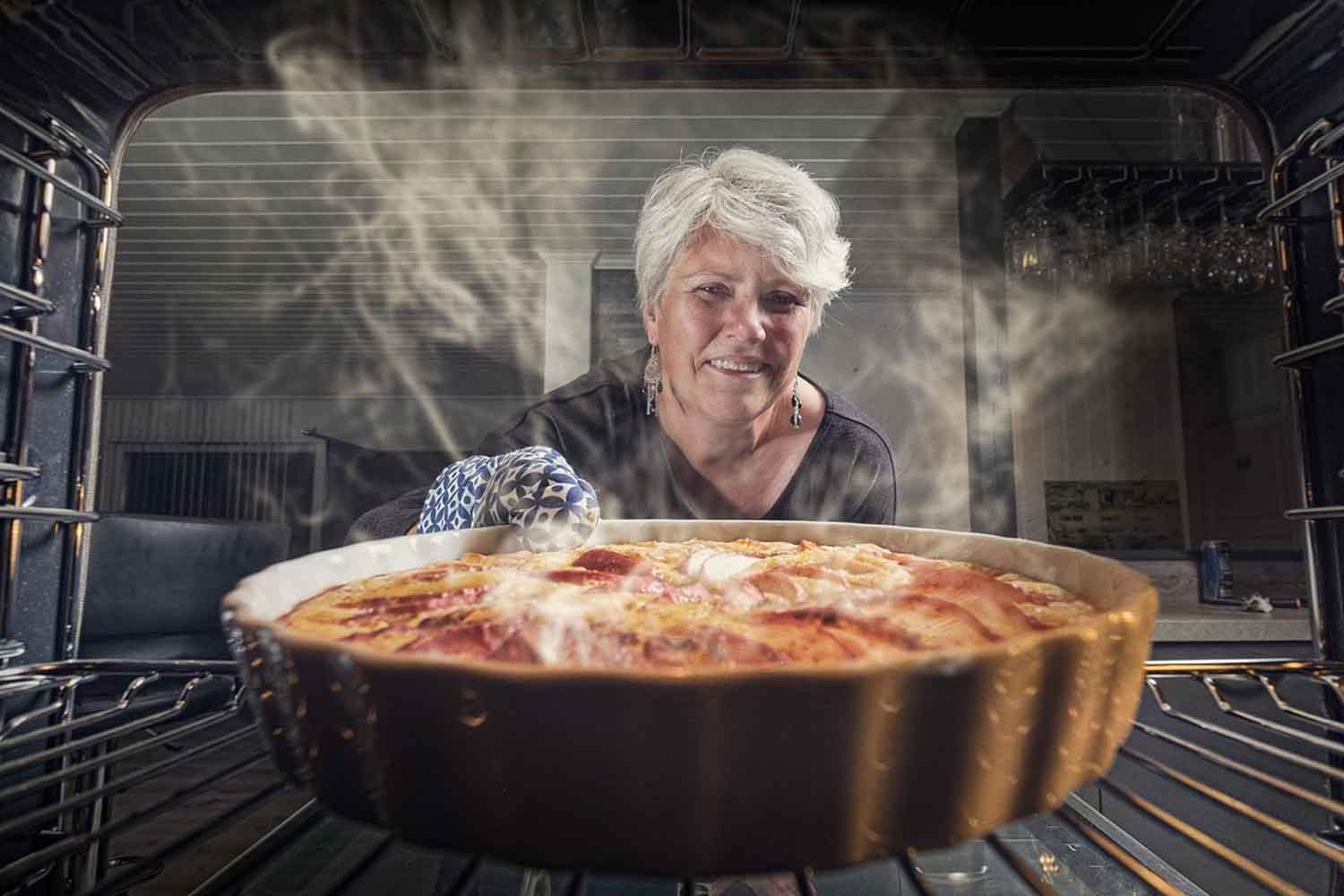
The doubt arises every winter: does cooking heat the house? Anyone who lives in a small apartment or a small kitchen notices it immediately. As the oven drops in temperature, the room warms up a few degrees, just enough to make the environment more pleasant. It is an ephemeral warmth, sure, but immediate. The temptation to “exploit” it is natural, also because the oven really releases heat into the environment, especially if it is electric.
Opening it after cooking accelerates this dispersion, even if it does not transform the kitchen into an alternative heating source. Rather, it returns a fragment of the energy already consumed, a gesture that only makes sense if it remains prudent and aware. This is where a broader look comes into play on what we could do not only today, while checking the baking of a cake, but tomorrow, when the kitchen will be a space designed not to waste even a degree. The point is to understand when it is best to do it, how to do it safely and what we can learn from the most advanced technologies dedicated to domestic energy recovery.
First of all, it is important to remember that the natural dispersion of heat is normal: as the oven moves from the active phase to cooling, the temperature of the room increases to a variable extent, with more evident effects in small or closed kitchens. Opening the door slightly after finishing cooking can amplify this effect, but should not be interpreted as a true reheating method. Rather, it’s a smart way of using what’s already there, reducing waste.
How to use the residual heat of the oven
Making use of waste heat is simple, as long as it is clear that it does not replace a heating system. Turning off the oven a few minutes before the end of cooking, for example, allows you to complete the preparation using only the accumulated energy. Likewise, leaving the oven open – only after turning it off – facilitates the diffusion of hot air into the room.
The situation changes completely with gas ovens: in that case you should never use them to heat the environment. Burning can release carbon monoxide, an invisible and dangerous substance. Consequently, the residual heat can only be used with the oven turned off and closed, without attempting to open it for heating purposes.
And it is precisely by observing these limits that it becomes interesting to look at what is happening in the world of research, where attention to domestic energy recovery is changing the way we think about cooking.
A scientific approach
Looking beyond everyday use, a recent scientific study offers a surprising perspective. “Energy saving starts in the kitchen” tells something that overturns our idea of the kitchen: no longer a set of appliances that produce heat and disperse it, but a system capable of recovering and reusing it. The SMACK project, described by the researchers, is a modular kitchen connected to a heat pump that captures the energy of the various appliances and recirculates it, from preheating the oven to the production of hot water and drying the dishes.
The research suggests savings close to 50% and highlights a principle that, as the GreenMe editorial team, interests us more than any technical data: the future of sustainability does not require impossible sacrifices, but intelligent environments that work for us, recover what we would otherwise lose and transform domestic energy into something more balanced. Even those who ask themselves whether cooking warms the house find a different answer here: it is not the open oven that makes the difference, but the ability to design a house that does not let what it produces escape.
In everyday life, however, all this translates into simple choices. Residual heat remains a moderate ally, useful only if managed with prudence. It does not replace a radiator, it is not a shortcut, but it can make the kitchen more welcoming while inviting us to imagine, with a little curiosity, a kitchen that one day will be able to recover every watt in a natural way, without anyone having to open or close anything.
You might also be interested in:
