
The time travel it’s one of those thoughts that seem to belong only to cinema and literature, and yet every now and then it comes back to knock on the door of science. Not with sensationalistic promises, but with patient hypotheses, made of formulas, doubts and attempts to hold together what, until now, seemed irreconcilable. That’s what he’s doing Lorenzo Gavassinophysicist of Vanderbilt Universitywho in a recent study tried to answer a seemingly simple question: is time travel really forbidden by the laws of the universe?
For years the implicit answer was “yes”. Not so much due to lack of imagination, but rather due to the infamous paradoxes. If I go back and change the past, what happens to the present where I came from? It is the classic logical short circuit that caused the topic to be archived as a science fiction curiosity. Yet, on a theoretical level, the question has never been completely closed.
When space-time bends and time stops being a straight line
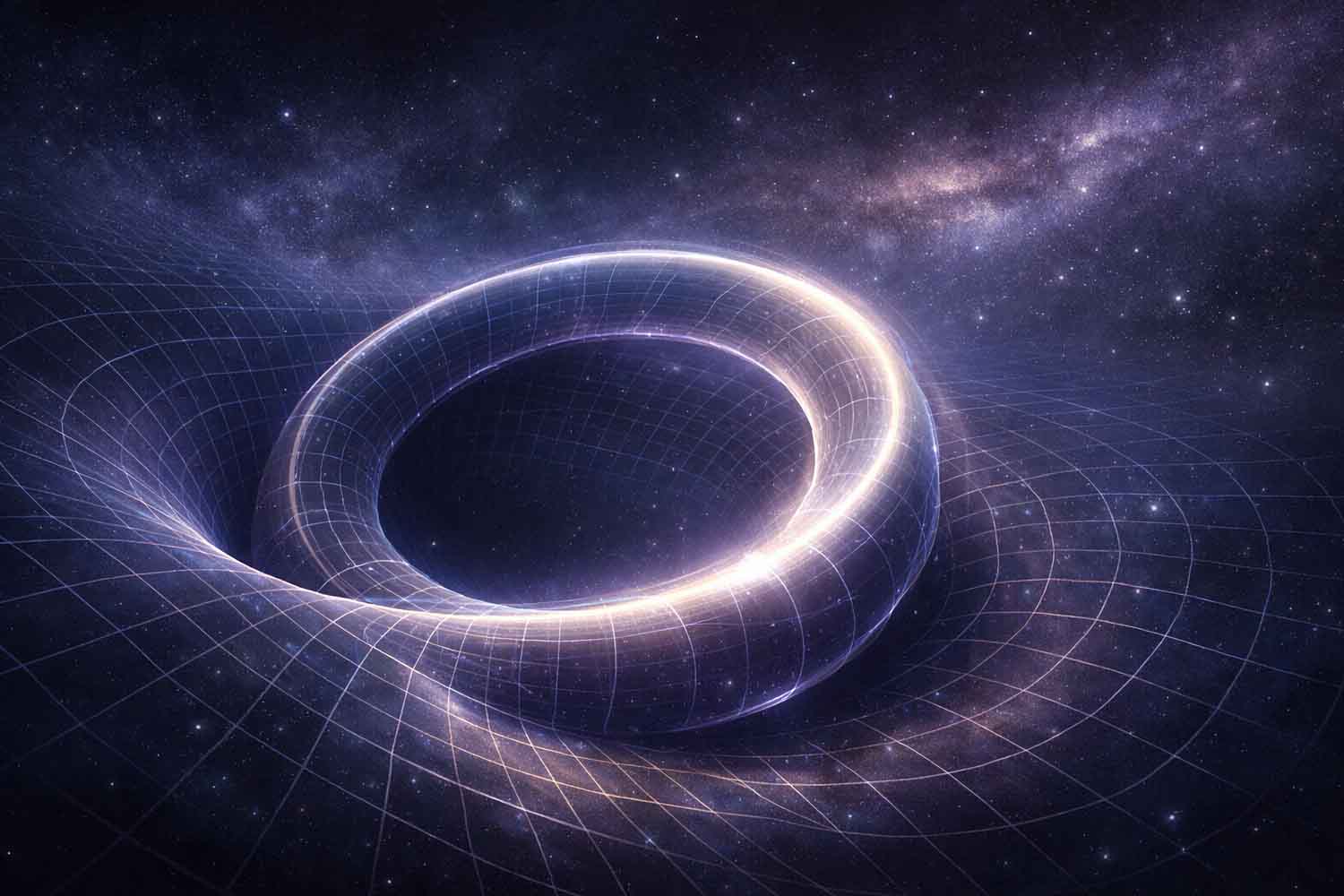
It all starts from general relativity Albert Einsteinwhich taught us to think of space and time as a single elastic structure, capable of deforming under the effect of enormous masses and energies. In extreme scenarios, this structure can curve so pronouncedly that it creates paths that loop back on themselves. Physicists call them “closed time curves”: trajectories that, at least on paper, would allow us to return to the starting point in time.
The problem is not the mathematics, which holds up. The problem is reality. Because if time goes in circles, what happens to one of the most solid laws we know, the one that governs the increase in entropy? Simply put: disorder always grows, and this is what gives time a precise direction. It’s the reason why a broken glass never becomes whole again and why we grow old.
Entropy and quantum: a difficult, but not impossible coexistence
Gavassino’s study tries to shift the gaze right here, to the point where thermodynamics and quantum mechanics meet. The idea is that, within a closed time curve, quantum fluctuations can introduce small local exceptions to the rule of increasing entropy. Not a total overturning of physical laws, but a sort of “free zone” in which, for short stretches, time could behave differently from how we are used to perceiving it.
In this scenario, some events considered irreversible may be partially reversed or not completed at all. Not because the universe goes crazy, but because it manages to compensate for these anomalies without losing its overall coherence. It’s a delicate balance, one that exists only under extreme and theoretical conditions, but enough to dispel the idea that time travel is automatically impossible.
A universe that does not allow contradictions
The most interesting consequence of this hypothesis is that paradoxes, the ones that fascinate us so much in films, may not occur at all. Even if someone attempted to alter the past in a drastic way, the universe would find an alternative configuration that avoids the contradiction. History, in other words, would always remain coherent with itself.
It is a vision that reinforces a line of thought already explored in the past, according to which nature does not allow inconsistent timelines. Not by chance Stephen Hawking he spoke of “chronology protection,” hypothesizing that the universe has self-defense mechanisms against time travel. Whether these mechanisms really exist, and how they work, is still to be understood.
Because all of this concerns us more than it seems
We are not talking about building a time machine, nor about traveling to the past around the corner. The research remains confined to the territory of theoretical physics. But exploring these possibilities serves something very concrete: better understanding how space-time, entropy and quantum phenomena work in extreme conditions. The same conceptual tools come in handy when studying black holes, the origin of the universe or the new frontiers of quantum computing.
The time travelthus, it stops being just a narrative dream and becomes a lens through which to observe the limits – and surprises – of natural laws. We may never go back to change the past, but continuing to ask ourselves these questions helps us better understand the present and the complex world in which we live.
