
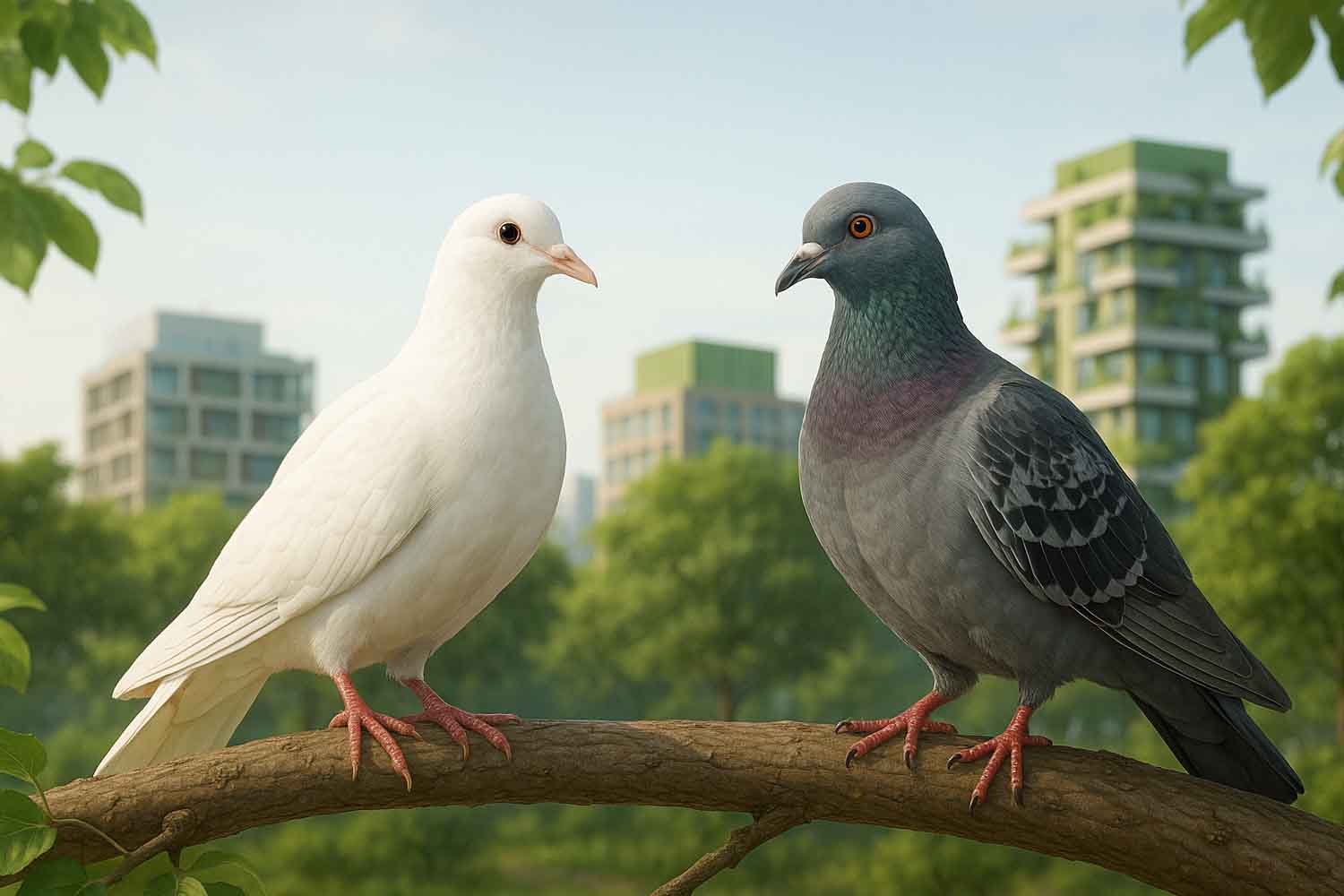
If you say “dove”, a clear image appears in the heads of many: a candid, elegant, almost spiritual bird. If you say “pigeon”, your thoughts immediately go to city sidewalks, to the crumbs next to the bins, to their slightly funny obstinacy. It is curious how convinced we are that these two animals belong to different universes, when in reality they are very close relatives, so much so that they share the same family, the Columbidae, a large tribe of over 350 species scattered around the world.
Nature does not separate them. We are the ones who do it, out of habit, out of aesthetics or out of that entirely human instinct to divide between “worthy” and “annoying”. But, if we stop for a moment to observe them, we discover that the difference between doves and pigeons it is almost non-existent. And that the story they tell is much more interesting than it seems at first glance.
When science speaks, the difference between doves and pigeons crumbles
In the biological classification there is no distinction between dove and pigeon. The two names have been used interchangeably for centuries, in different ways depending on the language and tradition. In Italian, then, the confusion increases: “piccione” evokes the urban one, “colomba” the image of peace, “colombella” and “tortora” an almost literary delicacy. But these are labels, not natural barriers.
We generally call smaller, more harmonious-looking species “doves”, while “pigeons” becomes the everyday label for their more robust cousins, especially those that populate cities. Yet, from a scientific point of view, practically nothing changes. Their evolutionary history, surprisingly, is common.
The urban pigeon
The pigeon that we see walking among the bar tables is not at all a “dirty” or “invasive” animal by nature. It is a descendant of the wild pigeon, a bird that has inhabited cliffs, sea caves and rock faces for millennia. We were the ones who transformed it, first domesticating it to carry messages or as a food resource, then unintentionally releasing it into cities around the world.
From these escaping domestic forms the wild domestic pigeon was born, what we simply call the “city pigeon”. An animal that has been able to adapt impressively to our world of concrete and traffic, exploiting every opportunity to survive.
Meanwhile, its wild ancestor has almost disappeared. True rock pigeon colonies survive in only a few isolated areas of the UK, mostly in Scotland and Northern Ireland, and resemble their urban cousins so much that scientists have to use DNA to tell them apart. Nature, in short, does not at all agree with our Manichean division.
Wood pigeon and dove
Moving through parks, woods or the English countryside, you come across the wood pigeon, the largest and most massive of the European Columbidae. He has a calm gait, a pink-tinged chest and a distinctive white patch on his neck that seems like a last-minute elegant detail. Its call, the one that many transform into the famous “good morning to you”, marks mornings and afternoons with an almost therapeutic calm.
Then there is the dove, which on the contrary does not like to be noticed. It is smaller, more compact, with a uniform color and dark eyes that make it immediately recognizable to those who know how to look. It prefers the discretion of hollow trunks or quiet fields, and if it passes near us it is easy to confuse it with an urban pigeon, but only because our visual categories are rigid. She, however, is not at all.
The wild dove
Among the most delicate species, the wild dove is the voice we risk losing. We know it more by tradition than by actual sightings, because in the United Kingdom it has fallen by 98% in less than fifty years, while in Italy it has decreased between 60% and 80% from the 1980s to today. Its song, a soft and continuous hum, has become a rarity, and its pink and brown wings are increasingly absent from the European countryside.
He lives between two worlds: he spends the summer in Europe and then faces a very long migration towards West Africa. Along this route it is hampered by illegal hunting, the disappearance of habitats and climate changes that put its survival to the test.
The eastern collared dove
In contrast, the Eastern collared dove has made one of the most astonishing natural journeys of the last century. Originally from southern Asia, it arrived spontaneously in Europe, set foot in England in the 1950s and has never stopped spreading since then. It is recognized by the black collar on the back of its neck and by its insistent call, three notes that immediately become part of the landscape. It’s a perfect example of how Columbidae are capable of adapting, transforming the urban environment into a new home.
So, what is the difference between doves and pigeons?
If we listen to what science and nature say, the answer is simple: the difference between doves and pigeons doesn’t really exist. There are different species, different adaptations, different colors. But not that moral, aesthetic or symbolic distinction that we have built around ourselves. Nature does not divide them. Maybe we shouldn’t do it either.
You might also be interested in:
