
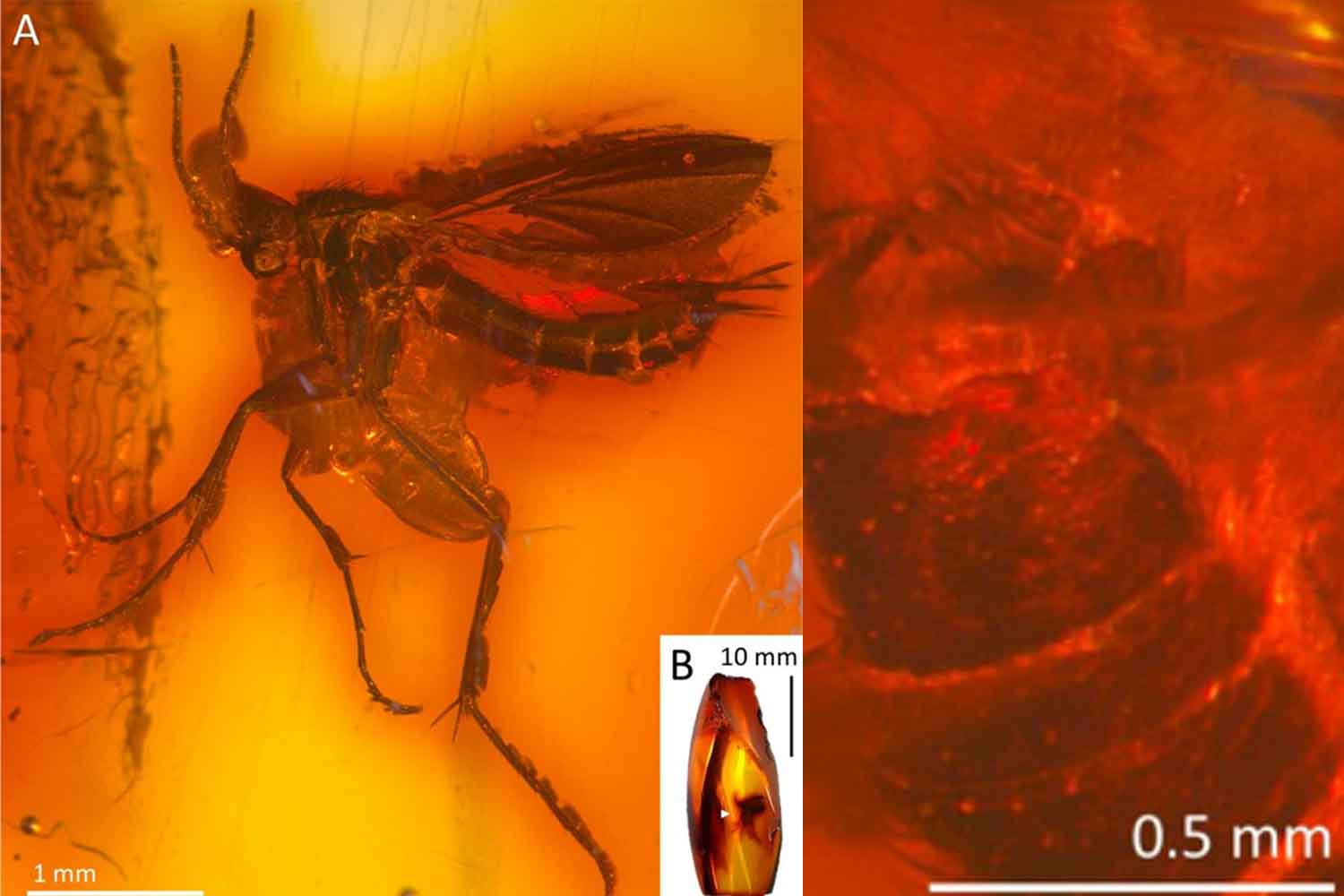
A exceptional discovery preserved in amber for 40 million years is rewriting what we know about the evolution and geographic distribution of some predatory insects, offering scientists an extraordinary window into the Earth’s deep past.
Within the collections of the Natural History Museum of Denmark, which holds further 70,000 amber fragments coming from different geological eras, a group of researchers has identified something absolutely unexpected. By analyzing a sample that had remained forgotten for decades in a drawer, the scholars discovered a perfectly preserved fungus gnat trapped in amber dating back to approx 40 million years ago.
The fossil belongs to a species never described before: Robsonomyia henningsenia rare insect unknown to science until now. According to researchers, this tiny predator represents a real missing link between two living species of fungus gnats currently distributed in Japan and the United Statesseparated by an ocean and almost 8,000 kilometers away.
This geographic distance has long been an enigma. The presence of Robsonomyia henningseni in Europe in fact, it suggests that, millions of years ago, the genus Robsonomyia was widespread much more widely, probably over much of thenorthern hemisphere. Europe, in this scenario, would have played the role of a natural bridge between Asia and North America.
The name of the new species is a tribute to CV Henningsena Danish amber collector who found the fragment on the west coast of Jutland in January 1961. The entire collection was donated to the museum, but that very piece remained unnoticed for longer 60 years olduntil researchers realized they were guarding a species never seen before.
In the same study, scientists also described a second new speciesnamed Robsonomyia balticaalso from amber from the Baltic region. This discovery strengthens the hypothesis that the genus Robsonomyia was not an isolated case or an occasional migrant, but a group diversified and well rooted in Europe during the Eocene.
According to the researchers, the fragmented distribution observed today in some insect species could be the result of ancient migrations and subsequent climatic eventsa model that could apply to many other organisms with similar patterns.
The Eocene climate and amber as a natural archive of biodiversity
The research team was not initially looking for a fossil midge. The main goal was to study amber to better understand the impact of climate change on the fauna that populated the Earth duringbeginning of the Eocenea period between approximately 56 and 40 million years ago.
At the time, global temperatures increased to eight degrees Celsius due to the high concentration of carbon in the atmosphere, a situation that presents disturbing analogies with the current one global warming. Analyzing the fauna of that period allows scientists to understand how insects and other organisms reacted to extreme climatic conditions.
Baltic amber, formed during the Eocene, is an irreplaceable tool for this type of study. The fossilized resin was extremely sticky and trapped insects, arthropods and even small vertebrates such as lizards. Over millions of years, the resin hardened, preserving organisms in three dimensionswith an astonishing level of detail.
An ancient predator, intact in body but without recoverable DNA
Robsonomyia henningseni lived between 35 and 40 million years ago in the area of Fennoscandiapresent-day Northern Europe. He inhabited environments sub-tropical or tropicalcharacterized by dense and humid forests. It was a predatory insect that he used sticky webs covered in acidic fluids to capture and kill small invertebrates.
Belonging to the family of Keroplatidaewhose larvae are known for their aggressive hunting strategies, this group of insects used oxalic acida toxic substance also present in rhubarb leaves, to immobilize prey. Some modern relatives of these midges even exploit the bioluminescence to lure victims into traps.
Despite the incredibly realistic appearance of the fossil, the DNA is no longer recoverable. Over millions of years, the genetic material has undergone chemical and physical transformations that make it impossible to extract. The fossil now represents a fragile, hollow structure, which would disintegrate if removed from the amber.
However, scientists do not rule out that future technological advances may enable the recovery of DNA fragments even from such ancient remains. The discovery of Robsonomyia henningseni offers a rare opportunity to study the in detail migration and evolution of a genre that is still little known. By comparing these three-dimensional fossils with living species, researchers can observe with great precision the morphological changes occurred over millions of years in response to environmental changes.
As highlighted by scholars, understanding how the distribution of organisms has changed over time is fundamental for interpreting current biodiversity patterns and for predicting how flora and fauna could react to ongoing climate changes.
