
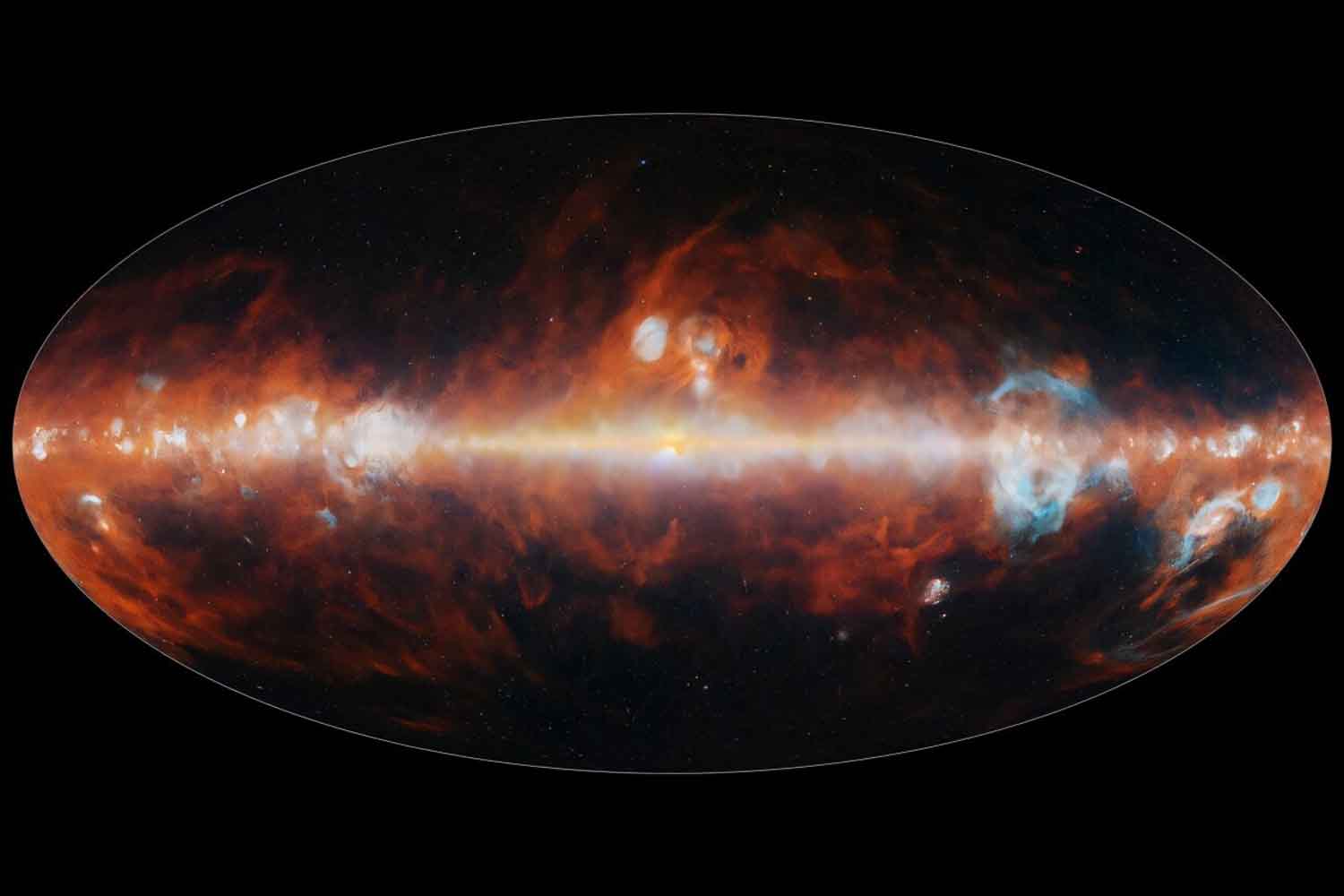
Looking at the sky and thinking you know it is a reassuring illusion. In reality, most of the universe escapes us because it does not shine in the light our eyes can see. That’s where it comes in SPHERExthe new space telescope from NASAwhich completed the project in just six months first infrared map of the entire sky in 102 colors.
Colors that we will never see with the naked eye, but which tell precise stories: where stars are born, how cosmic dust is distributed, how far away galaxies are. It’s as if someone had finally turned on the light in a room that we have observed in the dark for centuries, sensing the shapes but never really distinguishing them.
How SPHEREx “scanned” the sky piece by piece
SPHEREx doesn’t look at the universe standing still. It orbits the Earth about fourteen and a half times a day, passing over the poles and observing a different strip of sky each time. Day after day, as our planet revolves around the Sun, the telescope’s gaze also shifts. The result, after six months of silent work, is a complete 360-degree vision.
In this way the universe is observed not once, but 102 timeseach in a different infrared wavelength. Some highlight the stars, others the hot gas, still others the cosmic dust which, paradoxically, is invisible in “normal” light but becomes the protagonist in the infrared. It’s a shift in perspective that allows scientists to tackle huge questions, like understanding what happened in the very first moments after the Big Bangwhen the universe expanded very rapidly, giving shape to the structure we see today.
The mission is managed by Jet Propulsion Laboratorywhich started observations in May and closed the first large map in December. It is not a point of arrival, but the beginning. Over the next two years, SPHEREx will repeat this scan three more times. Merging all the maps will make the data even more precise and, an important detail, they will be accessible to anyoneincluding scientists and curious citizens.
Because SPHEREx changes the way we observe the cosmos
The true strength of SPHEREx lies in the balance between breadth and detail. Other telescopes, such as the James Webb Space Telescopethey manage to observe the universe with an extraordinary level of precision, but over very small portions of the sky. SPHEREx does the opposite: look Alltogether, and it does so with a wealth of information never before achieved in a global map.
Each infrared color corresponds to different information. By crossing them, astronomers can measure the distance of hundreds of millions of galaxiestransforming a flat map into a three-dimensional representation of the universe. This allows us to study how galaxies group together, how they have evolved over time and how ancient events continue to influence what we see today.
There is also an implication that closely concerns our galaxy. SPHEREx will help pinpoint the distribution of frozen water and key molecules, the same ingredients that made life possible on Earth. It is not a search for aliens, but a concrete step towards understanding how common the conditions we know as “habitable” are in the universe.
SPHEREx does not send spectacular poster images, but data. And precisely in these numbers, in these invisible colors, lies the possibility of rewriting important parts of our cosmic history. It is patient, almost humble work, which however changes the way we look at the sky: no longer as something distant and immutable, but as a constantly evolving story, of which we are finally learning to read the right pages.
