
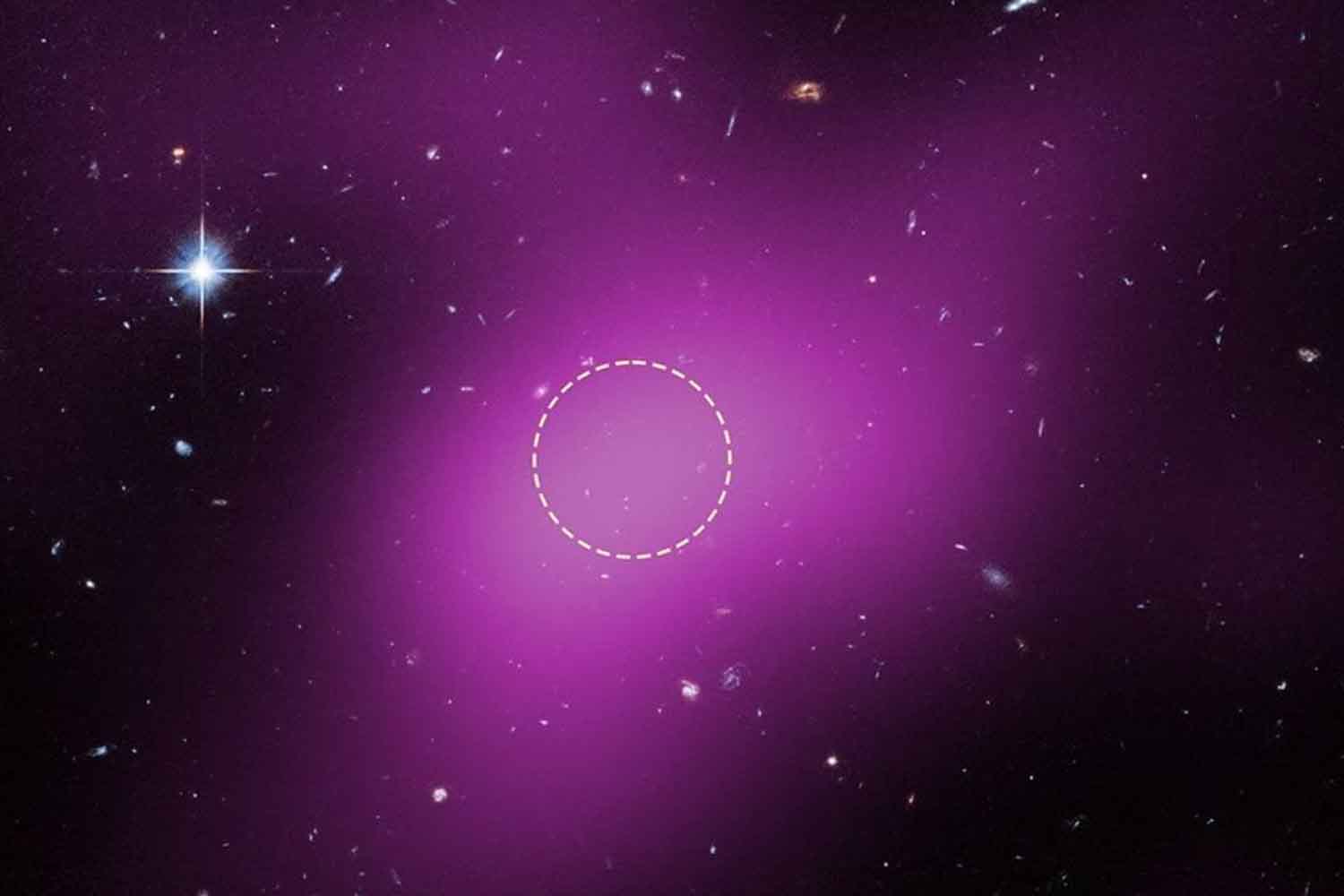
There is a recent discovery that is forcing astronomers to rethink some ideas that are considered solid. Is called Cloud-9 and it is a celestial object which, according to the most widespread theories, . And yet it is there, about 14 million light years from Earth, silent and invisible, identified thanks to the joint work of radio observations and very high precision images of the space telescope Hubble Space Telescopedeveloped by NASA and ESA.
Cloud-9 is located at the edge of the spiral galaxy Messier 94in a region where space seems empty but actually holds one of the most mysterious components of the cosmos: dark matter.
What makes Cloud-9 such a peculiar object is the total absence of stars. We are not talking about a weak or dimly luminous galaxy, but about a cloud of gas that . Hubble’s images were decisive for this very reason: where one would have expected even the faintest signal of light, there is nothing.
Radio data had already shown the presence of neutral hydrogen, initially detected by the Chinese radio telescope FAST and then confirmed by Green Bank Telescope and from Very Large Array. But until recently there remained doubt that the stars were there, simply too faint to be detected. Hubble has ruled out this possibility definitively.
Why Cloud-9 is considered a “failed galaxy”
Scientists call Cloud-9 a sort of “failed galaxy,” a structure that formed in the early stages of the universe but never managed to evolve as expected. It is composed of a compact, almost spherical cloud with a diameter of approximately 4,900 light years and a mass of gas equal to one million times that of the Sun. To remain stable, however, it must be immersed in a halo of enormous dark matter, estimated at approximately five billion solar masses.
Precisely this disproportion between what we see and what we do not see makes Cloud-9 an extraordinary case study. Without starlight to interfere, astronomers can observe the effects of dark matter more directly, trying to understand how it influenced the birth of galaxies and the structure of the universe we know today.
The research results were published on The Astrophysical Journal Letters and they suggest that Cloud-9 may not be an exception. Many other similar structures could exist in the vicinity of galaxies, which are difficult to identify because they lack stars and are easily disturbed by the surrounding cosmic environment.
Cloud-9 reminds us that the universe isn’t just made up of what shines. Much of its history is written in the dark, in silent objects that escape the gaze but which, precisely for this reason, can tell us something essential about our cosmic origins.
