
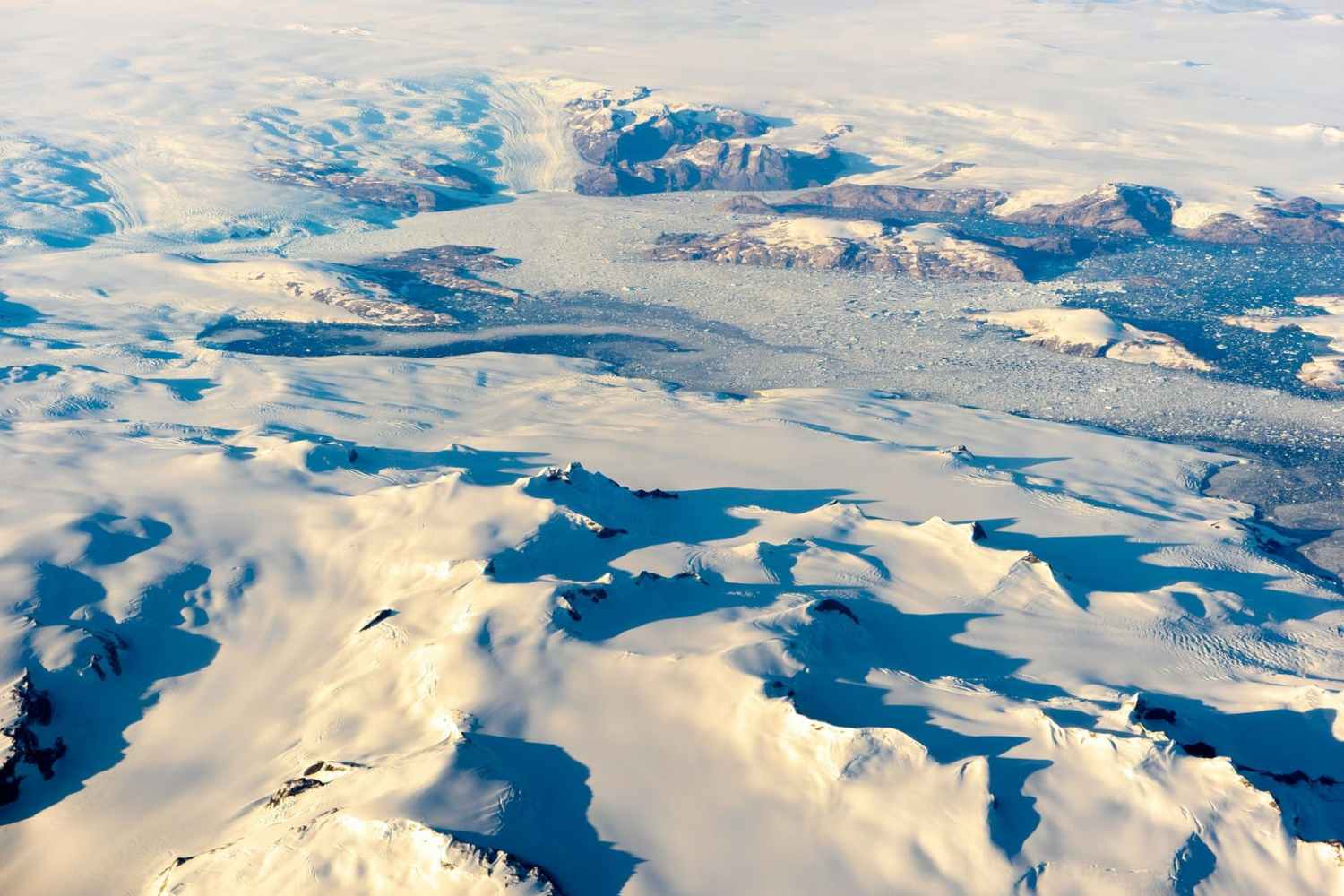
For a long time, Prudhoe Dome, in northern Greenland, was considered a stable presence, almost a structural element of the Arctic landscape. An ice dome up to 500 meters thick, covering approximately 2,500 square kilometers – more or less the size of Luxembourg – which seemed destined to resist even relatively warm climatic phases. Today that certainty no longer exists.
A group of international researchers has demonstrated that the Prudhoe Dome completely melted about 7,000 years ago, in a recent geological and climatically mild period. The result, published in Nature, changes the way scientists assess the vulnerability of Greenland’s ice sheets and explains why the word “time” often appears in their statements: not if it will happen again, but when.
What the sediments under the ice tell us
The discovery was born from the GreenDrill project, conducted in 2023 together with Columbia University. The researchers drilled into the ice cap to a depth of 508 metres, recovering sediments and rocks that had remained buried under the ice. To understand when those materials were last exposed to sunlight, they used luminescence dating: a technique that measures the energy accumulated by electrons in sediments during the burial period.
According to the findings, Prudhoe Dome not only melted, but did so during the Early Holocene, an epoch that spans the last 11,700 years and is considered unusually climate-stable. Average global temperatures were then about 3-5°C higher than today. A crucial detail, because it suggests that the dome is highly sensitive even to moderate heating, much more than previously assumed.
A “mild” past that resembles our future
Jason Briner, professor of Earth Sciences and co-director of the study, highlights the historical paradox: “This is a period known for climate stability, in which humans began to develop agricultural practices and take steps towards civilization.” He adds that while relatively modest natural warming was enough to make Prudhoe Dome disappear for thousands of years, current human-induced warming poses a real threat.
The implications are not local. If Prudhoe Dome were to completely melt, global sea levels could rise by up to 73 centimetres. According to data from the European Copernicus programme, every single centimeter of rise exposes around six million more people to the risk of coastal flooding. Translated: The fate of an Arctic ice dome has direct effects on coastal cities around the world.
Not imminent collapse, but a clear trajectory
Scientists are not talking about an immediate collapse, but about a well-defined direction. Some climate projections indicate that, without a dramatic reduction in heat-trapping emissions, global temperatures could approach Holocene temperatures by 2100. That’s why the team plans to drill back into the ice cap: understanding how quickly it melted in the past and at what level of warming is the only way to estimate what might happen in the coming decades.
Prudhoe Dome is a natural archive that tells an uncomfortable story. It shows that even apparently solid systems can react drastically to temperature changes considered moderate. And it is precisely this memory of the ice, more than future simulations, that explains why scientists today speak of a real and not theoretical threat.
