
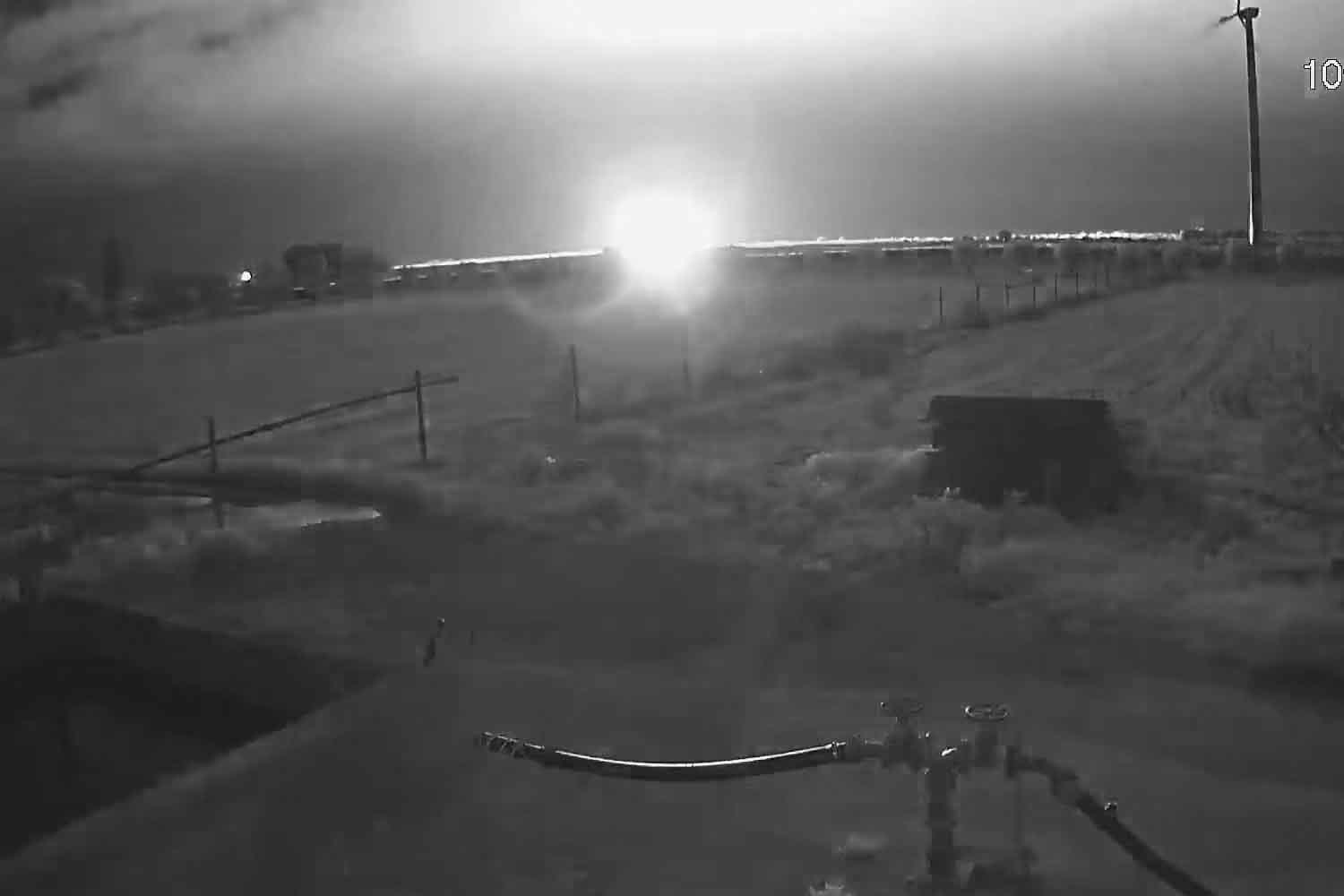
A sudden flash in the sky, then a dry, deep roar, capable of making the windows vibrate. This is what they experienced late on Saturday afternoon January 10, 2026 many people in the territories of Casamassima, Valenzano And Turiin the province of Bari. An episode that lasted a few moments, but enough to leave behind questions, fears and a curiosity that is difficult to extinguish.
Within a few hours, similar stories began to circulate on social media: an intense, almost blinding light suddenly appeared in the sky, followed by a noise likened to an explosion. Someone spoke of a sharp bang, others of an unseasonable thunder. Everyone, however, had the clear feeling that this was not an ordinary phenomenon.
A sudden phenomenon
The reports did not only come from Casamassima, but also from Valenzano, Turi and other neighboring areas. In several cases the flash was immortalized by private video surveillance cameras, which showed a sky lighting up like day for a fraction of a second, immediately before the explosion. No seismic shock was recorded and there was no damage to people or things, a detail that helped to exclude, at least initially, causes of terrestrial origin.
As the hours passed, the hypothesis that found the most space was that of a fireballthat is, a particularly bright meteor which, upon entering the Earth’s atmosphere, can generate a strong glow and a sound wave that can be perceived even at a great distance. These are rare, but not exceptional, events which often surprise precisely because of their sudden spectacularity.
What we know about the meteorite hypothesis
When a fragment of space rock enters the atmosphere at very high speed, friction with the air causes it to overheat and shine intensely. In some cases the body disintegrates completely before reaching the ground, producing only light and noise. In others, smaller fragments can reach the ground, often without us realizing it.
In the case of Bari, there is currently no official confirmation of the discovery of remains on the ground. Experts urge caution: only the analysis of data collected by astronomical monitoring networks will be able to clarify whether it was really a meteorite or another atmospheric phenomenon. However, an important element remains: the absence of seismic shocks and explosions on the ground makes the fireball hypothesis one of the most plausible.
Similar events have been observed in various areas of Italy in recent years. Our Planet is constantly crossed by small cosmic debris and, in the vast majority of cases, these encounters result in spectacular light trails destined to disappear within a few seconds.
