
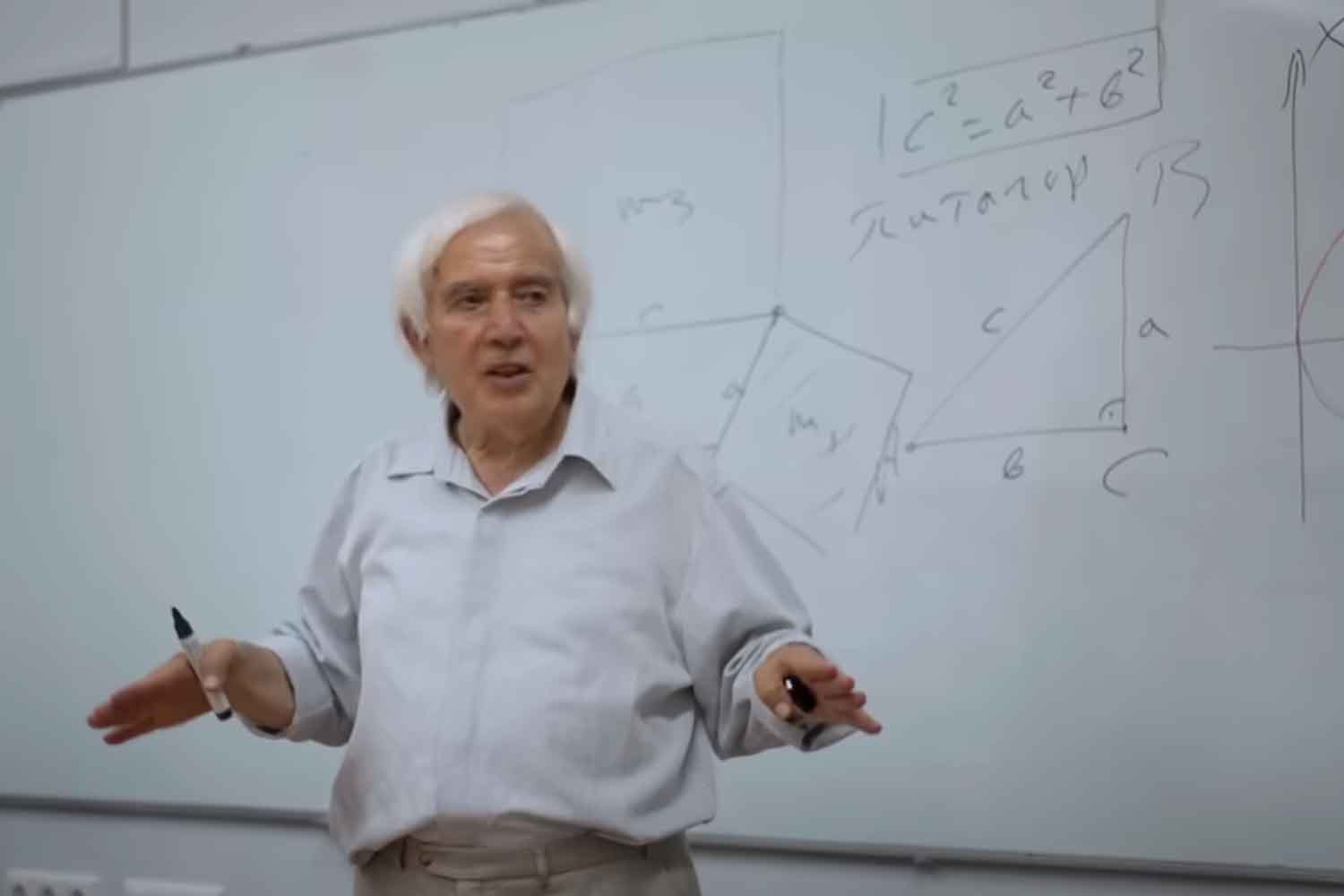
In Bulgaria there is a teacher who has been working away from the spotlight for decades, in a semi-abandoned school in the Balkans, and who continues to train some of the brightest scientific minds in Europe. Is called Theodosi Theodosievis 78 years old and is known in his country as “the golden master”. Not for a symbolic title, but for a concrete fact: a significant part of the gold medals won by Bulgaria at the International Physics Olympics bears his educational signature.
His story reached the general public thanks to a report on the Franco-German channel ARTwhich described a radical teaching method, light years away from the digital teaching and technological shortcuts that dominate Western schools today. A method that divides, but which forces us to ask ourselves an uncomfortable question: are we really helping kids to think?
An idea of knowledge that does not accept compromises
Teodosiev teaches for free in a disused school near Kazanlak, on the fringes of the official education system. Here come students selected through national mathematics and physics competitions, willing to undergo a very tough path in order to learn. The lessons are held all year round, without real breaks, and during the summer they move to the Rose Valley, transformed into an informal theoretical physics classroom.
To access the courses, families pay around 330 euros. An important figure in one of the poorest countries in the European Union, where public spending on education remains among the lowest on the continent. In 2022, Bulgaria invested just 685 million euros, an abysmal distance compared to the large European countries. The results can also be seen in the rankings PISAwhich place the country in the last places for scientific and mathematical skills. In this context, Theodosiev’s school appears as a resistant anomaly, almost a form of educational counterculture.
Fifteen hours of study, no smartphones and an open challenge to AI
The heart of Theodosiev’s method is discipline. Students study for up to fifteen hours a day, with repeated quantum physics lessons and long exercise sessions that extend into the night. Everyone receives a stopwatch to measure the real time spent studying. Even breaks must be controlled, because for the professor concentration is a personal responsibility.
Smartphones are prohibited. No social media, no internet. A choice that also arises from a private experience: Teodosiev says that his daughter won medals in every physics competition, until the arrival of the first smartphone, which would have interrupted that continuity. Hence a harsh criticism of Western educational models, accused of wanting to make everything simple and pleasant, forgetting that some disciplines, such as physics, require effort and perseverance.
Artificial intelligence also enters into his reasoning. Not as an enemy, but as a yardstick. If a student can solve a problem that a machine cannot address, then he has developed a form of thinking that makes him truly free and non-replaceable. For Teodosiev, the goal is not to beat an algorithm, but to build a deep intelligence, capable of dealing with complexity without relying on shortcuts.
Between excellence and brain drain
Many former students of Teodosiev today live and work abroad. Some have completed accelerated academic tracks at universities such as University of Cambridge, Harvard University and the MIT. Among them is Katerina Naidonova, gold medalist at the International Physics Olympics, now a researcher at the Medical Research Council Laboratory of Molecular Biology. His work contributed to the development of fundamental tools for electron microscopy, also used in the study of SARS-CoV-2.
Another former student, Petko Dinev, heads a company in the United States that produces high-resolution cameras used by NASA in space missions, including lunar ones. Success stories which, however, also tell of a structural problem: every year around 100,000 Bulgarians leave the country, and among these many young scientists trained by Teodosiev himself.
The professor is aware of this and does not hide it. This is why he is working on a project that goes beyond him: a permanent physics school in the Bulgarian mountains, designed as an isolated and protected place, where study can continue even after him. For Teodosiev, people pass away, but what they build can remain. As long as someone is still willing to really study, without distractions.
