
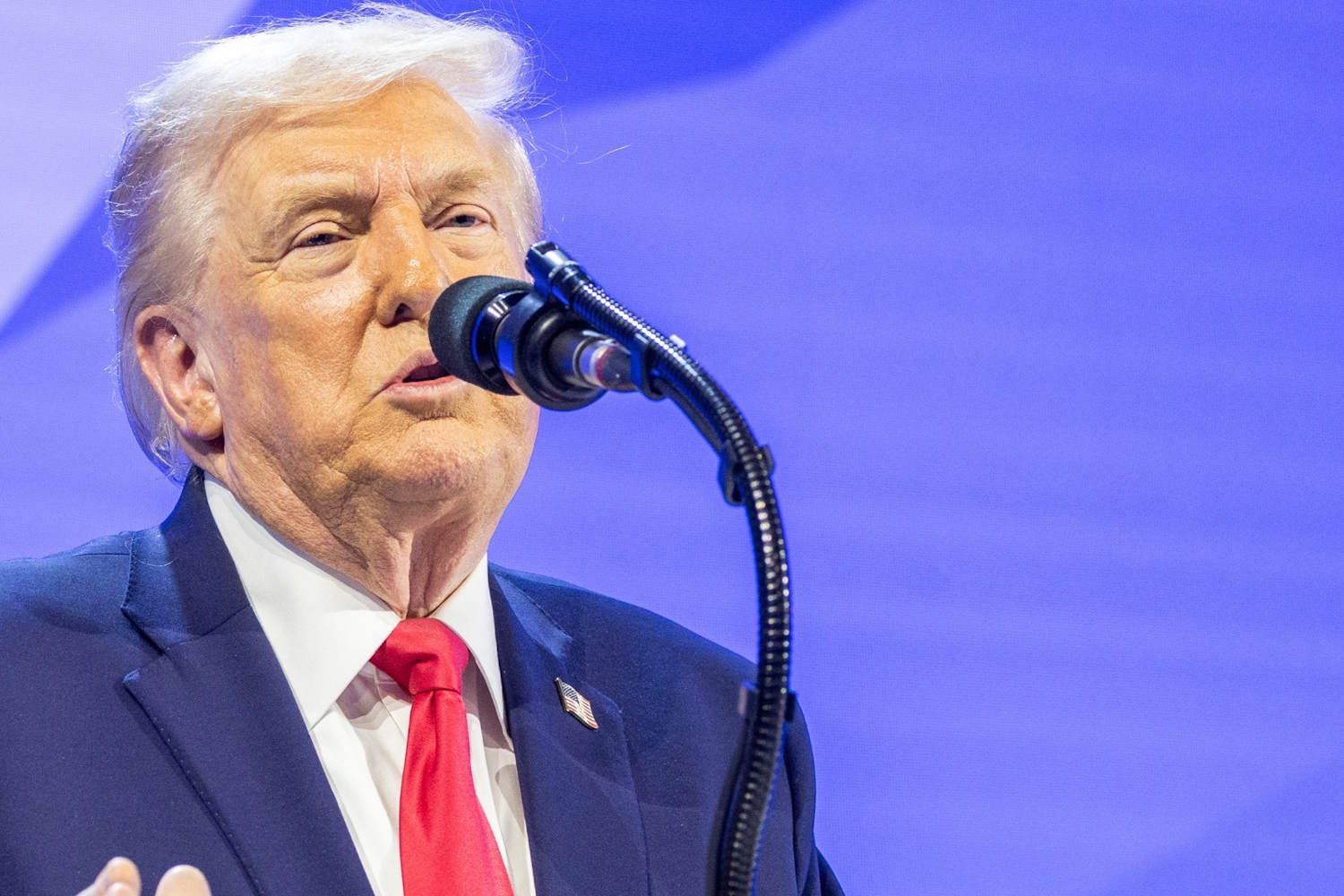
So far he has obtained the support of Middle Eastern monarchs, of a dictator like Putin and of at least one leader wanted for alleged war crimes, the dear Netanyahu. In the middle of the World Economic Forum in Davos, Donald Trump relaunches one of the most controversial initiatives (if it is possible to make an order) of his second mandate: the Board of Peace, a new international body which, according to the White House’s intentions, should deal with the management and resolution of global conflicts.
A project which, needless to say, profoundly divides the international community and raises questions about the stability of the multilateral architecture built after the Second World War.
Trump has invited dozens of countries to join the council that aims to resolve global conflicts, but his mandate has alarmed several US allies, as has the US leader’s comment that it “could” replace the United Nations.
Indeed, the council (chaired indefinitely by Trump, among other things) was originally conceived as a body charged with overseeing the reconstruction of Gaza. But its scope later broadened to address conflicts around the world, and the draft charter, sent along with invitations to participate, appears not to even refer to the Palestinian issue.
What is the Board of Peace and what purpose would it serve
The Board of Peace would be a new international body that Donald Trump is relaunching as one of the pillars of his foreign policy (after the spat with Norway, moreover). Formally it was born with the approval of the UN: the Security Council adopted a resolution, proposed by the States, which establishes a transitional peace council and also authorizes an international stabilization force. Its mandate would be to promote stability, re-establish legitimate governance and ensure lasting peace in areas affected or at risk of conflict.
In the declared intentions, the Board should deal with the post-conflict phases: managing the transition after the destruction, coordinating reconstruction, guaranteeing security and accompanying the birth of a new Palestinian administration. It is the idea of an international authority that takes control of a territory devastated by war and guides its political, economic and institutional future. On paper it is a project that might even appear logical: fill the power vacuum, avoid chaos, prevent the return of armed militias.
The problem is not so much the objective, but the way in which the Board is constructed: that is, it was not born as a true multilateral body. It is not based on an international treaty, it does not provide a system of balanced representation between the areas of the world, it does not respond to the classic UN mechanisms. It is, in fact, an American political structure: designed in Washington, led by Trump as president in the initial phase and with the power to decide who can become part of it.
Alongside the actual Board, two parallel bodies would be envisaged:
This is where the heart of the problem emerges: formally each member state would have one vote and decisions would be taken by majority, but in practice the president of the Board concentrates enormous power, being able to choose the members, suspend or remove them, block decisions that he deems not in line with the objectives of the Board, decide when and where the Board meets and approve the agenda.
Nothing passes without his consent. Governance is not truly collective, therefore, but vertical.
It’s all about money
Making the picture even more controversial is the rule on access to permanent power. Each country remains in office for three years, but whoever contributes at least one billion dollars in the first year of the body’s life gets one status permanent, without expiration. In other words, decisional stability is bought. Political weight does not depend on population, international law or global consensus, but on financial capacity. The Board, therefore, would be more of a geopolitical platform in which political power and economic power openly merge.
As for members, Trump invited 52 countries. To date, those who have officially accepted are 14, including Hungary, Argentina, Israel, the United Arab Emirates, Morocco, Vietnam, Azerbaijan and Kazakhstan. Other prominent leaders – from Erdoğan to al-Sisi – are among the invitees, but not all have yet released their reservations.
In summary, the Board of Peace would be a peace council born out of the logic of multilateralism, guided by personal leadership, where governance is based on political strength and economic weight rather than on international law.
And this is where the initiative could become politically explosive. Trump, obviously, presents the Board as an instrument of global pacification, but builds it as a tailor-made body, in which peace is not the result of a balance between states, but rather the product of a central command and a system of financial power. What does it seem like this to us? A vertical, selective peace, negotiated from above.
And Europe?
Europe seems to distance itself from Trump’s initiative. The first to do so openly was France, followed by Italy. Palazzo Chigi has already made it known that the answer will be negative, if only that such an unbalanced body violates the principle of equality between states required by article 11 of the Constitution. A requirement that the Board of Peace, as it was conceived, does not guarantee.
Germany will also not join the Committee. Der Spiegel writes this, citing a directive from the Foreign Ministry sent to the German representatives in Brussels. Not only that: Chancellor Friedrich Merz will leave Davos before the inaugural ceremony. The same choice was announced by Norway, where relations with Trump are at an all-time low after the controversy linked to the failure to award the Nobel Peace Prize.
