
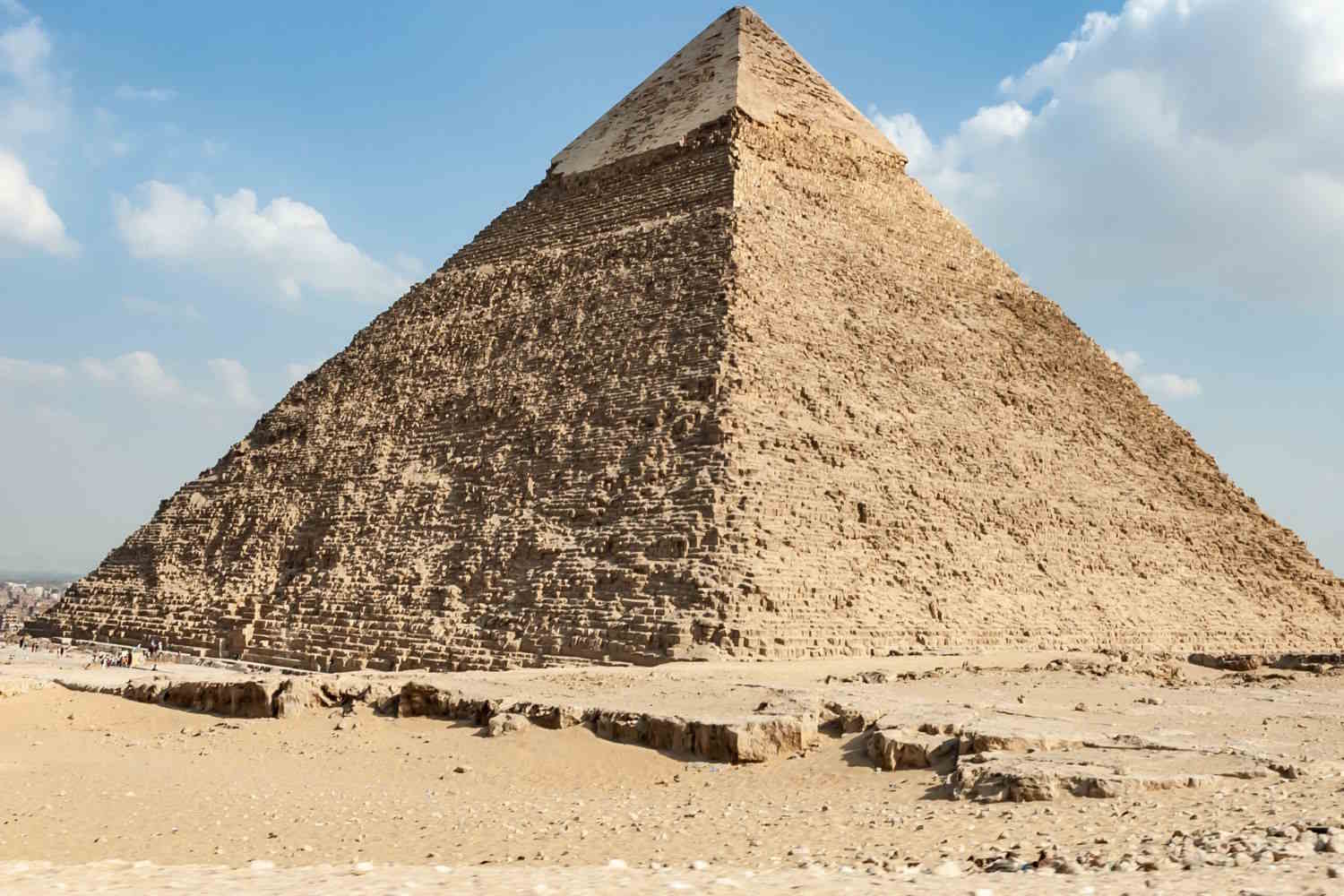
When we think of the Egyptian pyramids, we imagine endless ramps, ropes pulled by hundreds of men and blocks of stone dragged under the sun. It is a powerful, almost cinematic image that has been with us for decades. But what if it hadn’t really happened that way? If behind one of humanity’s greatest feats there had been a natural force that we have always underestimated, silent and invisible: the water.
The pyramids are not simply ancient. They are precise, massive, almost stubbornly perfect. Built over 4,500 years ago, with millions of stone blocks weighing an average of two and a half tons, they continue to pose problems even for modern engineers. No electricity, no steel, no motor. Yet they are still there. We have always wondered how it was possible. Now, a new scientific hypothesis suggests we may have been looking in the wrong direction.
How we have always imagined the construction of the pyramids
For a long time there seemed to be only one answer: ramps. Rammed earth structures, straight or spiral, along which workers would drag the blocks on sleds, using levers, ropes and impressive manpower. A logical idea, repeated in school books and documentaries, but which still leaves many open questions, especially when looking at the oldest and most monumental pyramids.
Over time, other theories were also born: internal ramps hidden inside the pyramids, counterweight systems, progressive lifting. Some modern scans have identified anomalous spaces, but none of these hypotheses have ever made everyone agree. However, we know one thing for sure: the pyramids were not built by slavesbut by specialized workers, organized, nourished and supported by an extremely efficient state machine. Yet, even taking all this into account, the question remains: was it really just human strength?
Water as a secret ally
The new hypothesis arises from the study of a very specific structure: the Djoser’s Step Pyramidin the necropolis of Saqqaraone of the oldest pyramids of the Old Kingdom. Here, according to a group of researchers led by Xavier Landreau, traditional ramps may not have been the main solution.
The idea is as simple as it is destabilizing: the ancient Egyptians would have used a hydraulic system to lift the stone blocksa sort of water elevator integrated into the structure of the pyramid itself. Not an improvised trick, but a complex system, based on the collection, control and use of water coming from natural courses and seasonal rainfall.
According to this reconstruction, the water was conveyed into basins and canals, accumulated and then channeled into vertical wells inside the pyramid. The water pressure would have allowed the materials to be lifted upwards, greatly reducing the human effort required. An idea that, if confirmed, would radically change the way we imagine ancient Egyptian engineering.
Clues on the ground
What makes this theory less imaginative and more concrete are some archaeological elements present in the area. Not far from the pyramid there is a large stone structure, the Gisr el-Mudir, which for years was interpreted as a fortification. Today, however, many scholars note how its characteristics are more compatible with one dam or water control system.
Traces of ditches, settling basins and tanks also emerge around the pyramid which seem to meet the needs of a real hydraulic system, capable not only of accumulating water, but also of managing and purifying it. Inside the pyramid, then, some architectural details make you think: granite blocks, limestone structures bound with clay and closure systems that recall flow and outflow mechanisms.
In particular, the northern shaft of the pyramid presents a configuration which, according to researchers, is consistent with a hydraulic lifting system. Not definitive proof, but a series of clues which, put together, tell a different story from the one we are used to.
This theory is not yet accepted by the entire scientific community. Many archaeologists remain cautious and remember that, especially for the pyramids of Giza, traditional ramps remain the most solid hypothesis. But the value of this new reading lies elsewhere. It lies in reminding us that the ancient Egyptians had a profound knowledge of nature and knew how to communicate with itexploiting resources such as water in an ingenious and sustainable way.
While today we return to wondering about energy, natural resources and human ingenuity, this story also speaks to the present. Perhaps the pyramids are not just a monument to the past, but an invitation to review what we have always taken for granted.
