
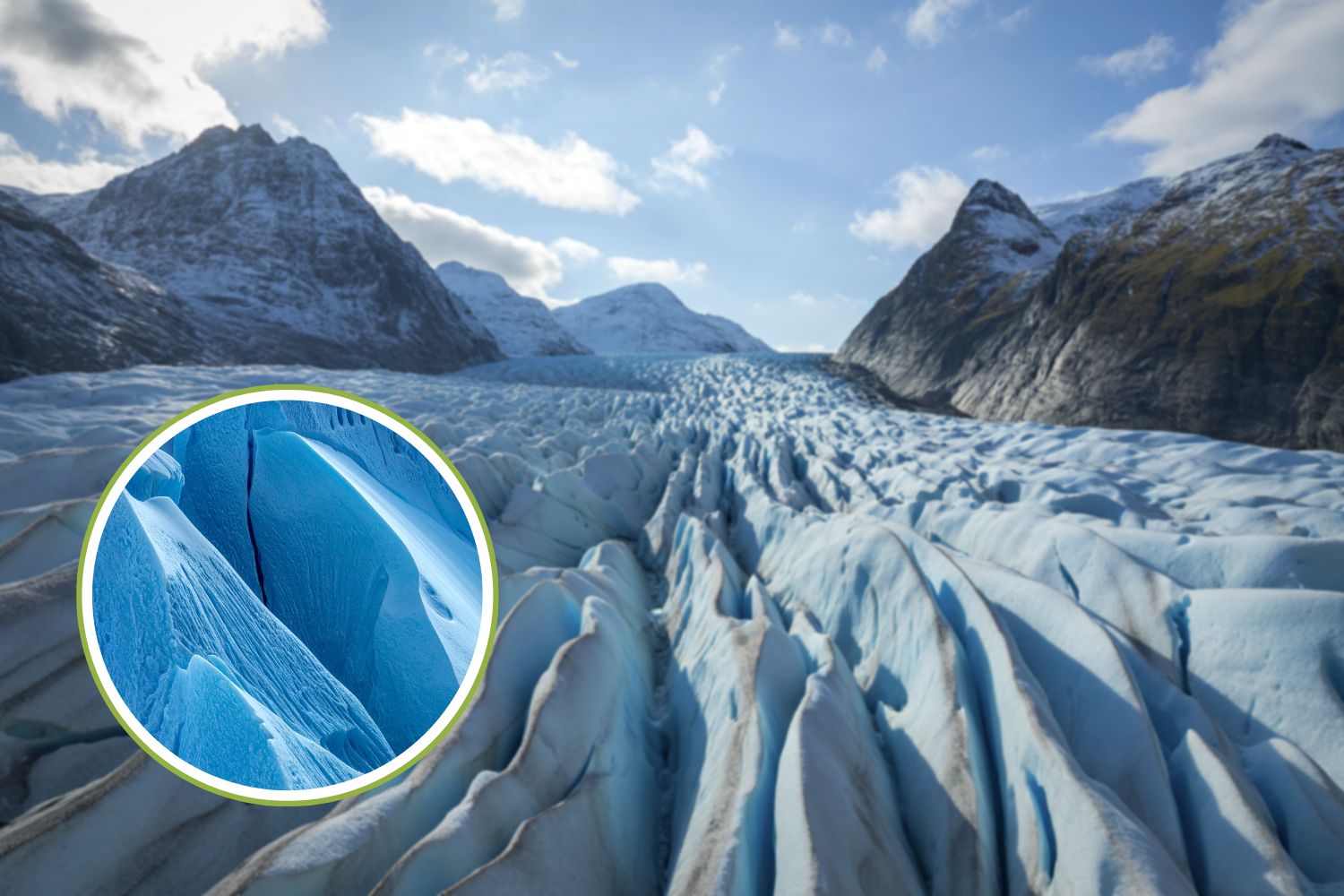
In the midst of the global climate emergency, while images of crumbling glaciers now appear daily before our eyes, there is a place that goes against all odds. In the heart of Central Asia, among the very high peaks of the Pamir Mountains, a huge glacier not only resists, but continues to grow.
It is called Vanch-Yakh Glacier and is one of the longest glaciers existing outside the polar regions. For decades it has shown surprising stability, in clear contrast to the majority of the planet’s glacial masses, which are currently in rapid decline.
Because a growing glacier could tell us something new
The area where it is located, in Tajikistan, is also home to another climate anomaly: the Kon-Chukurbashi ice cap. Here, at extreme altitudes, the ice seems to follow its own rules. It is precisely to understand what is happening that an international scientific expedition decided to drill into the ice cap and extract ice cores up to one hundred meters deep.
Inside these ice cylinders, about the size of a can, is a natural chronicle that covers approximately 30,000 years of climatic history. Each layer preserves tiny chemical traces, dust and sediments that tell what the planet was like when that water turned into ice.
According to Yoshinori Iizuka, a professor at the Institute of Low Temperature Science at Hokkaido University, understanding the reason for this growth could prove invaluable. The idea, however ambitious, is that the mechanism that protects these glaciers can also offer useful ideas for others, which are increasingly fragile today.
Ancient ice cores, unexpected dust and a still open enigma
While analyzing the samples, scientists came across something unexpected. Above seventy meters deep, the ice is unusually rich in dust, in quantities never observed before in similar expeditions. The last few meters even have a yellowish color, a detail that has opened up new questions and which will be the subject of further studies in Japanese laboratories.
Analyzes are still ongoing, but it is clear that the Pamir glaciers behave differently than those of many other mountain ranges. A resilience that could depend on local climatic factors, atmospheric circulation or dynamics that are still little understood.
Behind this research there is not only scientific curiosity, but also a race against time. At the end of September 2025, the Ice Memory Foundation led an international expedition to the Pamir glaciers, bringing 13 scientists to work at 5,800 meters above sea level, on the Kon-Chukurbashi ice cap.
Here, deep ice cores over 100 meters long were extracted for the first time: a true natural archive that preserves centuries, perhaps millennia, of climate, dust and atmosphere of one of the most fragile and least studied regions of the planet. One of these samples will be analyzed immediately, the other will be kept in Antarctica, in the foundation’s ice sanctuary, as a memory to be saved before global warming makes it impossible to recover. Because even where the ice seems to resist today, the signs of change are already written within each layer.
An extreme expedition between ice, helicopters and global science
The mission, followed in the field by AFP, involved researchers from Switzerland, Russia, Japan and Tajikistan. The ice cores were transported on shoulders, in refrigerated segments, along impervious routes until they reached off-road vehicles and refrigerated trucks. The project was supported by a Swiss climate institute and by the Ice Memory Foundation, which works to conserve ice samples in Antarctica to save them from irreversible melting. An operation that has the flavor of a race against time, to preserve natural archives destined to otherwise disappear.
Perhaps there is no simple or immediate solution. But if among those ancient air bubbles and mysterious dust there is a clue capable of explaining why this glacier grows, then the Vanch-Yakh could help us understand how to better protect the planet’s ice. In an age of bad environmental news, this story is not a fairy tale with a happy ending, but a rare sign of complexity. And it reminds us that nature, even under pressure, can still surprise us.
You might also be interested in:
