
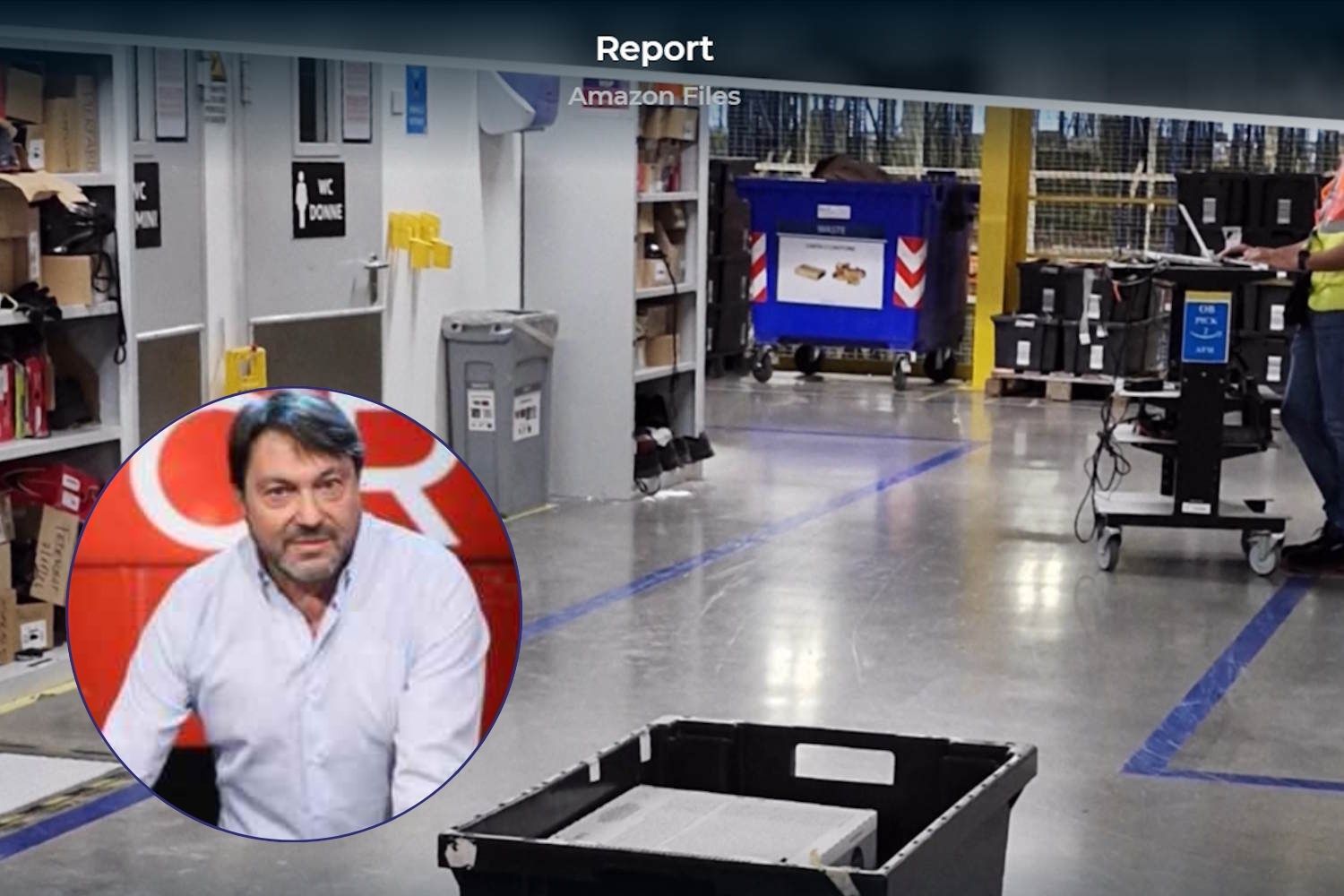
An Excel file in which to write down data relating to the health and trade union commitment of employees: “she is a foreigner with a small daughter” or “he is quite active in the union, to be monitored“. All information whose collection is prohibited by law. It happens on Amazon and this is one exit strategy actual with the sole purpose of getting some employees fired. Nothing more.
Report once again opens Pandora’s box, with the investigation “Amazon Files” by Emanuele Bellano. The journalist focuses on the Amazon warehouse in Passo Corese, Lazio, the parcel sorting center in the central south which has over 2 thousand employees.
Here managers collect information on workers and transcribe it: they practically file employees based on pathologies and family problems. But how much is legal?
The labor inspectorate would have authorized software six years ago to monitor those who work in the company, but what is it really for? Report came into possession of an Excel file with a list of the names of the employees, complete with private family and health data. Everything seems except a document necessary for “company security”. The collection of such information, in fact, is prohibited by the Workers’ Statute.
The FCLM, the fulfillment center labor management: what it is
This is a software about which we actually have little information, but which is used by Amazon in all its warehouses around the world. With this tool there is constant monitoring of employees to obtain maximum profit, a set of data for each individual worker, which is kept for years.
A real crime if this serves to control the operator, as established by article 4 of the Workers’ Statute, according to which “the audiovisual systems and other tools from which the possibility of remote control of the workers’ activity also derives can be used exclusively for organizational and production needs, for workplace safety and for the protection of company assets and can be installed following a collective agreement stipulated by the unitary trade union representation or by the company trade union representatives”.
However, it is forbidden to use them to control the productivity of the individual worker and his movements. The authorization of this tool, as we were saying, passes through the National Labor Inspectorate, which, called upon by Report, essentially washes its hands of it, leaving open the question of controls by the authorities that should protect workers.
Meanwhile, what emerges from the investigation is that the boundary between “organizational needs” and systematic control of workers has been largely crossed. As shown by Report, the FCLM, in fact, would not limit itself to measuring general production flows, but would be used to evaluate the performance of the individual employee, tracking times, breaks, slowdowns, absences and even physical and personal conditions. A system that effectively transforms each worker into a row on a spreadsheet, with useful indicators to establish who is “suitable”, who is “problematic” and who should be fired.
In fact, in the Excel file analyzed by the broadcast, annotations appear that have nothing to do with productivity: illnesses, accidents, pregnancy, family problems, situations of personal fragility, up to trade union commitment. Very sensitive data which, according to the GDPR and the Workers’ Statute, cannot be collected nor stored by an employer. Yet, they are recorded, updated and shared internally, as if they were normal company parameters.
Health and privacy, these unknowns
Another key point of the investigation concerns the pace of work. In Amazon warehouses every operation is timed: picking, moving, depositing. The system automatically reports “anomalies”, i.e. moments in which a worker slows down, stops or takes longer than expected. But Report highlights how human variables are almost never taken into account: tiredness, physical pain, injuries, environmental conditions, repeated loads. The worker must adapt to the machine, not the other way around.
This is also where the link with the topic of health comes from. The investigation shows how in the Passo Corese center there are numerous cases of musculoskeletal disorders, back, joint and tendon problems. Pathologies that affect those subjected to fast pace and repetitive movements for hours. Yet, instead of becoming a wake-up call to improve working conditions, this information seems to become elements of “negative” evaluation of the employee himself.
The paradox is evident: health, which should be protected, becomes an occupational risk factor. Those who get too sick, those who get injured, those who have physical limitations are seen as performing less well, therefore less useful. An approach that completely overturns the principle of worker protection on which labor law is based.
And the unions
Another central issue of the investigation is the relationship with the union. The notes on “union activism” show how the company keeps track of those who participate in strikes, meetings and collective initiatives. A very serious fact, because trade union activity is protected by the Constitution and is one of the most protected areas of all. Monitoring it is equivalent to creating a list of “special prisoners”, with a clear deterrent effect on those who would like to claim rights.
Amazon’s version
These are not “dossiers”, as they are described – they say by Amazon. It is common practice for employees to have informal discussions with their managers upon returning after a period of absence. These interviews do not concern the health status of employees but are simply aimed at understanding any operational support needs and identifying organizational changes that can improve working conditions and people’s well-being (such as shift changes, changes in tasks and ergonomic interventions, management support or family assistance). It is a system that allows the company to meet, when possible, the specific needs of workers, balancing them with those of the company.
HERE are Amazon’s responses.
And now the broader question remains: Amazon is not an isolated exception, but the emblem of a production model that aims for hyper-efficiency while sacrificing the human dimension. What becomes the real boss is an algorithm, which decides times, rhythms, evaluations and the employment destiny of people. An enormous and difficult to contest power.
And this is precisely the most disturbing aspect of the investigation: not so much the existence of a single illegal Excel file, but the normalization of a corporate culture in which the worker is no longer a person with rights, limits and needs, but a system variable to be optimized, monitored and, if necessary, discarded.
A model that poses an urgent question: to what extent are we willing to accept that logistical efficiency is paid for by the compression of fundamental rights? Because behind every package delivered in 24 hours there is a human being, not a spreadsheet.
