
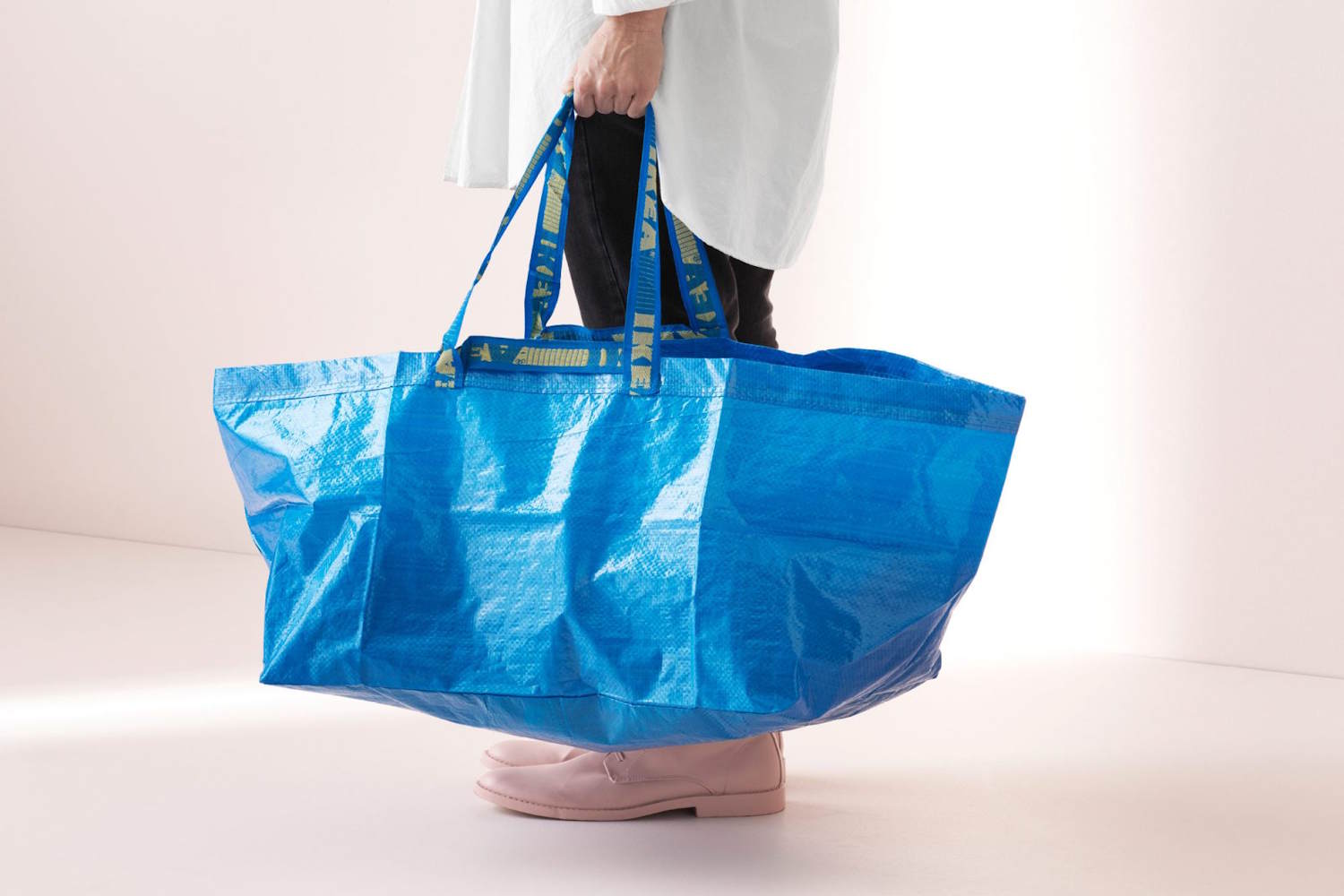
In the trunk of the car, in the closet, in a wardrobe, under the bed. It is even said that some keep it under lock and key, so that no one ever steals it. It is the iconic Frakta by Ikea, the well-known maxi-bag in recyclable polypropylene with the unmistakable blue colour. A must for shopping at Ikea and beyond: do you want to know how convenient Frakta is when moving?
Why are we talking about it? Because, after 30 years of honorable career, Mr. Ikea has decided to retire it. Straight to the attics of the Swedish brand, therefore, because the life of true rock stars – as we know – is short but intense and full of global successes.
That’s right, from East to West, the identity of this bag has gone far beyond the checkouts of megastores. It has become an object of our everyday life and beyond: it has inspired stylists and designers and has ensured that everyone, absolutely everyone, has the exact same object around the house (after the bookcase Billyobvious).
In short, following the rules of marketing, the iconic blue bag will be eliminated this spring, marking the end of an era. Are we ready to say goodbye?
How Frakta was born
The history of Frakta began in the 1960s, when Ikea began to sell more and more small household objects. It was realized, however, that the shops lacked a practical way to transport them: the baskets were too small and customers ended up carrying everything in their arms, often giving up part of their purchases. Ingvar Kamprad, founder of IKEA, then decided that a large, robust and easy-to-use bag was needed.
The idea took shape in 1986. Kamprad and purchasing manager Lars Göran Peterson found a manufacturer in Taiwan who used polypropylene, the same material as rice bags: light, waterproof and very resistant. The bag had to hold up to 50 kilos. To test it, they say, they had a woman weighing about 50 kg climb into the bag and lift her up, each holding a handle. It didn’t break: it was approved.
Thus the first yellow version was born. But a problem soon emerged: at the checkout no one could distinguish the bags already paid for from those yet to be purchased. The solution was to create a second version, blue, intended for sale. This is how Frakta was officially born in 1989, the big blue bag we know today.
The name is not accidental: in Swedish “frakta” means “transport goods“. And that’s exactly what it was created for. Over time, however, the bag has surpassed its original role and has become a multifunctional object, used by fruit pickers, families, sports coaches, improvised movers and even owners of large dogs in New York, when a law required them to carry them on public transport in a bag.
Frakta has also become a creative symbol. Designers and artists have reinterpreted it in limited editions, such as in the 2016 YPPERLIG collection, in Virgil Abloh’s MARKERAD, or in the rainbow STORSTOMMA version, whose proceeds went to the UNHCR to support LGBTQ+ refugees. Even luxury fashion has “copied” his design: in 2017 a fashion house presented a blue leather bag that was clearly reminiscent of FRAKTA, triggering viral reactions. IKEA replied ironically: “Nothing beats the flexibility of a big blue bag.”
To help recognize the original, Ikea even published a guide: if it rustles, if it folds to the size of a wallet, if it can be washed with water, if it costs very little, then it is a real FRAKTA.
Of his success and our psyche
Today, millions of Frakta are sold every year all over the world and its success perfectly embodies the Ikea philosophy: functional, resistant, accessible, democratic. It does not represent a luxury object, but it solves real problems, and perhaps this was its greatest value: in a world of ephemeral products, Frakta appears as a symbol of intelligent simplicity. A bag for everyone, which lasts over time and demonstrates that sustainability, practicality and design can really go together.
And, perhaps, Frakta’s triumph also tells something about us: our brain loves simple, recognisable, reassuring icons. An aspect that those who work in marketing know well: we have learned over time to look for identity, belonging and even emotional comfort in objects. This is now an everyday story.
We become attached to a bag, a brand, a logo, as if they could give us stability. It’s the victory of marketing disguised as affection, folks. Icons are not created just because they are useful, but because we need ready-to-use symbols, easy to recognize, which replace pieces of meaning that we are increasingly struggling to find elsewhere. But that’s another story.
In the meantime, we still keep Frakta under the bed. Jealously.
