
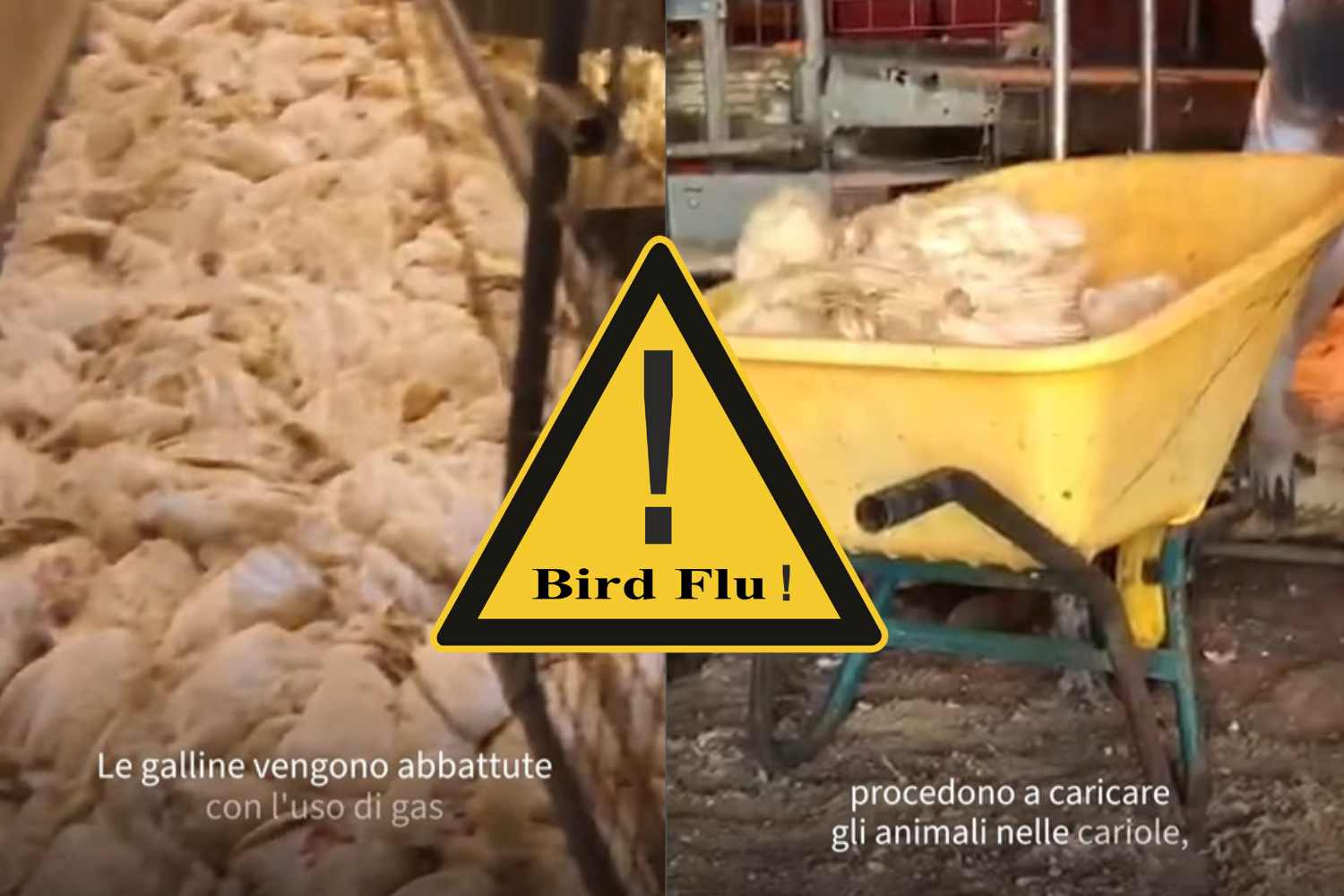
A million hens killed with gas, carcasses piled up in containers, sheds transformed into animal cemeteries. These are the devastating images that Giulia Innocenzi and the Food for Profit team are previewing today, a few days after the broadcast of a maxi-investigation on avian flu which will be broadcast on Sunday 1 February on Report, on Rai3.
The investigation documents what happens in intensive farms when avian flu breaks out, focusing on an emblematic case: the farm of the Monaldi company in the province of Verona, linked to the egg giant Eurovo, which is hit by the virus for the fourth consecutive year.
A collapsing system
The numbers are impressive: considering the production cycles of 2021, 2023, 2025 and now 2026, avian influenza has affected this structure four times. In 2025 alone, 800,000 hens had been culled. This year it will probably exceed one million.
The exclusive images show the so-called “stamping out”, the total slaughter of the animals using gas that saturates the sheds and then the workers loading thousands of carcasses onto wheelbarrows and piling them into huge containers.
The question arises spontaneously: how is it possible that the same farm is hit four times in a row, despite the biosecurity measures that should protect the animals?
The Veneto region has the highest density of intensive chicken and hen farming in Italy, and has been living with recurrent avian flu epidemics for years. In 2025 the virus affected 699 farms across Europe, 64 of which in Italy.
But there is another aspect, even more disturbing, that emerges from Giulia Innocenzi’s investigation and concerns who has to pay the bills for all this. The answer? The citizens. Through access to documents, the investigative team obtained documents that reveal the amount of public funds intended to manage avian flu emergencies.
In 2022 alone, the Veneto Region has provided over 700,000 euros in reimbursements to farmers for slaughtered animals, over 200,000 euros to the Army, called to intervene in the emergency and has drawn up a preventative Framework Agreement for 4 years with a total estimated value of over 115 million euros with private companies for the slaughter, transport and disposal of carcasses
“Why do we all have to pay?” reports the journalist Giulia Innocenzi:
If breeders and the livestock sector do not have to dip into their wallets, not even through compulsory insurance to deal with epidemics, will they really be incentivized to maintain biosecurity standards at the maximum to prevent viruses from entering the sheds?
View this post on Instagram
A system that puts public health at risk
Innocenzi’s words go to the heart of the problem: an intensive farming model that is supported by public money and which, according to the investigation, “puts public health at risk and remains standing only thanks to political choices that do not favor the common good”.
Avian influenza is not just a question of animal welfare or economic costs, it is a health threat that perpetuates itself in a system where the concentration of thousands of animals in confined spaces creates the ideal conditions for the spread of viruses.
The complete investigation will be broadcast on Sunday 1 February on Report on Rai3. In the meantime, the images released today show us a reality that too often remains hidden behind the doors of intensive farming sheds.
