
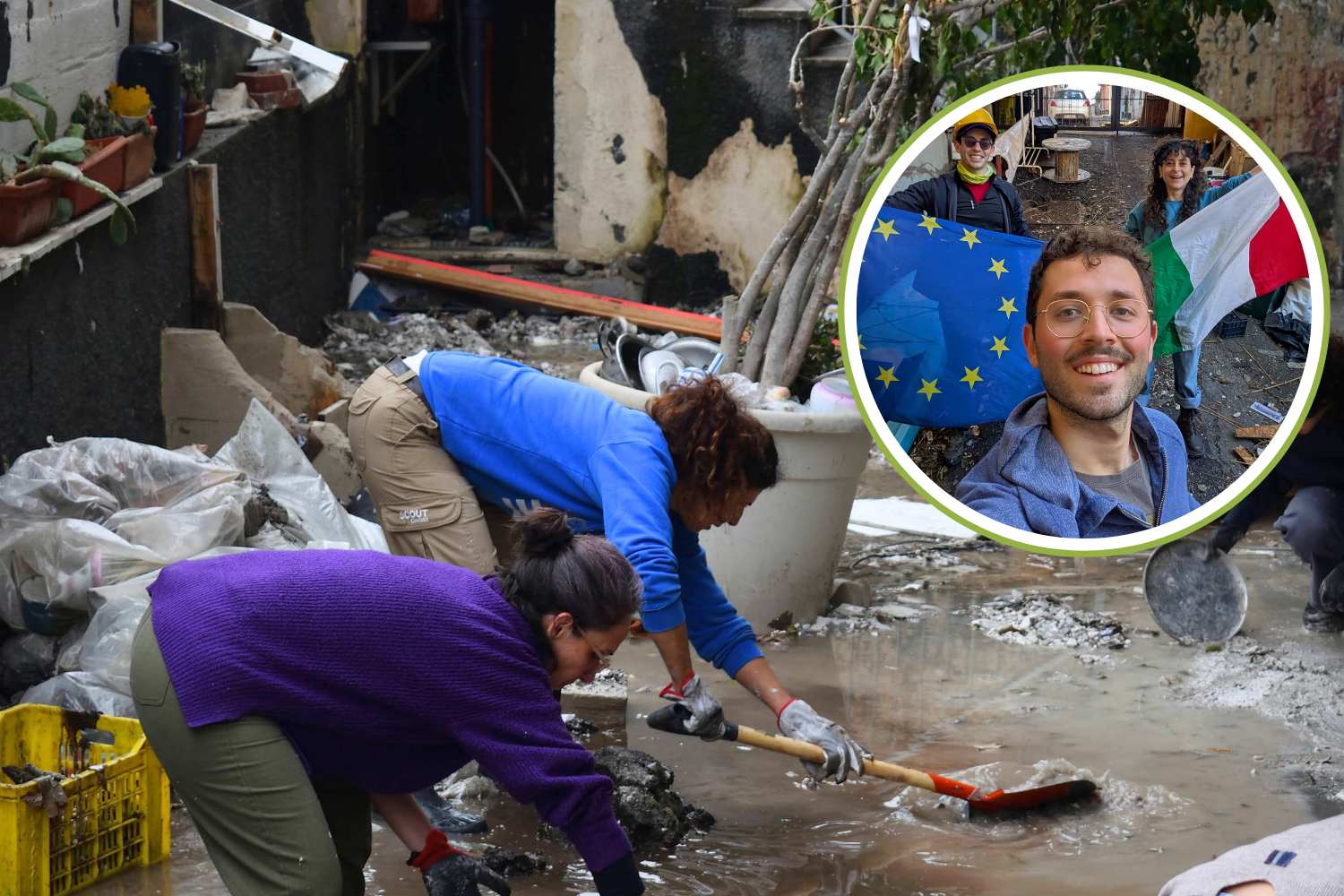
“Hi, I wasn’t here when Cyclone Harry hit Sicily, I came back yesterday and would like to know how to help”
“If you send me the measurements of work gloves and rubber boots, I’ll see if I can find the material to make it available.”
“In the afternoon I will be in Riposto to help, if anyone wants to join, I have 4 seats in the car”
“Help is needed in Fondachello in holiday homes and beaches, who can join?”
It is a continuous tom tam of messages on the WhatsApp group created from below to offer and ask for help after Cyclone Harry which devastated Sicily. On the various channels, divided by province, everyone offers a hand as they can. There are those who call them “mud angels” and they really are in this scenario of anguish and desolation. Its members are mainly young people who – between study and work – organize themselves as much as possible to go and shovel mud, remove debris from houses, restaurants and various commercial activities brought to their knees by the fury of storm surges and strong gusts of wind.
“When we saw the destruction of the coasts we couldn’t stand still. We created a WhatsApp group to understand where we could go to help and the people who wanted to give their contribution were already more than 1200. Every day we report various events: private homes, restaurants, meeting places and public places that require intervention. We connect to the requests of the various municipalities, of the civil protection, of the other associations and citizens of the various towns between Catania and Messina” Simone Grasso, a young volunteer among the promoters of the great mobilization, tells us for Sicily.
View this post on Instagram
Cyclone Harry – emblem of a climate crisis that is hitting ever harder – has obliterated entire coastlines, swept away beaches, swallowed up roads and destroyed premises and homes: a catastrophe, which had a more dramatic scope than expected, but which was almost completely ignored by the various national news programs and media.
There are those who have remained without electricity and water for days and those who have seen the coast where they grew up and the company for which they have made sacrifices for years disappear before their eyes in a few hours. In Santa Teresa di Riva, in the Messina area, the seafront – which extends for around 3 and a half km – appears to have been bombed, as shown by the dramatic images immortalized by drones:
View this post on Instagram
As reported by the mayor Danilo Lo Giudice, the first estimates of the damages amount to 55 million euros. A dramatic figure, if you consider that the whole of Sicily will only receive 33 million euros in the first phase of the national emergency declared in recent hours by the Council of Ministers.
The situation is not any more comforting on the small island of Linosa, in the Pelagie archipelago, where the roads, electricity poles and walls have been destroyed.
Riposto, a municipality in Catania which represents the second largest navy, suffered heavy damage, including to the port, where the pier’s covering largely collapsed. The seafront, particularly in the seaside village of Torre Archirafi, was devastated by the fury of the waves.
View this post on Instagram
Among the commercial activities in Riposto that were most affected by the extreme event, the “Ai Tre Massi” restaurant, where debris and mud reign, which several volunteers are now removing.
“It was terrible to see our country destroyed overnight, no longer being able to find ourselves in our favorite places, where we grew up. – say Martina Calabretta and Martina Cosentino, two young people who made themselves available to revive Riposto – We decided not to just watch, but to help those in need in our own small way. Together we can do beautiful things.
A catastrophe (almost) invisible on the national media
Those who make a living from tourism in the areas affected by Cyclone Harry will find themselves having to deal with months – if not years – that promise to be dark. Yet some newspapers limited themselves to talking about bad weather and strong storms. To the incalculable damage, insult has been added: that of indifference.
“My colleagues from Lombardy knew nothing about what happened in the South, they told me they had heard some quick news on TV and radio and asked me: but was it that serious?” a friend of mine, of Sicilian origins, who lives in Milan, told me.
Only a few people known as Fiorello – strongly linked to his Sicily – took the time to give visibility to the issue on TV. And in the meantime the first fundraisers for the island are starting from the bottom.
As if that wasn’t enough, inappropriate comments have multiplied on social media: “parasites”, “It suits you, southerners! So stop building illegal houses”. And there are even those who have ventured a “I had booked in Sicily for the holidays, will everything be sorted?”.
Yes, it is undeniable, many houses and premises were built in risk areas where we shouldn’t have (even if in many cases it was all legal under the laws of the time) and that the watchword in these cases is prevention and care of the territories. But the plague of illegal construction and wild overbuilding is not a prerogative of Southern Italy: just look, for example, at the Cinque Terre in Liguria.
What if it had happened elsewhere?
In light of what happened, however, some questions arise spontaneously: what if it had happened in the North? What if cities that were strategic for the Italian economy had suffered all this damage? The reaction from the media and the political world would have been decidedly different and immediate. And had the same cyclone destroyed luxury hotels and resorts? A fundraiser would probably have started, launched by some VIP. But ultimately it is not the regions considered the locomotive of Italy that have been devastated. It is “only” the South, where you eat very well, without spending a fortune, and there are dream beaches but it is an already fragile and damned land, which is unable to redeem itself.
The reality is more dramatic than it seems from the outside: the funds allocated at the moment are negligible – just 100 million euros for Sicily, Calabria and Sardinia – in the first phase. And they will only be used to cover the first expenses incurred by the municipalities, namely the removal of debris and the restoration of the functionality of some essential services.
For the South the word reconstruction sounds a bit like a utopia. And while the political catwalks and promises begin – especially in the municipalities where there is an air of electoral campaigning – citizens roll up their sleeves and try to save themselves. With shovels, boots and gloves dirty with mud, thousands of volunteers are committed to restoring beauty and hope to these forgotten territories, which we remember when planning summer holidays.
Anyone wishing to join the WhatsApp group of volunteers in Sicily can do so by logging in HERE.
