
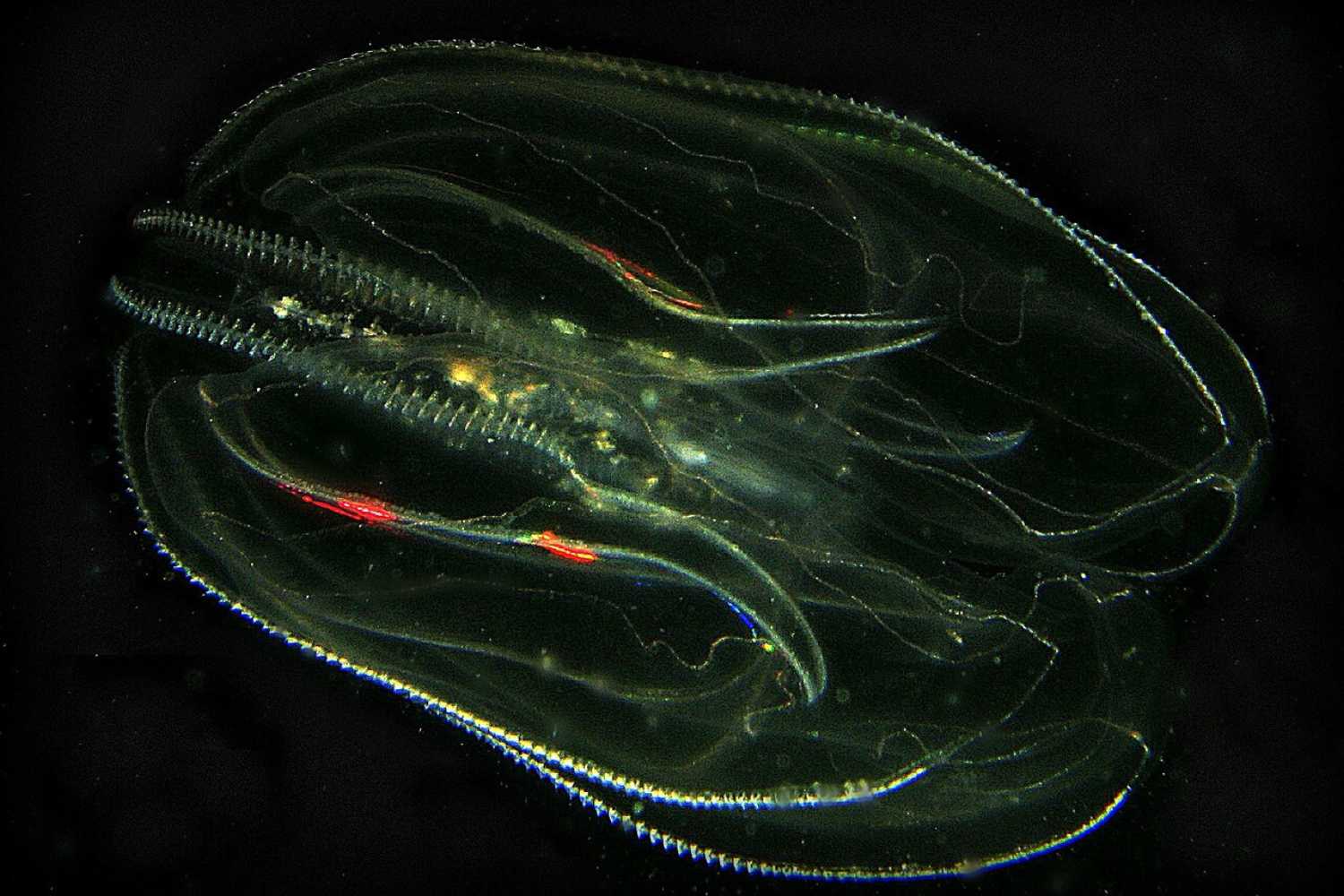
In the Venice Lagoon there is an invader who is changing the rules of the game. It is transparent, silent, almost invisible in the waters of the canals: the sea walnut, common name of Mnemiopsis leidyia ctenophore that arrived from afar and is now more of a concern than much more conspicuous alien species, such as the blue crab.
This is revealed by two years of monitoring conducted by the University of Padua together with the National Institute of Oceanography and Experimental Geophysics (OGS). The study, published in Science Direct, precisely reconstructs the ecological profile of this organism and its increasingly close relationship with the climate transformations underway.
An alien who thrives on change
Originally from the western Atlantic, the sea nut probably arrived in Europe with the ballast water of ships. In the Adriatic it appeared for the first time in 2005, in the Gulf of Trieste. Then, after a phase of apparent disappearance, since 2016 it began to reappear regularly, until it found a surprisingly favorable environment in the Venice Lagoon.
The reason is simple, at least on paper: Mnemiopsis leidyi tolerates almost everything. Laboratory and field analyzes show that it survives between 10 and 32 degrees and with very variable salinities, from 10 to 34 grams per liter. Conditions which, in an increasingly warm and saline lagoon due to drought, are becoming the norm.
Unrestrained reproduction, unrivaled appetite
It is not just adaptability that makes the situation critical. The sea walnut is hermaphroditic and capable of self-fertilization: a single individual can release thousands of eggs a day. The result is summer “blooms”, gelatinous masses that end up in fishermen’s nets and above all consume enormous quantities of zooplankton.
This is where the impact on the ecosystem becomes concrete. Zooplankton is the food base of many small fish. By subtracting this resource, the sea walnut enters into direct competition with native species. It is no coincidence that the International Union for Conservation of Nature (IUCN) includes it among the hundred most harmful invasive species in the world.
Lagoon under climatic pressure
The data collected in Venice show an increase in presences between late spring and early autumn, in parallel with the rise in temperatures and salinity. In the same period, between 2014 and 2019, the local catch decreased by almost 40%. The study does not speak of unique causes, but the picture that emerges is coherent: the climate is shifting the lagoon balance towards ideal conditions for the invader.
As Valentina Tirelli, OGS researcher and co-author of the research, explained, “the results suggest that ongoing climate changes could favor increasingly suitable environmental conditions for this ctenophore, increasing its presence in large aggregates and, consequently, increasing the risk of severe repercussions on the functioning of the entire lagoon ecosystem”.
The sea nut tells a lot about the present of the Venice Lagoon. In addition to being an alien species, it is a biological indicator of a system that is rapidly changing. Ignoring it would mean missing another signal, perhaps one of the clearest, of how much the climate is already rewriting the balance of our sea.
