
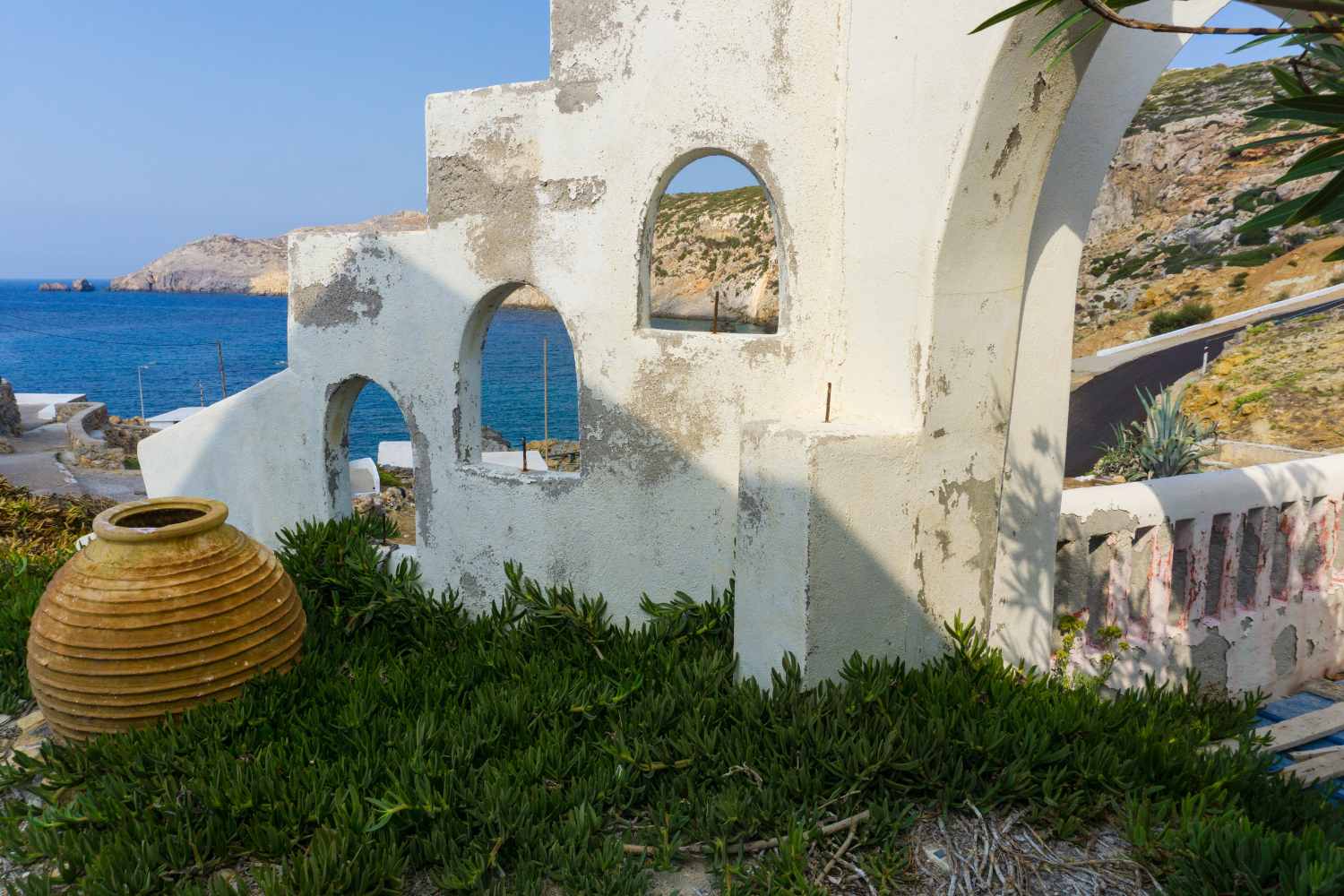
Antikythera occupies a secluded location in the Aegean Sea, suspended between the southern tip of the Peloponnese and the north coast of Crete. Connections remain limited to a few weekly ferries, a characteristic that has made it one of the most isolated and wild islands in Greece. In these parts, the distance from the rest of the country is not only geographical, but also, above all, cultural and temporal.
Few inhabitants and time that passes slowly
With less than fifty residents and a surface area that does not exceed 20 square kilometers, Antikythera appears to be a place outside the dynamics of mass tourism. The small size and the absence of large tourist flows have preserved a rare atmosphere, dominated by silence and a daily life marked by ancient rhythms.
No resort, no shopping centre, total absence of nightlife, just nature, clear sea and a community that keeps the most ancient and deep-rooted traditions alive.
Antikythera in brief: the essential data
Quick information about the island:
Because Antikythera offers money to those who move
The question arises spontaneously: why should a Greek island pay for new residents? The answer involves a slow but steady loss of population. With such a small number of inhabitants and a high average age, Antikythera risks being completely emptied within a few years. To counter this scenario, the Greek Orthodox Church, together with the local authorities, has launched a project aimed at repopulation. The initiative aims to attract new families, with particular attention to those with children, so as to guarantee a future perspective for the island and keep essential services alive.
What does the repopulation program include?
The project is not a simple economic incentive, because it proposes a true integration path:
The objective is not temporary help, but the construction of a stable presence, capable of becoming an integral part of island life.
Who is the project aimed at?
As mentioned in the previous paragraph, the initiative is not aimed at those looking for a temporary parenthesis or a short escape from routine, because Antikythera is looking for people willing to put down roots, ready to start a new chapter in their lives. Young families, especially with children, are the ideal profile, as long as they are available to live on the island all year round.
The winter stay requires a good deal of adaptation, given that in the cold months the isolation increases and the daily rhythm slows down further. You need a genuine interest in a truly basic lifestyle, connected to nature and away from urban conveniences, so it’s not a suitable choice for everyone.
Daily life on such an isolated island
Living in Antikythera means leaving traffic, noise and constant urgencies behind. The days pass between silences, simple gestures and a direct relationship with the surrounding environment. A context that offers clear benefits, but also some difficulties to take into account.
The advantages:
The challenges:
View this post on Instagram
Current project situation (January 2026)
At the end of the interviews, up to five families will be identified. The initiative has also attracted considerable attention outside Greece, with a new peak of interest expected in the first months of 2026, but at the moment no family units have yet settled on the island. Delays related to administrative procedures have slowed down the construction of new homes, effectively postponing the transfers. Applications remain open or under evaluation, and to follow any updates it is advisable to contact the local authorities or the Church of Kythera directly.
