
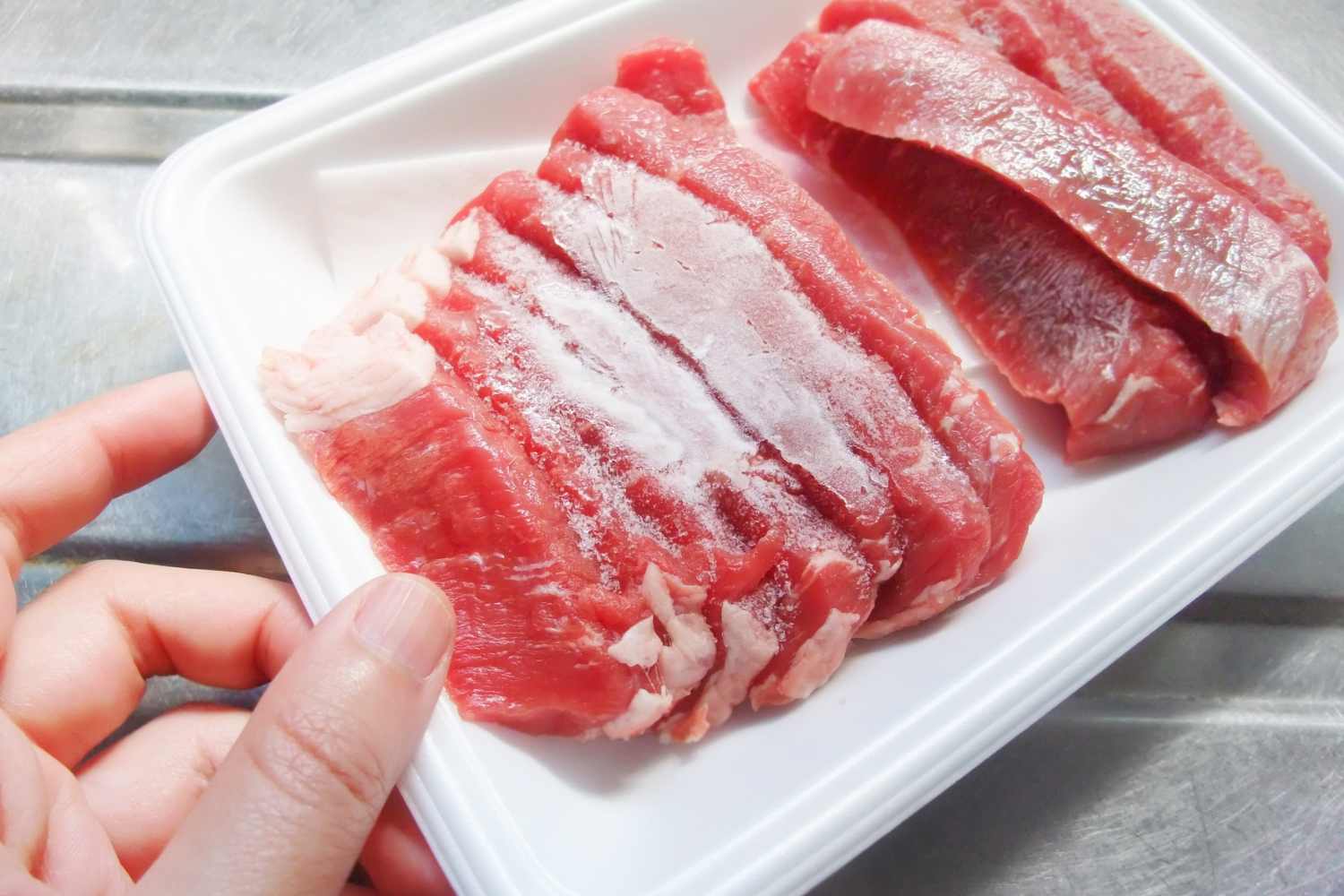
When we think about freezing meat, we tend to feel safe when it comes to bacterial growth. In reality, according to a new and detailed scientific study by EFSA (European Food Safety Authority), the problem could hide much earlier, in the days before freezing.
The research essentially reveals to us that it is not so much the freezing that makes the difference for the safety of the meat, but rather the way in which it is preserved in the previous days. And some practices currently permitted by European legislation may not be sufficient to guarantee safe products.
Why EFSA conducted this research
The European Commission has asked EFSA to clarify a thorny issue, that of the current regulations on frozen meat which appear to be incomplete and, in some cases, contradictory. In fact, for example, there are no precise indications on the maximum storage times before freezing, nor on the temperature limits to be respected.
The European regulation speaks generically about freezing “without undue delay” after slaughter, but does not specify what this actually means. This vague definition creates room for maneuver that can translate into real risks for consumers.
EFSA scientists studied five different ways of preserving meat (beef, pork and sheep) before freezing, using very advanced predictive models to estimate the growth of dangerous bacteria such as Salmonella, Listeria monocytogenes, Escherichia coli and Yersinia enterocolitica, as well as bacteria that cause meat spoilage.
To have a clear reference point, they chose as a standard meat stored at 7°C, under normal conditions (i.e. without vacuum), for 15 days. This scenario represents the “safe” situation against which all other conditions are compared.
The alternative scenarios instead combined two possible temperatures (7°C or 3°C), with or without vacuum packaging, and storage times of up to 6 weeks.
The goal was to calculate the so-called “equivalence time”, i.e. to understand how long the meat can be stored in each of these scenarios before the level of bacteria exceeds that of the reference scenario, therefore making it potentially unsafe from a microbiological point of view.
The problem of storage at 7°C
The most alarming result concerns conservation at 7°C with vacuum packaging: in these conditions, only 5-6 days are enough for Salmonella to grow enough to make the meat as dangerous as meat stored for 15 days without vacuum packaging.
This means that vacuum packaging, often perceived as a guarantee of longer shelf life, does not offer protection if the temperature is not low enough. Indeed, the anaerobic (oxygen-free) environment created by the vacuum can favor some pathogenic bacteria.
The probability that these scenarios at 7°C result in bacterial growth above the reference is estimated at between 95% and 99%, a level of certainty defined as “extremely probable” by experts.
By lowering the temperature to 3°C, the situation improves considerably, the equivalence time in fact increases to 29-30 days before it is necessary to freeze the meat.
In this case, however, the problem shifts from pathogenic bacteria to deteriorating bacteria, in particular lactic acid bacteria, which can alter the smell, color and appearance of meat long before it becomes dangerous from a health point of view.
Furthermore, if the initial contamination at slaughter is high (for example due to hygienic deficiencies), deterioration levels can be reached after 15-16 days, even at 3°C. This underlines how hygiene during slaughter remains a critical factor and cannot be replaced with simple refrigeration.
What happens during and after thawing
The good news is that thawing, if done correctly at temperatures of 4°C or 7°C, does not cause significant growth of bacteria. However, the problem arises immediately afterwards: if the thawed meat is kept for another seven days, the bacteria can start to multiply again. In the case of Yersinia enterocolitica, for example, the quantity can increase up to almost three times, while for Listeria monocytogenes the increase is approximately one and a half times.
This means that the storage times considered safe before freezing must be further reduced if the phase after thawing is also taken into account. In some situations it becomes necessary to immediately freeze meat after slaughter to ensure that the final product is safe.
The implications for industry and consumers
This research highlights a key point: freezing does not “fix” previous mismanagement. If the meat arrives in the freezer already loaded with pathogenic bacteria, these will remain present even after freezing, ready to multiply again during thawing and subsequent storage.
Currently, it is practically impossible for the consumer to know how much time has passed from slaughter to freezing. The label rarely indicates the freezing date and almost never the slaughter date, leaving us completely in the dark about the “history” of the product.
The real risk is therefore that of purchasing meat that is already compromised from a microbiological point of view, or close to deterioration despite freezing.
Based on these EFSA conclusions, the European Commission could (indeed should) review the regulations, introducing:
These changes would have a significant impact on the entire supply chain: slaughterhouses, processing industries, logistics and large-scale retail trade would have to adapt their procedures and infrastructures.
What we can do as consumers
While waiting for any regulatory changes, some precautions can still help us:
