
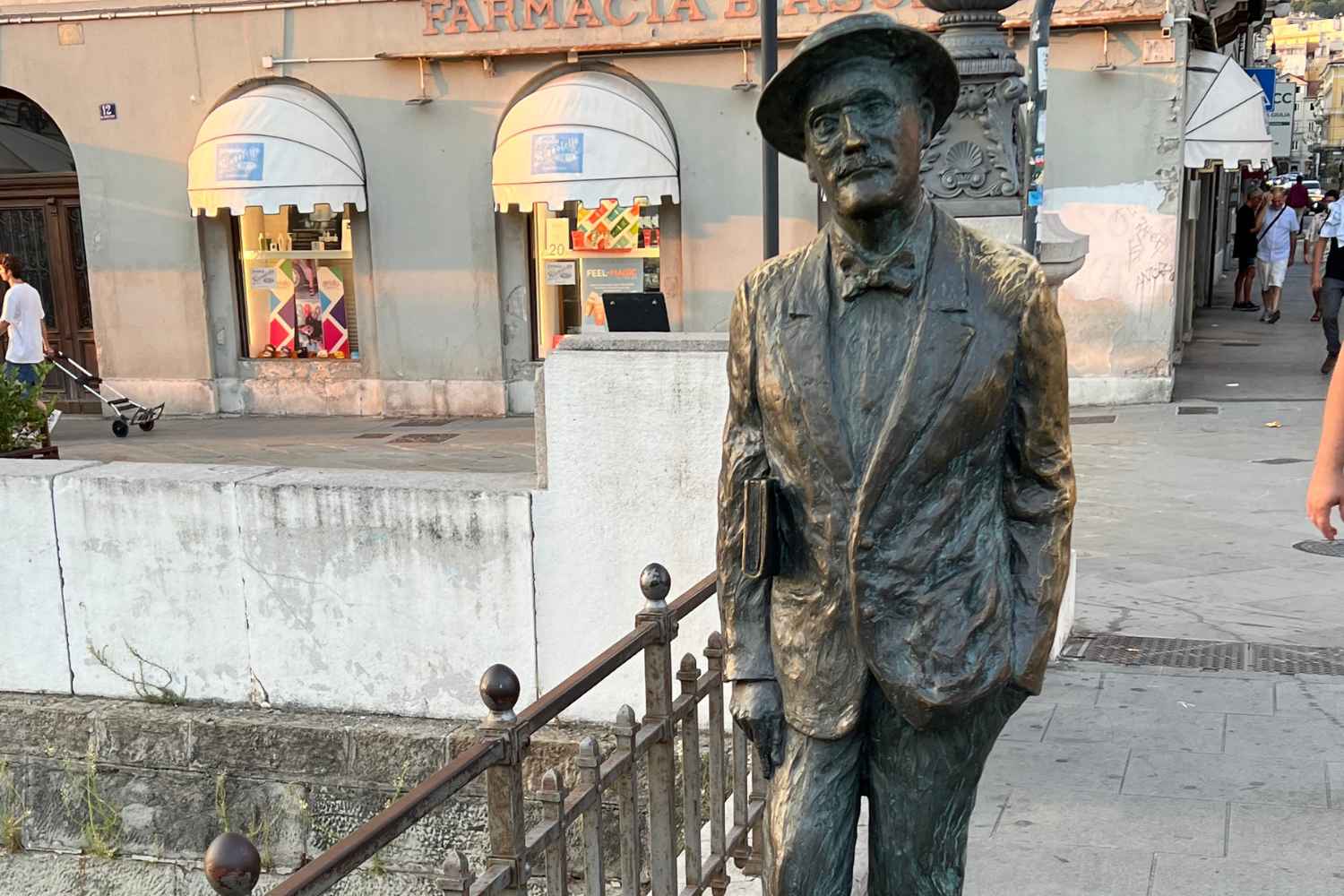
Walking along the central streets of Trieste, a few steps from the Molo Audace, we came across a presence that immediately caught our attention: the statue of James Joyce. Tall, imposing, in bronze polished by time and the caresses of tourists, this sculpture is not simply a tribute to a writer. It is testimony to a deep, almost visceral bond between a man and a city that welcomed him, inspired and transformed him.
The discovery that surprised us
When we reached Piazza Ponterosso, we did not expect to discover that that statue was located exactly where Joyce had lived. Yes, right there, in that building overlooking the Grand Canal, the Irish writer lived his first years in Trieste together with his partner Nora Barnacle. The Trieste sculptor Nino Spagnoli, creating this work in 2004 to celebrate the centenary of Joyce’s arrival in Trieste, did not choose the location by chance: he wanted to bring the writer back exactly where his Trieste adventure began.
Who really was James Joyce?
As we looked at the statue, we asked ourselves: who really was this man who is celebrated with so much affection today? James Joyce arrived in Trieste on 20 October 1904, at just 22 years old, together with Nora. The original plan was to work as a teacher at the Berlitz School, but the position was no longer available and the couple was rerouted to Pula. It was only in 1905, at the birth of their first-born Giorgio, that the Joyces finally settled in Trieste.
Their life here was not easy, Joyce struggled with alcohol, constant debts, the absence of stable employment. The turning point came when he began giving private English lessons to wealthy families in Trieste and when he obtained a position at the Berlitz School. But even in his darkest moments, Joyce never stopped writing.
Places of creativity
We discovered that many of his most important works were born right here, in the cafés and streets of Trieste. “Dublin People”, “Exiles” and above all “Ulysses” – the latter began to take shape at the tables of the famous Pasticceria Pirona, one of the historic literary cafés of Trieste, now splendidly restored and returned to its former glory.
In 1907, after a brief and unsatisfactory period in Rome as a bank clerk, Joyce returned to Trieste. Here his life was enriched: he wrote for the “Piccolo della sera”, held conferences on Ireland at the Università del Popolo, published “Chamber Music” and, crucially, met Ettore Schmitz, better known as Italo Svevo.
The friendship that changed two lives
Svevo turned to Joyce to learn English, but from that teacher-student relationship was born a deep friendship that would influence both writers. Joyce read Svevo’s “Una Vita” and “Senità”, works that the public had ignored, and encouraged his friend to continue writing. In the meantime, Joyce himself planned the first parts of “Ulysses”, while he divided his time between private lessons, the professorship at the Revoltella High School of Commerce and his publications.
In 1912 he attempted to publish “Dublin People” without success. The work saw the light only two years later, thanks to the intervention of Ezra Pound.
The war and the farewell
The outbreak of the First World War in 1914 forced Joyce to leave Trieste for Zurich. It was there that he finally achieved fame, completing “Ulysses.” He returned briefly to Trieste in October 1919, remaining there until June 1920. In those months he wrote “Nausicaa” and “Oxen of the Sun”, two episodes of “Ulysses”, and began “Circe”. Then he moved to Paris and never returned to the city that had defined his soul. “Ulysses” was published in 1922.
The Borgo Teresiano and memory
Walking through Borgo Teresiano, the eighteenth-century neighborhood built by the Habsburgs and elegantly built around the Grand Canal, we understood why Joyce loved Trieste so much. This was his world: cosmopolitan, Central European, full of intellectual stimulation.
The statue on the Ponterosso, 1.80 meters tall like the writer himself, is much more than a monument. It is a meeting point, a place of pilgrimage for lovers of literature, and above all it is the visible symbol of a bond that time has not broken.
Where to find it and why to visit it
If you want to see the statue of James Joyce in Trieste and relive his myth, all you have to do is walk along the Grand Canal to Piazza Ponterosso. He will be there waiting for you, with his gaze turned towards the Grand Canal, towards that Trieste which welcomed him as a penniless young man and saw him become one of the greatest writers of the twentieth century.
Under the statue, a plaque recalls the writer’s deep connection to the city. And every 16 June, since 2010, Trieste celebrates Bloomsday, the date on which the action of Leopold Bloom, the protagonist of “Ulysses”, is set through the streets of Dublin. But it is in Trieste that this masterpiece was born, and it is here that Joyce left his soul.
Of all the things to see in Trieste, you absolutely cannot miss this statue. And don’t forget to take a selfie with him: you will be in excellent company, that of thousands of readers, travelers and dreamers who come every year to pay homage to the writer who was able to transform everyday life into poetry and Trieste into immortal literature.
