
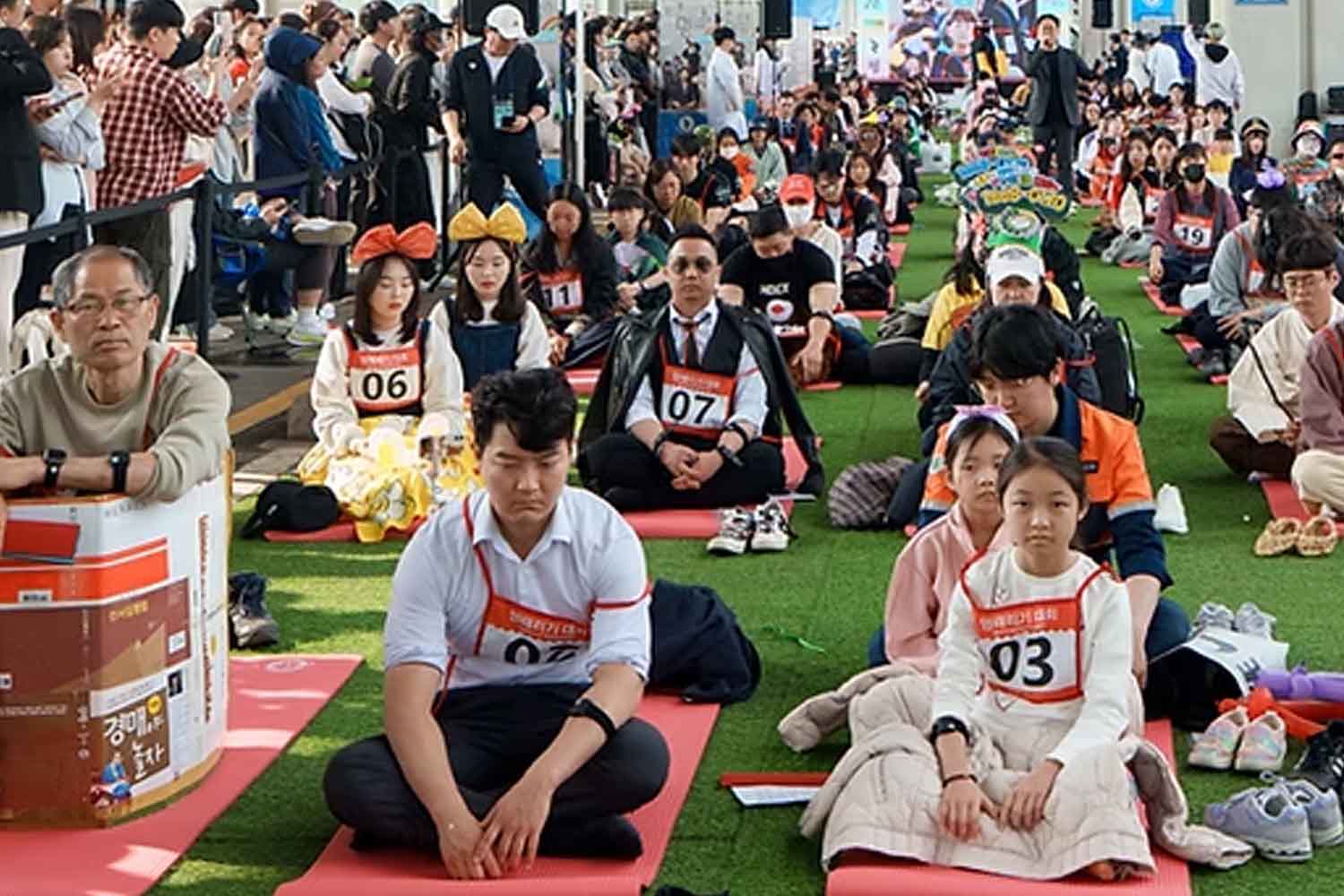
In South Korea there is a competition that, at first glance, seems like a joke but actually says a lot about us, our time and the way we experience work. It’s called space-out competition and its objective is as simple as it is shocking: to remain still, in silence, doing nothing for ninety minutes. No phones, no distractions, no performances. Just presence.
In a country known for its extremely hard work rhythms, for the social pressure linked to success and for an idea of personal value that often coincides with productivity, over the years this competition has become a small crack in the system. It doesn’t make any noise, it doesn’t shout slogans, but it invites you to stop. And to ask ourselves if we were really born to run non-stop.
The space-out competition was born in Seoul
The space-out competition was born in 2014 in Seoul as an artistic and social project. Not as a sporting event, nor as a spiritual practice, but as a concrete response to a widespread sensation: mental tiredness. A tiredness that doesn’t go away by sleeping a few more hours, because it has its roots in the constant obligation to be efficient, high-performing, always up to par.
During the competition, participants sit next to each other, often in parks or public spaces, and remain still. They don’t have to prove anything, they don’t have to win by outdoing someone else. Calm becomes the reference parameter. The heartbeat, the ability not to get agitated, not to give in to the impulse to control something, to do something. Ultimately, to justify one’s existence through action.
A response to the burnout that affects modern societies
Those who look at these images from the outside tend to smile. Ninety minutes of sitting seems like a small thing. Yet, for those who live immersed in daily pressure, doing nothing is surprisingly difficult. This is exactly the point. The space-out competition doesn’t make fun of the idea of competition, it dismantles it from the inside. Transform inaction into a conscious gesture.
In recent years the event has attracted more and more attention, especially in 2025, when hundreds of people attended the most recent editions. Among them also Byung-jin Park, musician and cultural entrepreneur, who described the experience as a way to free up mental space and find a more authentic contact with himself. No mystical enlightenment, no promise of happiness. Only silence, breathing and time that ceases to be an enemy.
What makes the space-out competition interesting for us too, here in Italy, is not the exoticism of the event, but the message it brings with it. We too live in a society that rewards those who run, those who respond immediately, those who fill every void. Free time is often experienced with a sense of guilt. Resting seems like a concession, not a right.
The Korean race reminds us that stopping does not mean giving up, but regaining clarity. That rest is not unproductive, on the contrary. Many participants say they emerge from those ninety minutes lighter, more creative, less reactive. As if, by removing the noise, something essential would emerge again.
The space-out competition does not propose universal solutions or models to copy. However, it offers a possibility: looking at our relationship with time and work from another angle. And perhaps, even just for a few minutes a day, give ourselves the luxury of doing nothing without feeling at fault.
You might also be interested in:
