
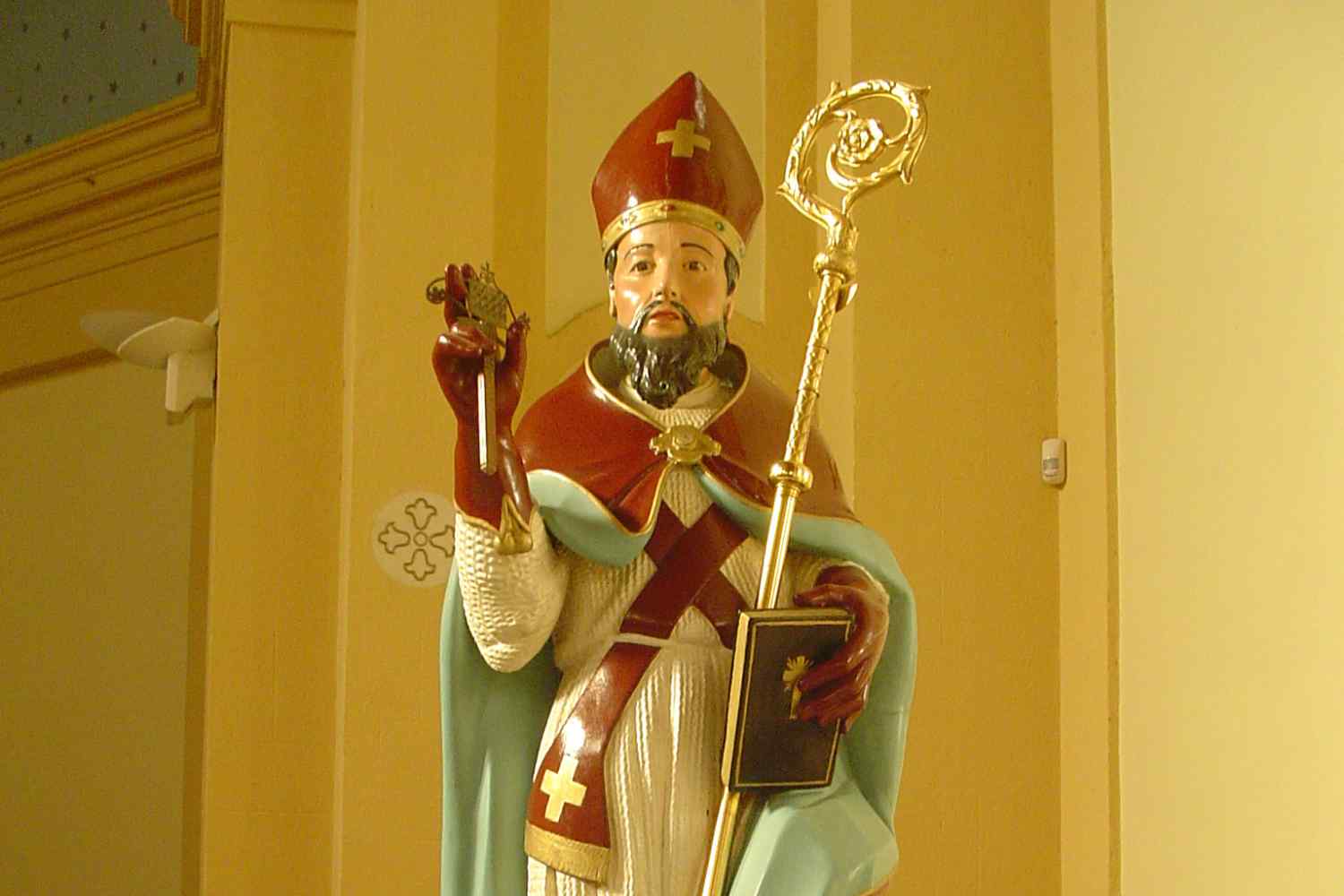
The figure of San Biagio, celebrated every February 3rd, represents one of the most heartfelt devotions in the Christian tradition, both Catholic and Orthodox. Its history has its roots in 4th century Armenia, in a turbulent period marked by religious persecution.
A medical bishop in ancient Armenia
Saint Blaise practiced as a doctor before becoming bishop of Sebaste, a city in Armenia. Information about his life comes to us mainly through oral testimonies collected by the hagiographer Camillo Tutini. His martyrdom took place around the year 316, during the clashes between the emperor Constantine, who governed the West, and Licinius, lord of the East.
The saint’s death was particularly bloody: arrested by Roman soldiers, he was violently tortured using iron combs intended for wool processing, which tore his flesh. He was finally beheaded for refusing to renounce his Christian faith.
The miracle that made him famous
During his imprisonment, Saint Blaise performed what would become his best-known miracle: he saved a young boy who was suffocating due to a fish bone stuck in his trachea. This extraordinary episode consecrated him as a patron saint against throat disorders, a role for which he is still invoked by the faithful today.
For this particular protection, San Biagio is counted among the fourteen holy helpers, a group of saints called to intercede for specific illnesses and afflictions.
The rite of blessing
A characteristic religious practice linked to San Biagio is the blessing of the throats, which is given during the liturgical celebrations of February 3rd. The priest carries out this rite by placing two blessed candles crossed in front of the necks of the faithful. In ancient times, instead of candles, consecrated oil was used.
Regional culinary traditions
In various areas of Italy, gastronomic customs linked to the saint’s feast have developed. In Milan, for example, families have the habit of consuming the leftovers of the Christmas panettone preserved specifically for this occasion, the so-called “panetùn de san Bias”.
In the Salerno area, precisely in Lanzara, the typical “meatball of San Biagio” is prepared, while in Salemi, in the province of Trapani, the tradition is linked to a miraculous event in 1542. In that year the saint saved the inhabitants from a terrible famine caused by an invasion of locusts that had devastated the fields. In memory of this miracle, every 3 February “cavadduzzi” (locusts) and “caddureddi” are made, small breads with a shape reminiscent of a throat, prepared with simple water and flour, then blessed and distributed among believers.
Since 2008, again in Salemi, an evocative historical re-enactment of the miracle of the locusts has been staged, involving all the educational institutions and local associations, culminating with a procession to the church dedicated to the saint.
The relics in Maratea
The remains of San Biagio are preserved in Maratea, a Lucanian town overlooking the Tyrrhenian Sea, of which he is the patron saint. Their story is shrouded in legend: in the year 723, a boat carrying a marble urn containing relics from Sebaste to Rome was forced to interrupt its journey to Maratea due to a violent sea storm.
Local tradition tells of prodigious phenomena: from the walls of the Basilica, and subsequently from the monumental statue of the saint erected in 1963 on the top of the mountain, an amber colored liquid flowed which the devotees collected to treat the sick. In 1563, Pope Pius IV, then bishop, officially recognized this substance as “heavenly manna”.
For this reason in Maratea San Biagio is honored with two annual celebrations: the canonical one on February 3rd and the one commemorating the arrival of the relics, which lasts for eight consecutive days, from the first Saturday of May until the second Sunday of the same month.
