
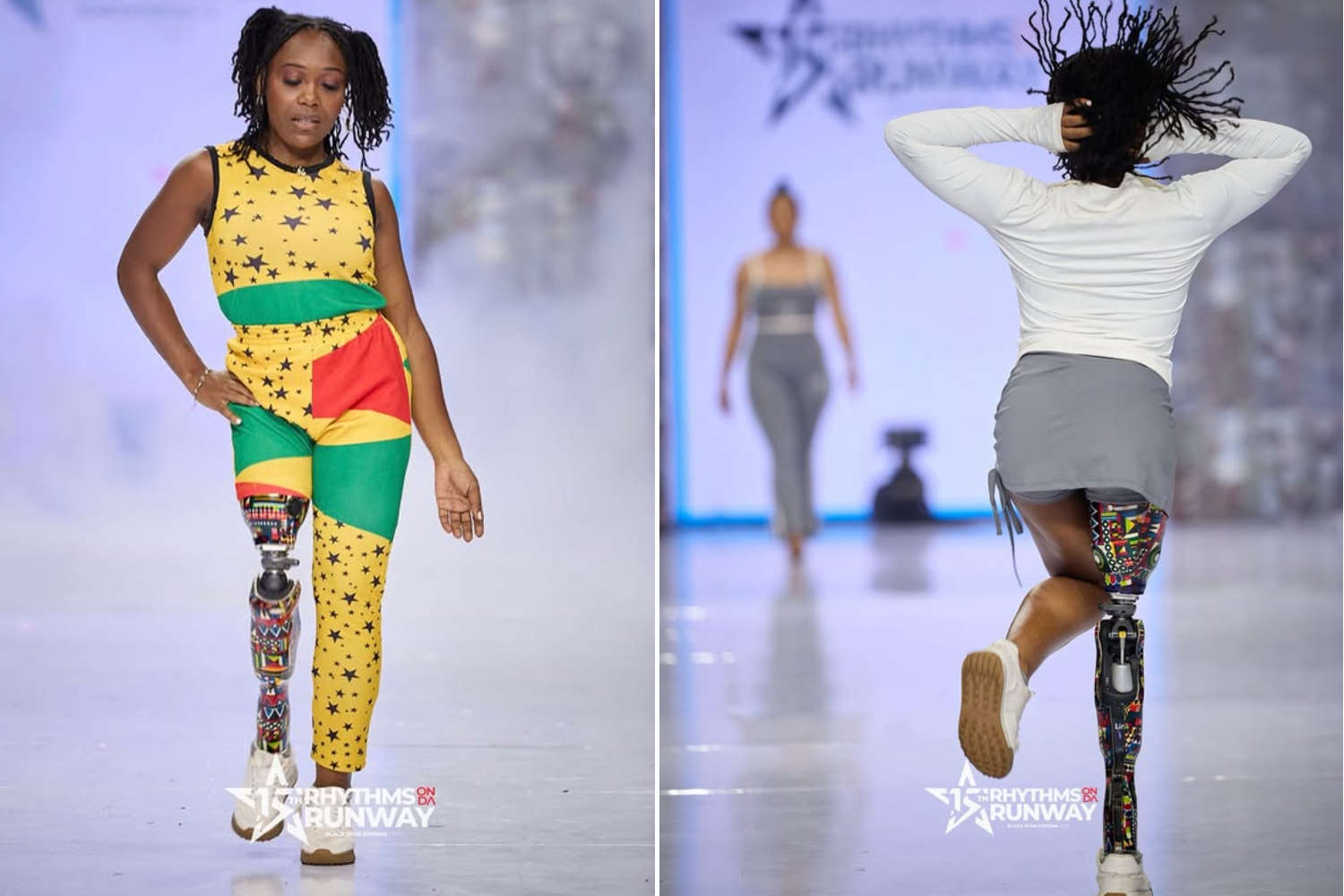
At the Rhythms on the Runway fashion show in Accra, one of the most relevant fashion events in Ghana, the presence of Abena Christine Jon’el transformed the catwalk into a space of visibility and discussion. The 33-year-old Ghanaian-American model and writer showed off her prosthetic, wrapped in traditional kente fabric, making it immediately apparent that it wasn’t just about fashion, but about representation.
View this post on Instagram
Abena did not hide her disability, on the contrary she made it a central part of the visual narrative. In a context in which people with disabilities are often marginalized, especially in the media and creative sectors, his choice took on a symbolic and political value. Kente, a fabric full of cultural and historical meanings, has become an extension of the body and identity, not an ornament.
At the age of two, Abena had her right leg amputated due to a rare tumor, Rhabdomyosarcoma, a sarcoma arising from striated muscle cells. Raised in the United States, in Chicago, she soon learned to live with therapies, rehabilitation and external gazes. Far from the stereotype of the silent and accommodating disabled person, she has always claimed a strong, direct, often uncomfortable personality. That same determination led her to become a writer, speaker and activist.
View this post on Instagram
The return to the roots
In 2021, a trip to Ghana was a turning point. In Accra and in the symbolic places of African memory, Abena felt a deep sense of belonging, which pushed her to move permanently to the country a few months later. Since then she has lived in the capital, where she was welcomed as part of the community, building a bond that she herself defines as ancestral and not symbolic.
Her participation in Rhythms on the Runway comes from a clear belief: without representation, stigma thrives. In Ghana, Abena explains, disability is still talked about almost exclusively through the lens of difficulty and compassion. Bringing a disabled body onto a nationally watched catwalk meant breaking that imagery, showing ambition, style and pride.
The moment of the parade was hailed as one of the most significant of the event, but for Abena the applause wasn’t the point. The real result was seeing people with disabilities no longer on the margins, but at the center of the scene. With her gesture, Abena Christine Jon’el reiterated that disability is not a limit at all.
View this post on Instagram
You might also be interested in:
