
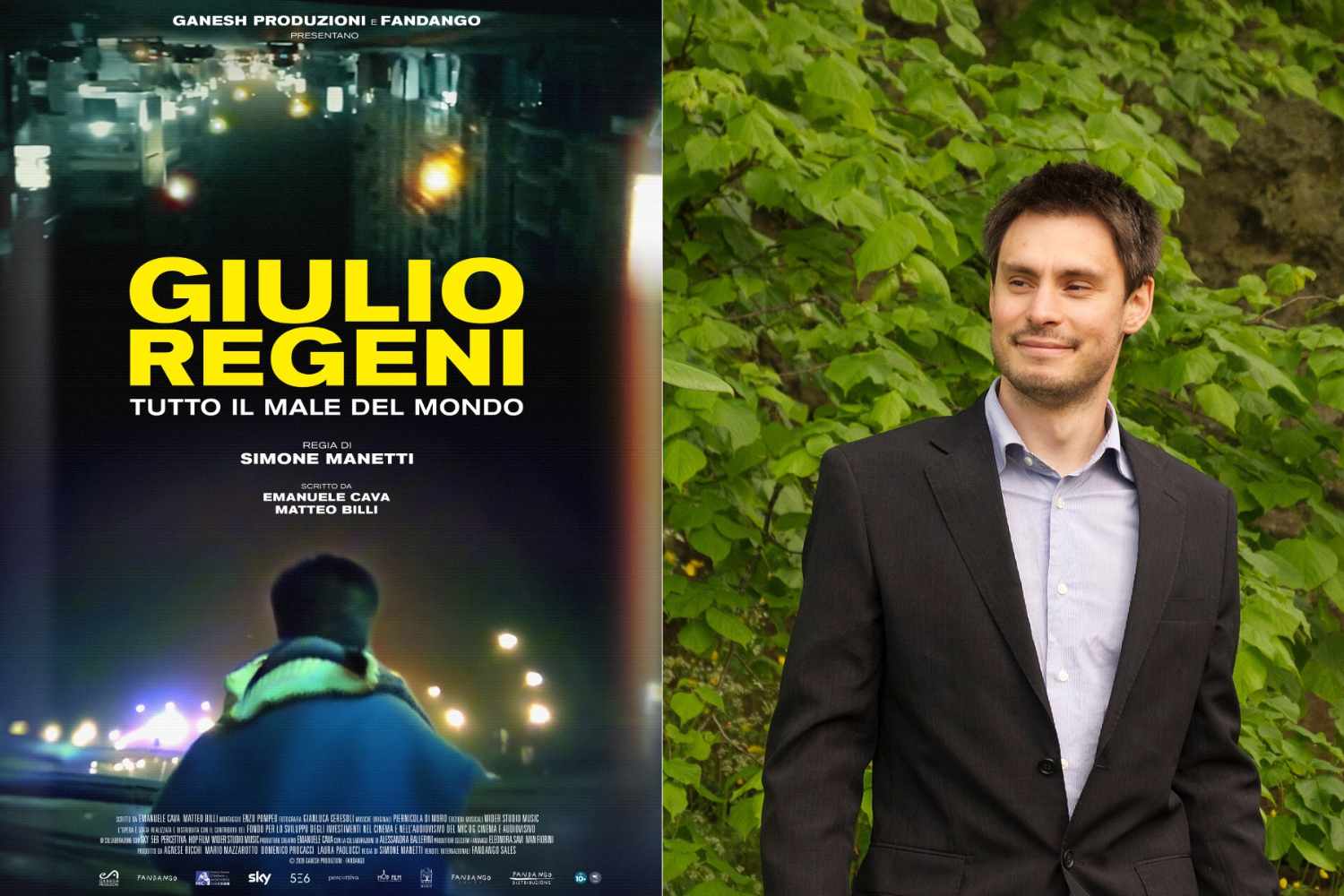
Simone Manetti’s documentary, Giulio Regeni – Tutto il male del mondo, proceeds with a firm step in the reconstruction of an absence that walks among the rubble of a truth that has been denied and actively trampled on for too long. Ten years after that 3 February 2016, when Giulio’s body was found lifeless on the outskirts of Cairo, the story of the young Friulian researcher has become the mirror in which Italy and the whole of Europe measure their own dignity.
Parents and civil determination
The entire structure of the film is governed by the presence of Claudio Regeni and Paola Deffendi. They tell of years of requests, expectations and closed doors. Next to them is Alessandra Ballerini, the lawyer who has assisted them since the beginning and who, both in Italy and Egypt, had been repeatedly advised to stop: continuing would only have created “false hopes” in Giulio’s parents. The choice to continue, however, is a fact that in 2023 leads to the indictment of four Egyptian National Security agents and, in the spring of 2024, to the opening of the trial in Rome. Today the trial is suspended for a question of constitutional legitimacy, with the horizon of a possible first instance ruling by 2026.
The system of paranoia and the “danger” of understanding
Giulio has been crushed by a dictatorial regime based on paranoia, where suspicion kills. In 2015 he moved to Cairo for research commissioned by the University of Cambridge on street vendor unions. Just one of them, the central source of his work, reports it to the Security Services.
In a context where life is not a value in itself, the foreigner who speaks Egyptian Arabic perfectly and observes reality represents a threat to be freed from. This is followed by stalking, house searches and a registration as a spy. During a union meeting, Giulio confides to a friend that he is worried: a woman has photographed him. If he had been in a position to understand the real risk he was running, says the lawyer Ballerini, Giulio would not have returned to Egypt after spending the Christmas holidays in his native Friuli.
The theater of red herrings and Al-Sisi’s promises
The film makes no concessions to betrayed promises. Remember President Al-Sisi’s touted commitment: “We will use every means to shed light.” Words that sound like the beginning of a macabre charade. An unprecedented mud machine starts: Giulio is described as a foreign agent, then as a homosexual. A (supposed) witness claims, and then recants, that he saw him arguing, in a pink shirt, with a man, right near the outskirts of the Egyptian capital where his body was found. Yet another paranoid, but partly effective, systematic attempt to cover National Security under the veil of an entire government’s lies.
The trial of the “voids” and the media hysteria
While the Court of Assizes of Rome proceeds in the absence of the defendants – General Tariq Sabir, Colonels Athar Kamel Mohamed Ibrahim and Uhsam Helmi, Major Magdi Ibrahim Abedal Sharif – Manetti lines up the gaps, reconstructing the Italian requests on the subway recordings. The videos from the day of his disappearance present gaps in time precisely at the time when Giulio was there to meet an Italian professor. Those gaps remain, even today, without explanation.
The testimony of former Interior Minister Marco Minniti emerges: “Giulio was doing a legitimate, sacrosanct research job. Period”. Yet, for Cairo, it was espionage. The hysteria of the Egyptian media responds to this search for justice: a presenter who blurts out, live, addressing Italy: “Why don’t you stop this search? Giulio Regeni go to hell”. It is the fracture between a regime that asks for oblivion and a people – partly Egyptian – that asks for truth.
The documentary also gives voice to those who shared detention with Giulio. Two men, in particular, say they recognized him because he spoke Italian. They tell of his request to speak to a lawyer but also of the torture, repeated for nine endless days, to which he was subjected until his voice was no longer heard. It is no coincidence that Paola Deffendi describes the recognition of her son’s body as the physical observation of the “evil of the world” poured out on him.
The yellow people
Last night, in the darkness of the full room where I attended the screening of this necessary documentary, not a sound could be heard. All the spectators welcomed the end of the film with a silence that we are not used to. An acknowledgment without the need for explanations, a memory that demonstrates how the “yellow people” are more alive than ever as a collective conscience.
This is why the truth about Giulio Regeni is a stubborn claim that we do not intend to give up: as long as that truth remains incomplete, we are all a little less free. As long as someone wears or displays that color, that evil will not have the final say. Because Giulio, with his desire to understand the world, was all of us.
